ALL PUBLICATIONS

Articles

603 published analyses, newest first.

Unlocking IMEC’s Western Link: From Vision to Operational Corridor
WEST ASIAFEBRUARY 27, 2026
25

Unlocking IMEC’s Western Link: From Vision to Operational Corridor

Authored by: Alexei Podgur, Adv. I Yonatan Koyfman I IMEConnect The India-Middle East-Europe Corridor, IMEC, has been widely framed as a transformative mega-project linking India to Europe through the Gulf and the Levant. While this long-term vision remains compelling, the current geopolitical and operational reality calls for a more pragmatic approach. Rather than waiting for full regional normalization or multi-billion-dollar railway projects, the focus should shift to what is feasible now. From IMEConnect’s perspective, the most actionable and strategically relevant step at this stage is to advance IMEC’s western link: the Europe-Jordan route via Israel. Why the Western Link Matters Now The eastern leg of IMEC between India and the UAE is already operational. In contrast, normalization between Israel and Saudi Arabia may take time, and large-scale rail connectivity across the Arabian Peninsula is still years away. In this interim period, the Europe-Jordan corridor via Israel represents the most practical pathway for turning IMEC from declaration into implementation. Jordan is not a marginal player in this equation. In 2024, trade between Jordan and Europe reached approximately €4.8 billion1, reflecting a 29 percent increase since 2019. Jordan also exported nearly USD 1.7 billion in textiles to the United States that year2. Yet large amount of this trade does not currently move through the IMEC western link, despite its potential efficiency advantages. The Real Bottleneck: Sheikh Hussein Crossing Few policymakers recognize that the primary constraint on IMEC’s western link is not political but operational. The Sheikh Hussein, also known as the Jordan River Crossing between Israel and Jordan, operates far below required capacity. At present, on the Israeli side, the crossing handles roughly 150 trucks per day, while estimated demand stands closer to 1,0003. The reasons are technical and administrative: early daily closures, manpower shortages, limited space for expansion due to surrounding private land, and the absence of a dedicated government budget. The crossing relies almost entirely on its own revenues.This has created a classic chicken-and-egg dynamic. Limited capacity discourages businesses from using the route. Low usage then reduces the incentive to invest in upgrading infrastructure. The result is a self- reinforcing bottleneck at what may become the central land gateway of IMEC in the coming years. In logistics systems, throughput is not merely a technical metric. It defines influence. Port ownership establishes access, control over sustained flow shapes routing behavior across regions. Even once regional rail lines are constructed, they are expected to run through the same crossing. Given the dominant role of Jordanian trucking companies, the land crossing is likely to remain strategically relevant even in a rail-connected future. Upgrading it now would be far more cost-effective than waiting for multi-billion-dollar railway completion. A Targeted Upgrade Strategy Several practical upgrades could significantly expand capacity. First, constructing an additional bridge, estimated at approximately USD 18 million4, could enable up to USD 4.1 billion in additional annual trade according to preliminary assessments5. Second, establishing a dedicated container yard for goods moving between Jordan and Europe or the United States would streamline transit. Third, deploying advanced security technologies could reduce manpower requirements, which currently account for roughly half of the workforce on the Israeli side of the crossing and represent a key operational constraint. Such steps would immediately improve cargo flow, increase route reliability, and generate the market demand necessary to justify broader IMEC investments, including rail infrastructure. Creating Demand: Positioning Haifa as a Western Gateway Upgrading infrastructure alone is insufficient. Demand must be cultivated in parallel. Despite public commitments by European actors to advance IMEC, many European and global business leaders remain unaware of the operational route via Israel and Jordan. This is particularly striking given the overall trade volumes between Europe and Jordan, alongside the underutilized potential in specific regions such as Greece and the Balkans, where bilateral trade remains relatively limited. Positioning Haifa Port as IMEC’s western gateway is therefore essential. Targeted outreach to chambers of commerce, strategic media engagement, and tailored commercial packages for Jordanian exporters could help shift trade flows incrementally. Highlighting Jordan’s textile sector as a proof-of-concept industry could demonstrate how rerouting exports through the Sheikh Hussein Crossing and Haifa might enhance efficiency and competitiveness. Strategic Incentives The Eastern Mediterranean is increasingly structured around port assets linked to major strategic actors. In such an environment, corridor relevance depends on continuity between maritime hubs and inland interfaces. For India-linked logistics actors, establishing a continuous chain from Indian ports through Haifa and onward to Mediterranean ports could create a competitive alternative to Chinese-backed routes. In this context, the recently signed IMEC trade partnership between Adani Ports and Special Economic Zone and the Port of Marseille Fos6 further strengthens the European anchor of this logistics chain, signaling concrete progress toward integrating Indian and Mediterranean port infrastructure within the corridor framework. India-linked actors have already secured strategic maritime positions in the Eastern Mediterranean. The question at this stage is less about expansion and more about optimization – whether existing assets can operate as isolated hubs or as components of a functioning corridor architecture. For the United States and the European Union, strengthening IMEC’s western link offers a commerce- driven response to China’s Belt and Road Initiative, while also reinforcing alignment under the Abraham Accords framework. Perhaps most importantly, advancing the western link provides a flexible and scalable model. It allows IMEC to begin functioning in partial form without waiting for Saudi normalization or the completion of approximately 1,615 miles of railway between the UAE and Jordan. Demonstrating viability through a working land and maritime corridor would transform IMEC from an aspirational concept into an operational proof of concept. From Declaration to Delivery The debate around IMEC often gravitates toward grand strategy. Yet corridors are not built by declarations alone. They are built by solving bottlenecks, aligning incentives, and creating incremental success stories. The Sheikh Hussein Crossing may appear small in physical scale, but it is strategically decisive. Upgrading it, while simultaneously stimulating commercial demand through Haifa, offers the most immediate and cost-effective

TR
Team Red Lantern AnalyticaAnalyst
arrow_outward
RLA x GWAFI Press statement
STATEMENTSFEBRUARY 13, 2026
26

RLA x GWAFI Press statement

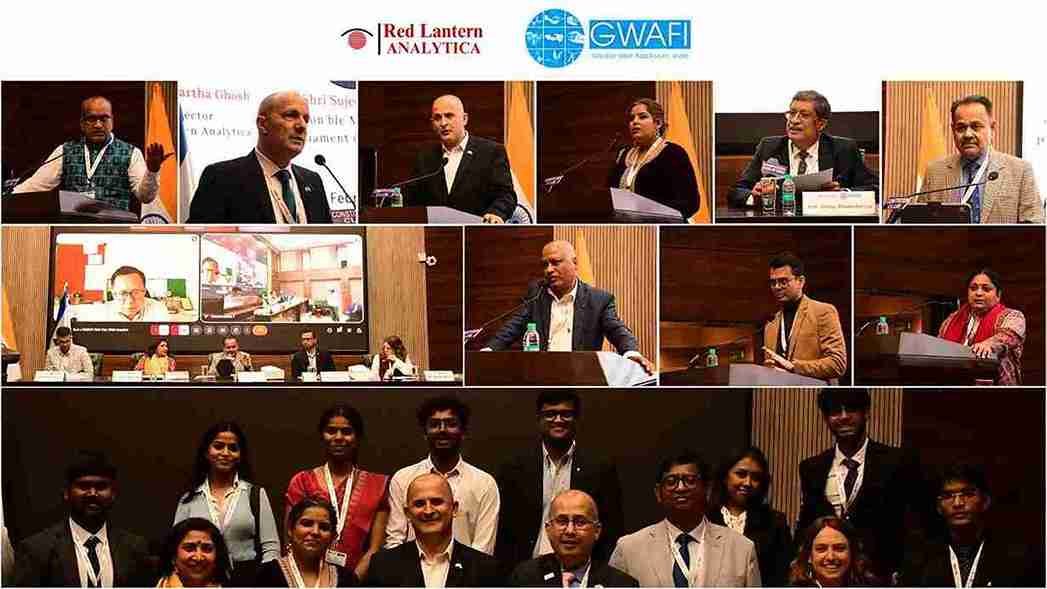
Red Lantern Analytica & Greater West Asia Forum, India Organise Seminar on “Exploring a New Strategic Geography in India–West Asia Relations: Coalitions, Connectivity and Converging Interests” On 12th February 2026, Red Lantern Analytica (RLA), in collaboration with the Greater West Asia Forum, India (GWAFI), successfully convened a high-level seminar titled “Exploring a New Strategic Geography in India–West Asia Relations: Coalitions, Connectivity and Converging Interests.” The event brought together diplomats, policymakers, scholars, strategic practitioners, and students to deliberate on the evolving contours of India’s engagement with West Asia amid changing geopolitical realities. The seminar examined emerging strategic frameworks, evolving security architectures, geoeconomic realignments, and people-centric cooperation shaping India–West Asia relations in an era defined by multipolarity, technological transformation, and new connectivity initiatives. Inaugural Session Delivering the welcome remarks, Dr. Siddhartha Ghosh, Director, Red Lantern Analytica, emphasised that while the idea of a “new strategic geography” has increasingly entered policy discourse, it is yet to be fully defined and conceptualised. He highlighted how digital connectivity, joint investment frameworks, and emerging economic corridors have transformed connectivity into a strategic instrument rather than merely an economic mechanism. According to him, coalitions emerging across maritime security, regional stability, and counter-terrorism demonstrate that connectivity now functions as a stabilising force, with India representing scale, reliability, and strategic continuity. The inaugural address was delivered by H.E. Ambassador Reuven Azar, Ambassador of Israel to India. He highlighted India’s rapid rise as a global power and noted that this transformation presents significant opportunities for Israel and the wider West Asian region. Ambassador Azar spoke about evolving economic chains linking India with Saudi Arabia, the UAE, and Israel through new trade corridors and partnerships, reflecting the increasing integration of regional economies. While acknowledging persistent regional tensions, he emphasised West Asia’s enduring strategic importance in global trade, labour mobility, and economic connectivity. A central theme of his address was the deepening mutual trust between India and Israel, reflected in growing cooperation across infrastructure, finance, and strategic sectors. He expressed optimism regarding the potential signing of a Free Trade Agreement between the two countries in the near future. He concluded by emphasising that regional cooperation remains essential for ensuring prosperity and long-term stability. The Chief Guest Address was delivered by Shri Sujeet Kumar, Member of Parliament (Rajya Sabha), who highlighted the strengthening India–Israel partnership and its growing strategic significance. He noted India’s expanding influence in West Asia and described contemporary relations as moving towards deeper diplomatic and technological collaboration. The address underscored cooperation in clean energy, innovation, and defence as key pillars of the relationship, while also stressing the importance of investment in research and development to sustain strategic advancement. Dr. Manjari Singh, Founding Member of GWAFI and Associate Professor, MRIIRS reflected on the evolution of India–West Asia relations and emphasised the multidimensional nature of contemporary engagement. She highlighted that West Asia remains India’s extended neighbourhood, marked by increasing high-level exchanges, expanding economic cooperation, and growing collaboration across both conventional and non-conventional domains. Session I: Security, Coalitions and Converging Strategic Interests The first plenary session examined evolving regional security dynamics and coalition-building across West Asia and the Indian Ocean region. Discussions focused on emerging security architectures, maritime cooperation, and the growing relevance of multilateral engagement in addressing shared challenges. Speakers explored how new frameworks are reshaping strategic alignments, including the complexity of bringing diverse actors together within cooperative structures. Themes such as maritime security, strategic autonomy, connectivity as a security enabler, and the role of India as a stabilising diplomatic actor were highlighted. The session also addressed the implications of regional power competition, shifting alliances, and the need for diversified engagement mechanisms to respond to contemporary security challenges. Session II: Trade, Connectivity and Geoeconomic Realignments The second session explored the geoeconomic transformation shaping India–West Asia relations. Discussions highlighted how economic engagement is expanding beyond traditional energy trade towards technology partnerships, supply chain integration, renewable energy collaboration, migration frameworks, and food security cooperation. Speakers examined the strategic importance of emerging corridors such as IMEC in connecting India with Europe through West Asia, positioning the region as a critical bridge between markets. The session also analysed the evolving role of global powers, including the United States, in shaping regional economic and security frameworks, as well as the challenges posed by geopolitical rivalries and economic competition. Participants emphasised India’s growing technological capabilities, diaspora influence, and expanding defence cooperation as key drivers of future engagement. The seminar concluded with reflections by Mr. Fares Saeb, Deputy Chief of Mission at the Embassy of Israel in New Delhi, who addressed contemporary challenges in narrative warfare and the evolving role of digital platforms in shaping global political discourse. He highlighted the need to address radical narratives circulating through social media ecosystems and emphasised the importance of decriminalising harmful ideological content while fostering constructive dialogue. Mr. Saeb also discussed how social media-driven dynamics influence perceptions of international partnerships, including India–Israel relations, and underscored the importance of strategic communication in an increasingly multipolar world. He noted that India’s evolving multipolar strategy positions it uniquely to engage diverse actors while maintaining strategic autonomy. The seminar reaffirmed the growing importance of India–West Asia relations in shaping emerging global strategic landscapes. By bringing together diplomatic voices, academic perspectives, and policy expertise, the event highlighted the need for sustained dialogue on security cooperation, connectivity frameworks, and geoeconomic transformation. H.E. Reuven Azar Shri Sujeet Kumar Mr. Fares Saeb

TR
Team Red Lantern AnalyticaAnalyst
arrow_outward
MoU signed with GALGOTIAS UNIVERSITY
STATEMENTSFEBRUARY 10, 2026
27

MoU signed with GALGOTIAS UNIVERSITY

We are pleased to announce the signing of a Memorandum of Understanding (MoU) between Galgotias University and Red Lantern Analytica on 10th February 2026. This collaboration marks an important step toward strengthening academic engagement, policy research, and strategic dialogue through joint seminars, research initiatives, student engagement programmes, and knowledge exchange in the fields of international relations, strategic affairs, and global geopolitics. RegardsTeam RLA

TR
Team Red Lantern AnalyticaAnalyst
arrow_outward
Bengal Florican and the Siang Grasslands
REPORTFEBRUARY 10, 2026
28

Bengal Florican and the Siang Grasslands

Why Arunachal Pradesh and Pasighat Matter: The Bengal Florican (Houbaropsis bengalensis) is the rarest bustard on Earth and one of the most evolutionarily distinctive birds anywhere. It belongs to a single-species genus, which makes its branch on the tree of life unusually isolated: if it disappears, there is nothing quite like it to take its place. Globally the species is classified as Critically Endangered, with a total population likely under a thousand mature individuals, split between South Asia and Cambodia (with a faint historical footprint in Vietnam and Bangladesh). The steep decline is driven by the loss and degradation of seasonally flooded grasslands, woody encroachment when fire and grazing patterns change, disturbance in the breeding season, and (in parts of its range) hunting and snaring. (BirdLife DataZone, EDGE of Existence) This report explains—in plain language but with research depth—why Arunachal Pradesh, especially the grassland archipelago around Pasighat and Daying (D’Ering) Ering Memorial Wildlife Sanctuary, is vital to the Florican’s survival, what we know about its ecology and movements in the Siang floodplain, what’s threatening the bird and its habitat, and how conserving it is inseparable from conserving the ecology, culture, and identity of Northeast India’s riverine grasslands. Rather than a “project plan,” what follows is a reader’s guide to the species and landscape: the big picture, the local picture, and the cultural picture—stitched together with the best available sources. Meet the bird: a specialist of floodplain grasslands: If you stood on a Pasighat river island (a chapori) in late spring, just as the monsoon hints at arriving, you might—if lucky—see a male Bengal Florican lift vertically above the grass with a sudden flutter, black-and-white wings flashing, crest upright, and then drop back into invisibility. That display, repeated at intervals, is how males advertise territories. Everything about the species is tied to grass structure and seasonality. It needs: ●Open sightlines for males to display (short-to-medium sward height in patches). ●Dense, concealing tussocks for females to nest and brood. ●Invertebrate-rich foraging among lightly disturbed swards and damp edges. ●A natural flood pulse that periodically resets woody growth and creates a shifting mosaic of islands and grass stands. Across its range, the Florican is not a long-distance migrant like geese or cranes. Instead, it makes short, seasonal movements—often a few to a few dozen kilometers—tracking flooding and grass height. In the Brahmaputra–Terai system and around Cambodia’s Tonlé Sap, birds occupy open breeding grounds in the dry season and then retreat to safer cover as monsoon waters rise; some individuals in Nepal have been tracked moving up to ~30 km, even slipping across international borders for seasonal refuge. For Pasighat, that means the bird’s year is lived within a network of chapori grasslands, not a single site. Protect the network, and you protect the bird. (Mongabay, Charles Sturt University Research Output) Why Pasighat–Siang is a cornerstone: Daying (D’Ering) Ering Memorial Wildlife Sanctuary lies just 13–25 km from Pasighat, spread over roughly 190 km² of river-created islands between the Siang (the Upper Brahmaputra) and the Sibya. About 80% of the sanctuary is grassland, with the remainder riverine and secondary forest—textbook Florican country when managed with seasonal sensitivity. BirdLife International recognizes D’Ering as an Important Bird Area (IBA) precisely for floodplain specialists, including the Florican and the endemic Swamp Grass Babbler. The sanctuary’s chaporis, remade each year by erosion and deposition, deliver the habitat heterogeneity—short swards here, taller stands there—that the species’ breeding and brood-rearing require. (BirdLife DataZone, Roundglass Sustain, Wikipedia) Yet the very dynamism that sustains these grasslands is now tilted against them. New analyses and reportage indicate that D’Ering lost ~55.9 km² of grasslands between 2012 and 2022— a massive contraction in one decade—driven by altered flood regimes, riverbank erosion,siltation patterns, and a suite of human pressures (from unseasonal burning and cutting to encroachment). For a bird that lives by the square kilometer of suitable sward, that loss is existential. (Mongabay-India) The threats explained: It’s easy to assume “grass grows back.” Floodplain grasslands, however, are not lawns. They are intricate systems shaped by water timing, sediment, fire, and grazing. Damage the rhythm, and the system flips. ●Hydrology out of tune. Flood pulses that linger too long scour and drown islands; pulses that arrive too erratically let woody plants take over. Either way, you lose the patchy openness males need for display and females need for safe nesting. The Siang’s recent patterns—erosion in one set of chaporis, silt burial in another—show up vividly in remote-sensing assessments and in ground reports from D’Ering. (ResearchGate) ●Ill-timed fire and cutting. Fire and mowing are not inherently bad. In fact, well-timed, light burns before breeding can restore open display arenas, and post-breeding rotational cutting can prevent shrubs from taking over. But late fires (March–August) cook nests and expose chicks; blanket cutting destroys heterogeneity. Nepal’s 2024– 2033 Florican plan and case studies from Cambodia lean heavily on seasonal grass management for this reason. (National Parks and Wildlife, Mongabay) ●Invasive and woody encroachment. Where fire is suppressed and grazing changes, woody clumps and exotics can fill in. The result is a “too-tall, too-dense” structure— bad for display, awkward for ground-nesting birds, and risky in monsoon. (This is a general grassland phenomenon, but it has particular bite for Floricans.) (Roundglass Sustain) ●Disturbance and hunting. In parts of Southeast Asia, hunting has been devastating. In the Indian and Nepali context, disturbance during the breeding season—including dog predation on ground nests—can be a big, invisible killer. Even occasional hunting pressure magnifies risk when a population is tiny to begin with. (Mongabay) ●Land conversion at the margins. Floodplains worldwide are magnets for agriculture. Where chaporis stabilize, they are tempting to convert; where they stay dynamic, they’re hard to govern. A sanctuary boundary helps, but a bird that moves seasonally among multiple islands needs friendly practices outside the boundary as well. (BirdLife DataZone)

TR
Team Red Lantern AnalyticaAnalyst
arrow_outward
Statement Condemning Chinese Comments over Indian territory of Shaksgam Valley
STATEMENTSJANUARY 13, 2026
29

Statement Condemning Chinese Comments over Indian territory of Shaksgam Valley

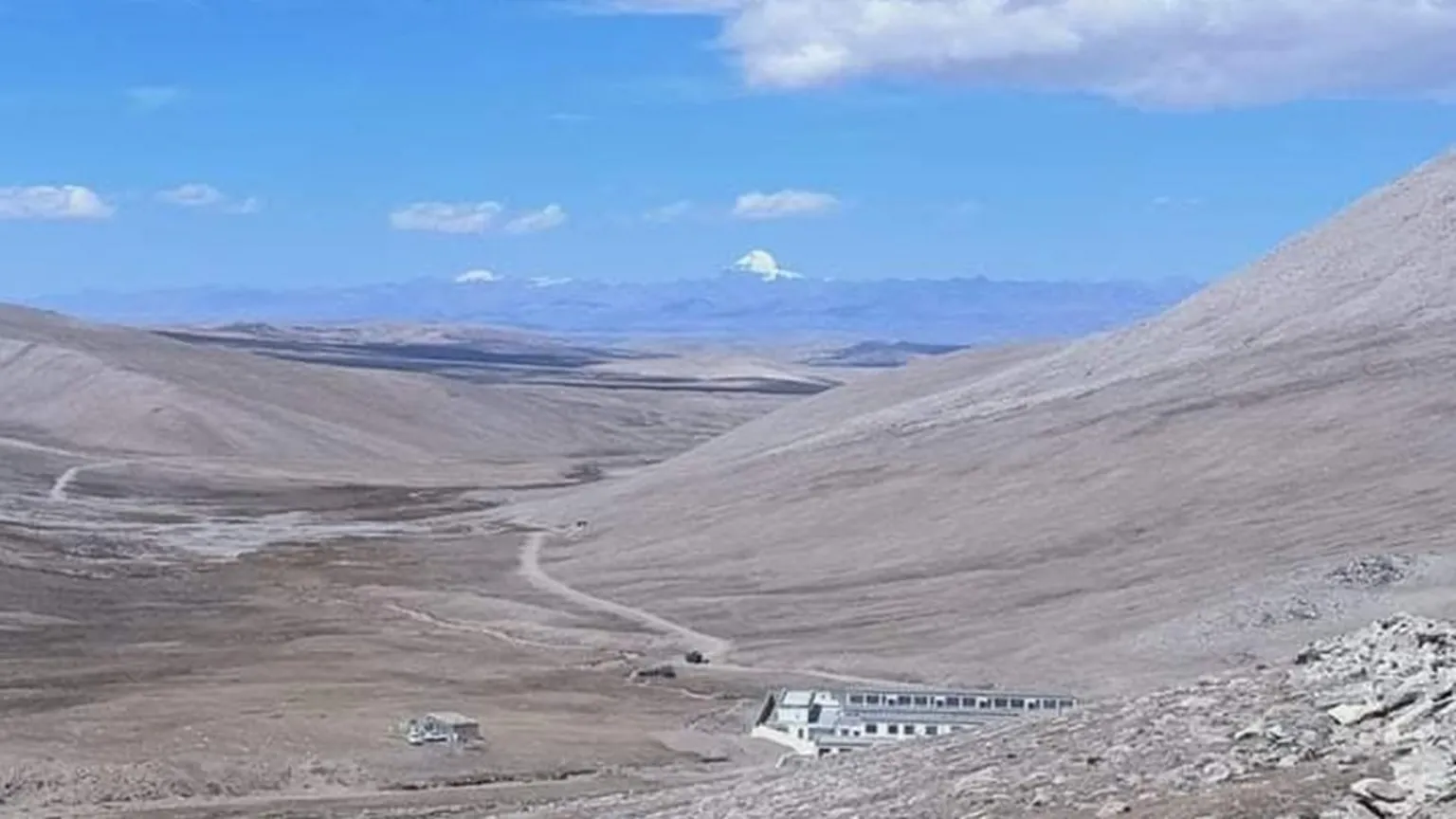
Date: 13th January 2026 Red Lantern Analytica unequivocally condemns China’s latest assertion of territorial claims over the Shaksgam Valley, which is an integral part of India’s Union Territory of Jammu and Kashmir. Such claims are baseless, historically untenable, and legally invalid, and represent a deliberate attempt to legitimise the consequences of Pakistan’s illegal occupation of Indian territory. The so-called 1963 China–Pakistan boundary agreement, under which Pakistan purported to cede parts of the Shaksgam Valley to China, has never been recognised by India. As the Government of India has consistently maintained, Pakistan had neither the legal authority nor sovereignty to transfer Indian territory under its illegal occupation. Any construction or so-called development activity undertaken by China in this region is therefore illegal and a violation of India’s sovereignty and territorial integrity. We fully support and reaffirm the principled position articulated by the Ministry of External Affairs of the Government of India, that the entire Union Territories of Jammu and Kashmir and Ladakh are an integral and inalienable part of India. Repeated attempts by China to justify any infrastructure build-up in the occupied areas do not alter ground realities or India’s consistent stance. Red Lantern Analytica also reiterates that projects such as the China–Pakistan Economic Corridor (CPEC), which pass through Indian territory under Pakistan’s illegal occupation, remain unacceptable to India. China’s selective interpretation of history, and disregard for established sovereignty only serves to erode trust and escalate tensions. India’s sovereignty is non-negotiable, and any attempt to question it—whether through cartographic assertions, infrastructure build-up, or diplomatic rhetoric—will be met with equally appropriate response.

TR
Team Red Lantern AnalyticaAnalyst
arrow_outward
Between Washington and the Global South: The BRICS Balancing Act
OPINIONSNOVEMBER 12, 2025
30

Between Washington and the Global South: The BRICS Balancing Act

Trump’s criticism of BRICS and warning to BRICS member states On October 14 2025 the US President, Donald Trump stated that the BRICS organisation was against the US Dollar (this is not the first time, that Trump has made such a claim). During a meeting with the Argentine Prime Minister Javier Milei at the White House, Trump also flagged the fact that he had warned BRICS member states, that he would impose tariffs on member states and that as a result many countries had pulled out of the organisation. Said the US President ‘They’re all dropping out of Brics. Brics was an attack on the dollar and I said, you want to play that game, I’m going to put tariffs on all of your products coming into the US. They said, like I said, we’re dropping out of Brics…They don’t even talk about it anymore.’ Russian President, Vladimir Putin while speaking at the Valdai Club (Sochi, Russia), on October 3, 2025 categorically stated that BRICS was not anti-dollar , but he also stated that his country faced sanctions and was left with no other option, but to trade with other countries in non-dollar-local currencies. Earlier this year Moscow had said that it had no intention of supporting a BRICS common currency . In recent months, ties between India — which will be holding the BRICS Presidency in 2026 -and USA have witnessed some hiccups due to two factors; First, the imposition of tariffs and Trump’s repeated claims that it was his personal intervention which led to the end of the India-Pakistan conflict in May 2025 (he repeated this claim). Even amidst these tensions, India has categorically distanced itself from the idea of a BRICS Common currency . In March 2025, India’s External Affairs Minister, S Jaishankar had said : “Regarding the role of the dollar, we are realistic. We have no issue with the dollar… We have no interest in undermining the dollar” BRICS Members and trade in local currencies Like several other countries, India has been supporting the idea of trade in local currencies. Here it would be pertinent to point out, that India recently paid for the purchase of Russian Oil in Yuan recently . There have also been reports of China seeking to links its central bank digital currency (CBDC) to some Asian and Middle Eastern nations. There has been no official announcement by the People’s Bank of China or any other central banks of the country . While there is not an iota of doubt, that countries are looking at reducing dependence upon the US Dollar given the growing uncertainty in the global economic order and with the objective of circumventing US sanctions on Russia — in the aftermath of Russia-Ukraine war. Over 90% of Russia’s trade with China and India is in local currencies. While commenting on the same, Russia’s Deputy Prime Minister Alexander Novak said: “..with our friends from China and India, we have already switched to national currencies by 90-95%. This is automatic, without any purpose, because they don’t allow settlements in the respective currency, which used to be the hegemonic one,’ BRICS is also moving towards setting up a BRICS payment system. While it is true, that intra-BRICS trade in local currencies has risen it would be premature to believe that BRICS payment system will emerge as an alternative to SWIFT. Not all countries are pushing for trade in local currencies with the intention of undermining the US Dollar as has been mentioned earlier. Expansion of BRICS and growing interest in the New Development Bank As a result of the prevailing uncertainty, several countries are showing greater interest in membership of BRICS. Four countries, Iran, Egypt, Ethiopia and UAE secured membership of the BRICS in 2024. Indonesia joined BRICS as a member in 2025. Over 30 countries have applied for full membership of the organisation. BRICS also has 10 observer states — Belarus, Bolivia, Cuba, Kazakhstan, Malaysia, Nigeria, Thailand, Uganda, Uzbekistan and Vietnam. All the 10 observer states have also applied for full membership of BRICS. More countries are also beginning to show interest in New Development Bank NDB. The NDB set up in 2015 provides financing for infrastructural development, energy, digital development and a gamut of other areas. Significantly, not all members of the NDB are members of BRICS and vice-versa. Indonesia, which entered BRICS in 2025 announced that it will be joining the NDB in March 2025 . The announcement was made during a meeting between Indonesian President Prabowo Subianto and Dilma Rousseff, President of the New Development Bank (NDB) on March 25, 2025. Rousseff while commenting on Indonesia’s decision to join the NDB said: “..Catching up to the advanced economies, in the era of fourth industrial and technological revolution, requires investment in technology and innovation, which are a common objective of NDB and Indonesia” Several Non-BRICS members are keen to join the NDB so that they can reduce their dependence upon western lending institutions. India’s presidency of BRICS While commenting on India’s role during it’s Presidency of BRICS, PM Modi speaking at the BRICS Summit, 2025 said : ‘Just as, during our G-20 chairmanship, we gave priority to the issues of the Global South in the agenda, similarly during our chairmanship of BRICS, we will take this forum forward in the spirit of people-centricity and humanity first’ India is likely to give a thrust to greater trade in local currencies between BRICS members and also showcase the Unified Payments Interface (UPI) network. While speaking at the BRICS Summit in 2024 at Kazan, PM Modi had stated : ‘We welcome efforts to increase financial integration among BRICS countries. Trade in local currencies and smooth cross-border payments will strengthen our economic cooperation. The Unified Payments Interface [UPI] developed by India is a huge success story and has been adopted in many countries,’ Conclusion It is true, that BRICS has its own set problems including differences between members over issues. The expansion of BRICS and the NDB will also come with

TR
Team Red Lantern AnalyticaAnalyst
arrow_outward
Beyond New Delhi: The Expanding Role of Indian States in Global Diplomacy
OPINIONSOCTOBER 6, 2025
31

Beyond New Delhi: The Expanding Role of Indian States in Global Diplomacy

Introduction In the past three decades, India’s foreign policy has witnessed significant changes. The economic reforms of 1991, the rise of regional parties and strong regional leaders and several other factors have meant that India’s states have emerged as stakeholders in India’s external outreach – especially the economic aspect[i]. This phenomenon is global and is referred to as para-diplomacy[ii]. While the economic reforms of 1991 and the India’s remarkable achievements in the realm of Information Technology, in the 1990’s and 2000’s, gave a key push to participation of states in India’s economic diplomacy, the rise of strong leaders like Chandrababu Naidu (currently CM of Andhra Pradesh) was also an important factor. Naidu during his tenure as CM of erstwhile AP in the 1990’s and early 2000’s and both his terms (2014-2019, 2024-) as CM of the newly carved out state of AP has been pro-active in reaching out to investors. While during his first term, Naidu reached out to IT giants and was credited for making Hyderabad – now the capital of Telangana into an IT Hub[iii] – as CM of AP he has been reaching out to foreign investors and governments for the development of Amaravati as well as Vaishakhapatnam[iv]. The past decade has also witnessed a growing trend of state investor summits. While PM Modi as CM of Gujarat had started the Vibrant Gujarat Summit, almost all states host Investors Summits – with an eye on drawing foreign direct investments. One of the important steps taken by the current government to improve coordination between the centre and the states is the setting up of the States Division in the MEA. There has also been talk of ‘competitive federalism’ between states. The PM himself has often spoken about competitive and cooperative federalism. After the signing of an FTA between India and UAE, state governments – including West Bengal, Maharashtra[v] and Tamil Nadu — are also trying to strengthen their trade linkages. UAE itself has been reaching out pro-actively to several states for strengthening economic linkages. While para-diplomacy is a reality and there is no doubt that states have become more pro-active. A few points need to be borne in mind. First, despite there being many mechanisms it is important to have better coordination between the centre and statesand to ensure that politics does not come in the way of issues pertaining to development. Second, in a changing geopolitical and economic situation coordination between centre and states is essential. For instance, on the issue of tariffs imposed by the US on India, there is need for better coordination similarly the decision of the Trump Administration to raise H1B fees will impact IT Professionals and companies. The IT professionals of AP and Telangana are likely to get impacted most and it is important that the central government works closely with both state governments. While Hyderabad has been wooing several IT companies, companies have already shown interest in Andhra Pradesh. India has an opportunity to benefit from the current unpredictability and turbulence. While in the short run there could be problems, in the long run India could benefit from some of the global changes underway, as it has in the past from uncertain situations. Third, it is important to make states, irrespective of the dispensation in power, stakeholders on not just FTA’s but also initiatives like Act East, Free and Open Indo-Pacific. Even in the context of ties with immediate neighbours, the centre and states need to work closely irrespective of the political dispensation in power in the states. Finally, in the sphere of higher education there is need for greater cooperation. Several overseas universities are showing interest in developing campuses in different parts of India. Apart from this, the centre and states should also regularly discuss changing trends in the international higher education sector and the possible impact on states. In conclusion, while there is no doubt that the trend of para-diplomacy has gained momentum in recent years, it is important to ensure that there are mechanisms facilitate strong centre-state coordination on issues pertaining to foreign policy. In a changing economic and geopolitical situation, the role of states is bound to increase and it is important that this is successfully harnessed. [i] Wyatt, A. (2017). “Paradiplomacy of India’s chief ministers”. India Review, 16(1), 106-124. [ii] Daily News Analysis, “From 1990s till date, how ‘paradiplomacy’ gained momentum in India”, August 7, 2023. Tridivesh Singh Maini. Weblink: From 1990s till date, how ‘paradiplomacy’ gained momentum in India [iii] L. Rudolph and S. Rudolph, “The Iconization of Chandrababu: Sharing Sovereignty in India’s Federal Market Economy,” Economic and Political Weekly, Vol. 36 No. 18 (2001), pp. 1541-1552. [iv] See Wyatt A, 2017. Paradiplomacy of India’s Chief Ministers. P.106-107 [v] The Geopolitics, “India-UAE CEPA: How India’s States Are Tapping Potential Benefits”, March 2, 2024. Tridivesh Singh Maini. Weblink: India-UAE CEPA: How India’s States Are Tapping Potential Benefits – The Geopolitics Authored by: Tridivesh Singh Maini, Assistant Professor, Jindal School of International Affairs, O.P. Jindal Global University, Sonepat, Haryana

TR
Team Red Lantern AnalyticaAnalyst
arrow_outward
Statement on Commemoration of the 65th Tibetan Democracy Day
MEDIA COVERAGESEPTEMBER 2, 2025
32

Statement on Commemoration of the 65th Tibetan Democracy Day

On this historic 65th anniversary of Tibetan Democracy Day, coinciding with the noble Year of Compassion, celebrating His Holiness the Dalai Lama’s 90th birthday, we join the global Tibetan community in commemorating in celebrating the vision, resilience, and unyielding spirit of the Tibetan people. We pay our deepest respects to H.H the Dalai Lama, whose visionary leadership and unwavering commitment to democratic values laid the foundation for the vibrant governance system that the Tibetan community in exile upholds today. At a time when Tibet’s culture, religion, and identity face increasing repression, we reaffirm our solidarity with the Tibetan people and their democratic aspirations. Red Lantern Analytica remains committed to amplifying their voices, advocating for religious freedom, human rights, and the preservation of Tibet’s unique heritage. Tibetan freedom movement continues to inspire movements for freedom and dignity worldwide. On this day, we call upon the international community, democratic nations, and civil society to stand united with Tibetans in their pursuit of freedom, equality, and self-determination.

TR
Team Red Lantern AnalyticaAnalyst
arrow_outward
Reimagining Oman as an Indian Ocean Green Hub: Looking at a Post-Carbon Future
COMMENTARIESAUGUST 21, 2025
33

Reimagining Oman as an Indian Ocean Green Hub: Looking at a Post-Carbon Future

The few stereotypes that persist regarding the Gulf are of its importance as a hydrocarbon centre over the past eight decades, since Bahrain and Saudi Arabia struck Oil in the 1930s. Oman, in comparison, struck Oil in Fahud in 1962, and shipped its first container from Mina Al Fahal in 1967. The oil revenues formed the bedrock of rebuilding the country during the 1970s, during which the Dhofar rebellion was still on. Oman is a Shell country, like Brunei, where Shell has been strategic in the country’s hydrocarbon exploration through a major stake in Petroleum Development Oman, or PDO, as commonly known. Many PDO employees have worked for Shell Brunei and Shell Sarawak as a part of their career circulations in the global MNC network. Oman was never a massive producer of petroleum as its wealthier neighbours in the GCC, even though its natural gas imprint is significant. Natural Gas is a key transition fuel, and Quriyat LNG in Sur has many long-term contracts with Korea, China, and Japan. However, Oil and Gas still form a major chunk of the GDP in Oman. Diversification has been on the agenda since the late 1980s, as localisation has always been a priority. Years of peak oil prices have led to the creation of avant-garde infrastructure and the education of a couple of generations overseas on scholarships, which was a byproduct of oil income. Now, the scenario has evolved as Oman’s population has increased, and the youth seeking work is often the refrain, as gauged from the comments section in the social media feeds. The cause of the Arab Spring protests in Sohar was corruption and lack of jobs, which led to a few heads turning. The post Sultan Qaboos era, under the able leadership of His Majesty Sultan Haitham Bin Tarik has moved towards diversification in a major way, seeking relationships far and wide. His Majesty has had meetings with the Dutch Leadership, President Putin in Moscow, Prime Minister Modi in Delhi, and the UK Minister Starmer within the past few months. The rich legacy of Oman being the Switzerland of the Middle East helps in its vital role in mediating the Yemeni crisis and as a trusted participant in the Iran paradigm, helps. Oman also controls half of the crucial Straits of Hormuz. Ibadhi Oman’s history as a littoral maritime empire has its long shadow in the present. Muscat is a diverse place, full of Zanzibaris, Baluchis, Ajmi’s, Lawati’s, and Hindu Bania’s, and other communities who were a part of the Omani imperial grid. The strategic culture of the Omani elite is transnational, with many Omani having ties across East Africa to Africa. Pankaj Khimji, an advisor to the Omani government, is a key Bania interlocuter between Muscat and Delhi via Mandvi. India and Oman have finalised the FTA negotiations recently. Aden was governed by the Bombay Presidency until 1937. These close ties entail prospects of power being exported to India/ Pakistan/East Africa via a subsea cable in the future. The engineering and program management excellence achieved by the national building efforts of PDO, especially in terms of talent development for the renewable sector, over the past decades. The first solar project was helmed by PDO as seen in the Amin Solar project. This is similar to the Aramco State, where the best expertise in Saudi Arabia lies with the engineers in the oil major. A glimpse of it was illustrated in Ellen R Wald’s book[1], which showed the role National Oil Companies have played in nation-building. Oman’s location as an Indian Ocean actor was confirmed with it hosting the Indian Ocean Conference this year in Muscat, where Member of Parliament Naveen Jindal ji spoke. Jindal operates one of the largest steel mills in the Middle East in Sohar. The ACME Group is coming up with a green hydrogen facility in the special economic zone in Duqm on the Arabian Sea coast. Duqm is also home to a naval base, which plays host to many navies, as it is close to the Horn of Africa piracy corridor. The green hydrogen corridor in Al Wusta and Dhofar is underway as ACWA Power from Saudi Arabia is investing in a green hydrogen facility in the southern Dhofar region. Another ACWA Power project in the form of Ibri 2 IPP is a project I know rather intimately. I was the lead social specialist for an impact assessment report for a multi-million-dollar 500MW solar park on the Saudi border. Long-term migrant workers from South Asia were identified as camel farmers in the desert on project land., However, during a recce visit and after speaking to long-term migrant workers looking after camels, we discovered that they were extremely precarious, relying on a solar-powered battery charger for mobile phones and to light a bulb. These workers, who were heavily reliant on precarious work, were being moved away from their off-grid homes to build a Chinese-funded solar park in relatively prosperous Oman. The irony was not lost on me. Globally accepted ESG governance norms kicked in, the move triggered an independent Resettlement Action Plan for these workers. Climate and Local developmental politics intersect in the middle of nowhere. The Beijing-based Asian Infrastructure Investment Bank or AIIB is the backer for the Ibri 2 Project, and Chinese contractors were the hands on Ibri 2. Belt and Road is right on our doorstep. Indian Engineers and Consultants work on these Chinese-funded projects as the technical hands behind the scenes. There are numerous other solar projects in the pipeline in the Wilayat of Manah. These areas are close to the Saudi Border and could be a part of an integrated GCC power grid. Oman’s great strength in terms of land needed for renewable projects is a plus, along with its positioning between the Gulf, South Asia, and East Africa, which makes it an Indian Ocean Green Hub[2] in the making. [1] https://www.amazon.in/Saudi-Inc-Arabian-Kingdom%60s-Pursuit/dp/168177660X [2] https://mem.gov.om/en-us/Our-Business/Renewable-Energy-and-Hydrogen/Renewable-Energy-and-Hydrogen-Projects Authored By: Manishankar Prasad PhD Scholar, University of Malaya

TR
Team Red Lantern AnalyticaAnalyst
arrow_outward
Statement on the PRC’s Deplorable Response to Indian Greetings to H.H. the 14th Dalai Lama
MEDIA COVERAGEJULY 8, 2025
34

Statement on the PRC’s Deplorable Response to Indian Greetings to H.H. the 14th Dalai Lama

Red Lantern Analytica strongly condemns the Chinese Communist Party’s latest attempt to malign the revered spiritual leader of the Tibetan people, His Holiness the 14th Dalai Lama, by labeling him a “separatist” under the cloak of religion. These remarks are not only baseless and inflammatory, but they also reflect China’s ongoing strategy to delegitimize the Tibetan cause and suppress peaceful expressions of cultural identity. It is important to reaffirm that His Holiness the Dalai Lama is not a political agitator, but a global symbol of peace, compassion, and nonviolence. His advocacy has consistently emphasized in the preservation of Tibetan cultural and religious heritage. To portray such a spiritual leader as a political threat is not only misleading but underscores the deep insecurity of a regime that cannot tolerate even the softest voice of dissent. The Chinese government’s persistent efforts to reframe Tibet as “Xizang” are part of a broader campaign of cultural erasure. This renaming is neither benign nor linguistic—it is a deliberate attempt to overwrite Tibetan identity, heritage, and historical truth. China’s occupation of Tibet in 1950 was not a peaceful liberation but an ‘annexation’, and since then, it has continued to pursue aggressive policies of Sinicization. These include the forced assimilation of Tibetan children into state-run boarding schools, demolition of monasteries, restrictions on religious practices, and the surveillance and incarceration of those who express loyalty to their native culture. Beijing’s criticism of Indian leaders for extending greetings to H.H. the Dalai Lama on his 90th birthday is both absurd and offensive. India, as the world’s largest democracy and host to the Tibetan government-in-exile, has every right to honour a figure who symbolises moral courage and spiritual wisdom. The Chinese protest is yet another example of overreach and an attempt to dictate the diplomatic and moral choices of sovereign nations. Red Lantern Analytica not only condemns the PRC’s absurd claims but also urges the international community to see through PRC’s narrative manipulation and stand firmly in defense of Tibetan identity, cultural rights, and spiritual freedom. The world must not remain silent while the entire Tibetan civilization is slowly erased under the CCP’s authoritarianism.

TR
Team Red Lantern AnalyticaAnalyst
arrow_outward
Statement of Support for Quad’s Condemnation of the Pahalgam Terror Attack
MEDIA COVERAGEJULY 3, 2025
35

Statement of Support for Quad’s Condemnation of the Pahalgam Terror Attack

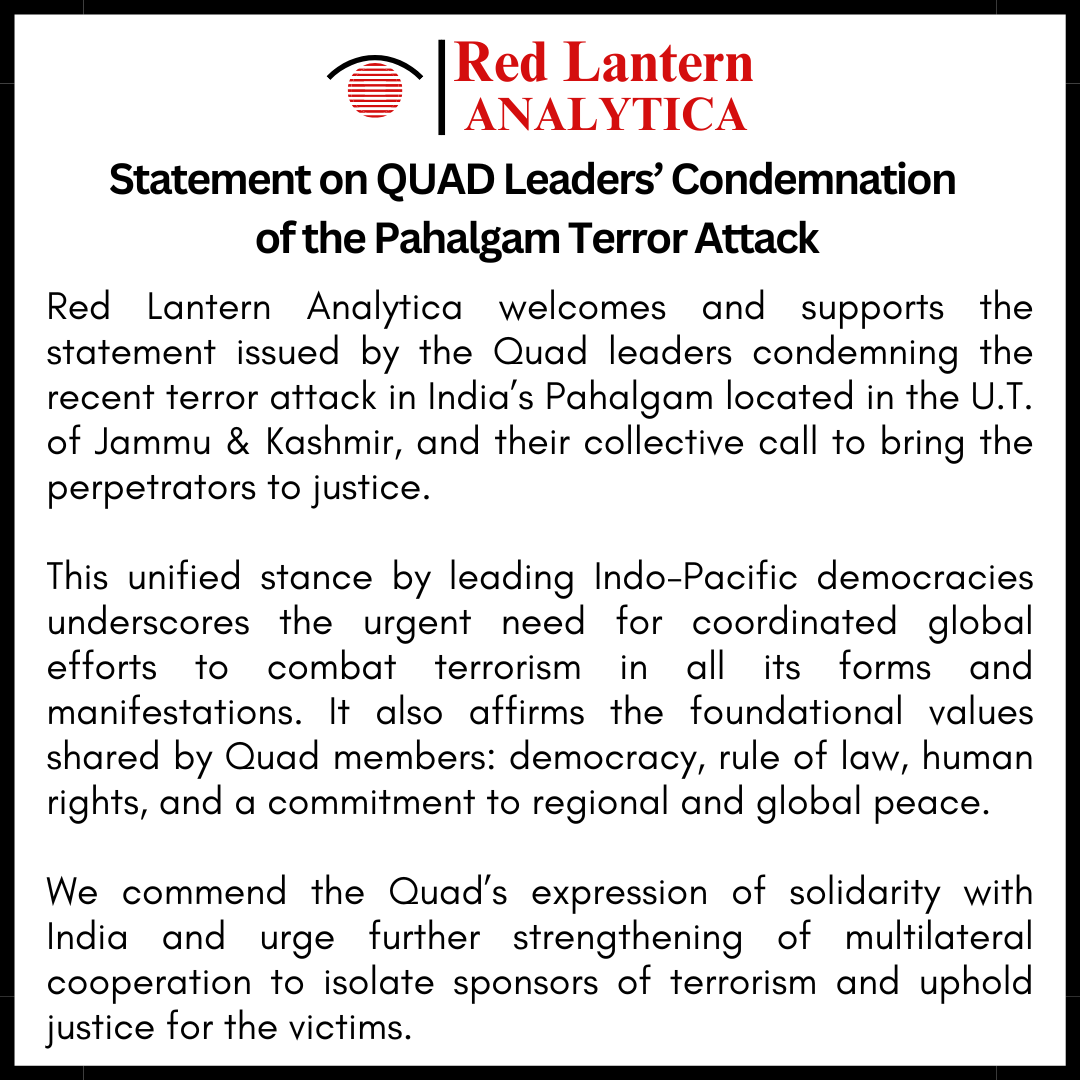
July 3, 2025 Red Lantern Analytica unequivocally supports the strong and principled statement issued by the foreign ministers of the Quadrilateral Security Dialogue (Quad) in the aftermath of the terrorist attack that took place in Pahalgam, Jammu and Kashmir, on April 22, 2025. The attack, which resulted in the tragic loss of 25 Indian nationals and one Nepali citizen, and caused injuries to several others, was a deeply reprehensible act of violence targeting innocent civilians. Such acts represent a gross violation of the fundamental principles of human dignity, security, and international law. We commend the Quad foreign ministers—representing the governments of India, the United States, Australia, and Japan—for their clear and unified condemnation of this atrocity, and for their firm call to ensure that the perpetrators, organisers, and financiers of this attack are identified and brought to justice without delay. This strong stance underscores the importance of sustained international cooperation in combating terrorism in all its forms and manifestations. Red Lantern Analytica further welcomes the Quad’s call for all United Nations Member States to fully cooperate, in accordance with their obligations under international law and relevant United Nations Security Council resolutions, with the competent authorities in this regard. The pursuit of justice must be collective, coordinated, and unwavering. Terrorism remains a persistent and transnational threat to peace, security, and stability. The international community must remain vigilant, united, and resolute in its commitment to upholding the rule of law and ensuring that such acts do not go unpunished. Red Lantern Analytica stands in solidarity with the victims of the Pahalgam attack, their families, and the people of India. We reaffirm our commitment to supporting efforts aimed at strengthening international mechanisms to combat terrorism and promote accountability.

TR
Team Red Lantern AnalyticaAnalyst
arrow_outward
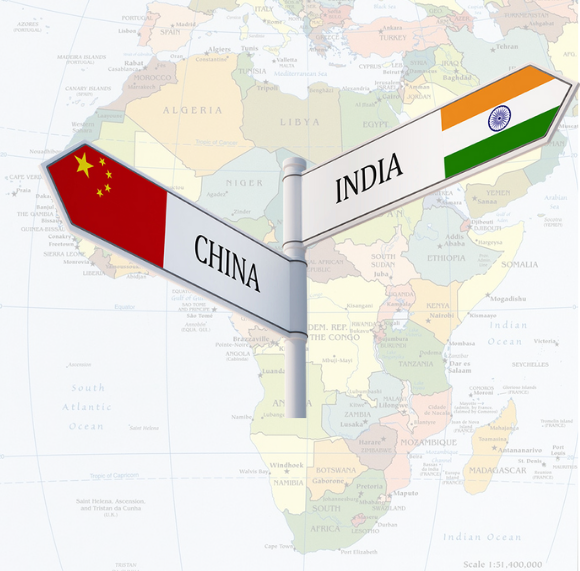
Webinar on “China’s Grip, India’s Hand: Competing Visions for Africa’s Future”
MEDIA COVERAGEJUNE 22, 2025
36

Webinar on “China’s Grip, India’s Hand: Competing Visions for Africa’s Future”

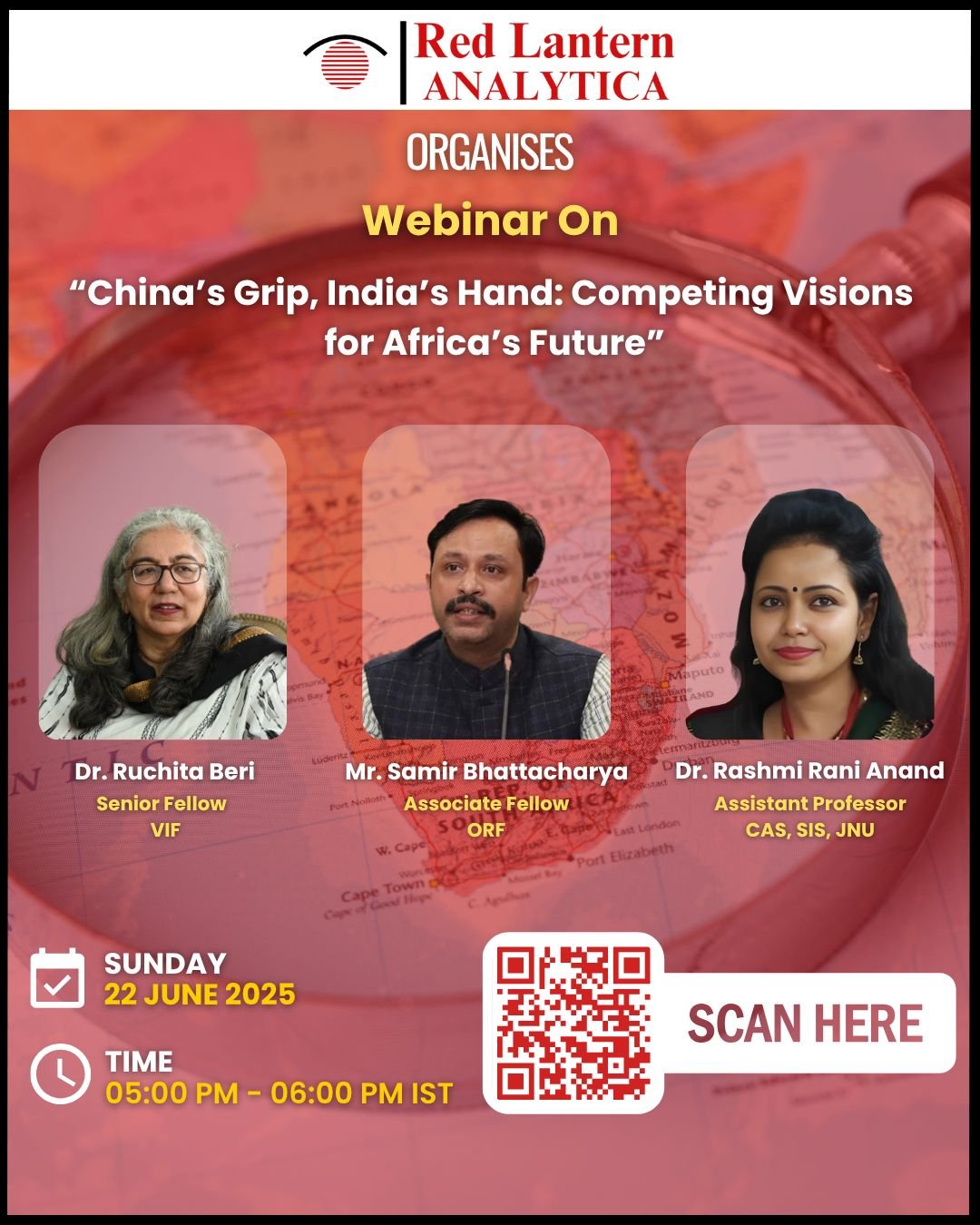
22nd June 2025 In a time when the world is paying a closer attention to the African continent, Red Lantern Analytica organised a webinar titled “China’s Grip, India’s Hand: Competing Visions for Africa’s Future” on 22nd June 2025. The session brought together distinguished scholars and participants from across India. The distinguished panel had: Dr. Ruchita Beri, Senior Fellow at the Vivekananda International Foundation, Mr. Samir Bhattacharya, Associate Fellow at the Observer Research Foundation, and Dr. Rashmi Rani Anand, Assistant Professor at the Centre for African Studies, SIS, JNU. The first speaker, Dr. Ruchita Beri, Senior Fellow at the Vivekananda International Foundation (VIF), delivered a compelling talk analysing the evolving dynamics of Africa’s international partnerships, with a particular focus on China’s expanding footprint and India’s distinctive approach to engaging with the continent. Dr. Beri began by examining China’s economic and political influence in Africa, emphasizing Beijing’s strategic efforts to broaden its presence across the region. Through a combination of aggressive trade policies, large-scale infrastructure projects, and investments in natural resource extraction, China has established itself as a dominant external actor in African affairs. She noted that this engagement is largely state-driven, with Chinese government-backed entities playing a central role in financing and executing development projects. While this model has brought visible infrastructural benefits, it has also raised concerns about debt dependency, lack of local capacity-building, and limited long-term economic sustainability. In contrast, Dr. Beri highlighted India’s approach to Africa, characterizing it as more people-centric and collaborative. Unlike China’s state-led strategy, India’s partnership model is rooted in the priorities of African nations themselves. “India’s engagement is not just about economic returns,” she remarked, “but about building long-term, sustainable partnerships that respond to African aspirations.” She elaborated on three key pillars of India’s Africa policy: Capacity Building and Skills Development – India has invested significantly in training programs, scholarships, and technical cooperation to empower African human capital. Initiatives such as the Indian Technical and Economic Cooperation (ITEC) program have become hallmarks of this people-to-people engagement. Private Sector Participation – Indian businesses have increasingly made inroads into African markets, particularly in sectors like pharmaceuticals, IT, and agriculture. Unlike China’s reliance on state-owned enterprises, India’s Africa strategy is led by private entrepreneurs, creating opportunities for inclusive economic development. Civilian Oversight and Grassroots Engagement – Dr. Beri noted that India’s partnerships often emerge from civil society collaborations, academic exchanges, and diaspora linkages, reinforcing a bottom-up approach to diplomacy that resonates with local communities. Dr. Beri concluded by affirming that while both India and China are key external players in Africa, their engagement models differ fundamentally. China’s economic interests dominate its policy, whereas India’s approach is more aligned with African development goals and societal empowerment. The 2nd Speaker – Mr. Samir Bhattacharya, Associate Fellow, ORF opened his remarks examined China’s rising footprint in Africa, driven primarily through large-scale infrastructure investments and concessional loans. He pointed out that China’s presence is visible in nearly every corner of the continent, from transport networks and industrial parks to energy and mining sectors. While these projects have accelerated infrastructure development in many African nations, Mr. Bhattacharya emphasized that the terms of Chinese loans often lack transparency and come with conditionalities, which can undermine national sovereignty and burden local economies with unsustainable debt. Crucially, Mr. Bhattacharya noted a shift in recent years, highlighting the emergence of greater African agency in international partnerships. “African countries are no longer passive recipients of foreign aid and investment,” he said. “They are increasingly scrutinizing their external engagements and recalibrating their partnerships to align with national interests.” This, he argued, is influencing how nations like China and India are received and perceived across the continent. Turning to India-Africa relations, Mr. Bhattacharya drew a clear contrast between China’s state-centric, top-down approach and India’s more balanced, market-driven model. He described India’s engagement with Africa as rooted in cooperation rather than domination, emphasizing mutual respect, shared democratic values, and a deepening people-to-people connection. He highlighted three key aspects of India’s Africa policy: Transparent and Demand-Driven Investment – Unlike China’s model, India’s investments are guided by market forces and African priorities, reducing risks of debt dependency and promoting equitable growth. Respect for Sovereignty – India’s approach steers clear of imposing political conditions or opaque loan terms. Instead, it focuses on creating win-win partnerships where African governments retain decision-making authority over their development agendas. Strategic Alignment Without Overreach – Mr. Bhattacharya emphasized that India does not seek to dominate Africa geopolitically but rather aims to be a trusted development and trade partner, particularly in areas like technology, health, digital infrastructure, and education. In his concluding remarks, Mr. Bhattacharya called for a nuanced understanding of Africa’s geopolitical evolution, stressing that future global engagement with the continent must prioritize local ownership, sustainability, and long-term development over short-term strategic gains. The final speaker, Dr. Rashmi Rani Anand provided critical insights into India’s strategic partnership with Africa, especially in the context of green energy transitions and the rising influence of global powers such as China on the continent. Dr. Anand emphasized that Africa holds immense strategic value for India, particularly due to its abundance of critical minerals essential for green energy technologies, including lithium, cobalt, and rare earth elements. These resources are pivotal as India pursues ambitious climate goals and transitions toward renewable energy. She underscored that India’s engagement with Africa is not symbolic but rooted in real South-South cooperation, built on principles of equality, mutual respect, and shared development priorities. “This is not just a policy on paper,” she noted. “India is deeply committed to empowering Africa through capacity building, technology transfer, and sustainable development initiatives.” In stark contrast, Dr. Anand addressed the implications of China’s deepening investments in African infrastructure and technology sectors, particularly under the Belt and Road Initiative (BRI). She pointed out growing concerns related to sovereignty, debt distress, and lack of transparency in Chinese-funded projects. These concerns are amplified by the opaque nature of financing terms, tied aid, and the long-term strategic control that often accompanies such investments. Key takeaways

TR
Team Red Lantern AnalyticaAnalyst
arrow_outward
China–Nepal Border Re Survey: Cartographic Invasion or Strategic Overture
ASIAJUNE 12, 2025
37

China–Nepal Border Re Survey: Cartographic Invasion or Strategic Overture

In early 2025, China and Nepal launched a comprehensive re survey of their 1,389-kilometre Himalayan border—the first such exercise since 2011. The joint effort, conducted under the provisions of the 1963 Boundary Protocol and revitalized through a bilateral understanding reached in June 2024, is framed as a technical necessity. Yet, the geopolitical undertones cannot be ignored. The question now being asked in Kathmandu, New Delhi, and beyond is whether this effort marks a mere cartographic modernization—or a more calculated strategic overture by Beijing. This re survey has emerged from the revival of the long-dormant Joint Expert Group, a bilateral mechanism that had fallen silent since 2006. Its recent activation comes with renewed energy. With both governments formally agreeing to resume ground work, teams of technicians equipped with satellite imagery, GPS instruments, drones, and digital cartographic tools began conducting on-site inspections of boundary pillars in early 2025. Chinese mapping experts, who possess a far superior technological edge, have been working alongside Nepali surveyors, ostensibly under the spirit of mutual cooperation. However, Nepalese stakeholders have expressed concern about the asymmetric nature of this collaboration—particularly the fear that technical superiority may translate into quiet leverage over physical terrain. For Kathmandu, the official narrative is one of modernization and clarity. Nepalese authorities have emphasized the survey’s potential to resolve minor discrepancies, update outdated maps, and facilitate future infrastructure planning in remote Himalayan regions. This includes better management of border crossings and improved access for development projects that traverse difficult topography. More importantly, government representatives point to the need to regularize trans-Himalayan trade corridors, particularly as Nepal’s reliance on China for trade diversification grows in the aftermath of its ruling leaders favouring Beijing due to political likeness. Despite this, the re survey has reawakened some longstanding concerns. Several areas remain disputed, notably the location of pillar No. 57 in Dolakha, discrepancies in Humla district, and disagreements in the Gorkha region. In these places, uncertainty over the precise boundary line leaves room for friction—not only between locals and authorities but also in terms of international diplomacy. A more recent concern emerged in June 2025, when pillar No. 71 near Kimathanka in Sankhuwasabha was buried due to a monsoon-triggered landslide. The replacement of this marker—how, where, and by whom it is reinstalled—will serve as a litmus test of the spirit of joint management or potential unilateral overreach. What complicates the matter is the simultaneous rise of large-scale Chinese infrastructure projects. The re survey is occurring alongside China’s push to integrate Nepal into its Trans-Himalayan Multi-Dimensional Connectivity Network. This includes the much-publicized Gyirong–Kathmandu railway line, for which feasibility studies are already underway and projected for completion in 2026. The re survey, by refining boundary coordinates and validating terrain assessments, supports these infrastructure plans both technically and diplomatically. Analysts suggest that the mapping exercise serves more than just border clarity—it is foundational to unlocking routes for Chinese investment and logistical presence in Nepal’s northern districts. Public perception in Nepal mirrors this ambivalence. While many welcome the potential for improved connectivity and development, skepticism persists. A recent poll conducted in Kathmandu in March 2025 found that 61 percent of respondents viewed trade and investment as the most valuable aspect of Nepal–China relations, but only 42 percent considered the bilateral relationship “strong,” compared to 57 percent who felt similarly about ties with India. This suggests that while Beijing’s material contributions are appreciated, they have yet to foster the same level of political or emotional trust that India retains. The political class in Kathmandu is therefore walking a tightrope—eager to harness the benefits of Chinese cooperation without ceding perceptual or territorial ground. India, meanwhile, is watching closely. The Sino–Nepali re survey has come at a time when Kathmandu’s own boundary tensions with New Delhi—particularly in the Kalapani–Lipulekh region—remain unresolved. Any perceived tilt toward Chinese narratives, especially if tied to digital mapping or the reinterpretation of pillar positions, could exacerbate tensions with India. New Delhi’s strategic concern centers around whether this re survey offers China more than data: it may offer leverage in the form of terrain familiarity, the legitimization of strategic infrastructure, and a deepening presence in Nepal’s northern periphery. Further complicating the picture is the issue of transparency. China’s prowess in geospatial intelligence, artificial intelligence, and surveillance capabilities is widely acknowledged. The concern within Nepal’s civil society and policy circles is that unless both parties are operating with equal access to mapping data, satellite imagery, and interpretive tools, the process might inadvertently cede informational sovereignty to Beijing. Nepalese lawmakers have demanded that any boundary-related agreements, particularly the proposed “Boundary Management System,” be formally ratified through Parliament and anchored in national law, not merely as memoranda. The public release of digital maps, field updates, and raw survey data has been requested by multiple transparency advocates, yet the details remain mostly behind closed doors. How Kathmandu and Beijing manage these sensitivities in the coming months will be telling. For example, the fate of the buried pillar in Kimathanka could set a precedent. If replaced jointly with public oversight and documented GPS coordinates made available to Nepal’s Survey Department and legal entities, it may reinforce mutual trust. However, if Chinese teams act independently or if mapping data is withheld or quietly revised, it would bolster narratives of cartographic intrusion. Similarly, if the Boundary Management System is passed through Nepal’s Parliament with full legal scrutiny, it will be seen as a sovereign endorsement. But any attempt to institutionalize new mapping standards through executive fiat may spark opposition, especially if linked to infrastructural projects involving land reallocation. What bears close watching is how this re survey becomes functionally integrated into Nepal’s broader policy trajectory. Should the updated boundary lines be used to expedite approvals for Chinese-built infrastructure—roads, railways, power corridors, or data cables—it will signal that the cartographic effort is not isolated, but deeply enmeshed in Beijing’s regional strategy. If those infrastructures are followed by increased security presence, surveillance installations, or joint patrol agreements, it may well amount to a silent shift in influence along

TR
Team Red Lantern AnalyticaAnalyst
arrow_outward
China’s Deceptive Playbook on Pledges and Provocations
ASIAJUNE 6, 2025
38

China’s Deceptive Playbook on Pledges and Provocations

In international diplomacy, consistency and good faith are the bedrock of trust. Only few powers have drawn as much scrutiny and criticism as the People’s Republic of China for its actions in disputed maritime and territorial zones. Boasting rapid economic growth, expanding military reach, and a growing appetite for regional leadership, Beijing has positioned itself as a global power. Beneath the veneer of “peaceful rise” rhetoric lies a consistent pattern of diplomatic duplicity: agreements signed in ink that are later eroded by deployments, infrastructure projects, and legal dismissals. A pattern has emerged over the past two decades in which China systematically disregards international judgments, bilateral agreements, and multilateral frameworks, asserting dominance through coercion, strategic infrastructure build-up, and selective adherence to legal norms. China has exhibited a pattern of calculated duplicity using diplomacy to stall while militarizing on the ground. This article examines major incidents where China promised peace but pursued power, unpacking the motivations, fallout, and wider geopolitical implications. 1. The Scarborough Shoal Standoff (2012) In mid-2012, the Philippine Coast Guard and Chinese maritime surveillance vessels became locked in a standoff at Scarborough Shoal, a traditional fishing ground well within Manila’s internationally recognized Exclusive Economic Zone. Initially, both parties agreed—even under U.S. auspices—to withdraw and negotiate under the umbrella of the United Nations Convention on the Law of the Sea (UNCLOS). But when Philippine boats pulled back, China seized the initiative: coast guard cutters moved in, establishing a blockade that prevented Filipino fishermen from returning. This maneuvers epitomized a “two-step” approach: publicly pledge cooperation, then exploit any opening to cement control. By cloaking its actions in diplomatic engagement, Beijing avoided international sanctions or direct military confrontation. In the weeks that followed, reports surfaced of Chinese vessels physically barring Filipino boats and harassing crews. The sudden conversion of Scarborough Shoal into a de facto Chinese outpost left Manila scrambling to protect its sovereign rights while grappling with domestic outrage over the loss of vital livelihood zones. Regionally, ASEAN’s credibility waned as smaller claimant states questioned whether the bloc’s consultative mechanisms possessed any real teeth. 2. Disregard for the ICA Ruling (2016) Perhaps the most blatant example of China’s defiance came in 2016 when the Permanent Court of Arbitration (PCA) in The Hague ruled overwhelmingly in favour of the Philippines in its case against China. In its landmark judgement the court held that China’s historic “Nine-Dash Line” held no legal standing, and its island-building, fishing restrictions, and hydrocarbon activities violated Philippine sovereign rights. Instead of accepting defeat, China branded the decision “null and void,” refusing to participate in the proceedings or implement any of the tribunal’s directives. Beijing’s dismissal of the PCA ruling underscored a cold calculation: international courts cannot enforce judgments without the cooperation of the losing party. By defiantly pressing on with land reclamation and military deployments, China signaled that its strategic objectives trumped any external adjudication. The immediate consequence was a profound erosion of faith in peaceful dispute resolution; Southeast Asian states, once hopeful that legal avenues might counter China’s heft, grew wary of challenging Beijing in court. Globally, allies of the United States and regional middle powers—Japan, Australia, and India—found themselves compelled to shore up “rules-based” coalitions, fearing a world where powerful states could ignore multilateral judgments with impunity. 3. Militarising the Spratly and Paracel Islands (2002) Under the 2002 ASEAN–China Declaration on the Conduct of Parties in the South China Sea, signatories vowed to exercise “self-restraint” and avoid “actions that would complicate or escalate disputes,” specifically militarization. Nonetheless, starting in earnest around 2013, China embarked on an unprecedented land reclamation campaign across the Spratly and Paracel archipelagos. Satellite imagery revealed dredged sand and coral piling up to form artificial islets, which soon sprouted airstrips capable of handling fighter jets, hardened aircraft shelters, radar installations, and surface-to-air missile batteries. The strategic logic was unmistakable: transform outposts into “unsinkable aircraft carriers” that could extend China’s anti-access/area-denial (A2/AD) envelope hundreds of miles from its mainland coasts. Such installations not only consolidate Beijing’s claims but also pose a direct challenge to U.S. naval operations tasked with maintaining freedom of navigation. ASEAN members fiercely protested this violation of the 2002 pledge, but with no formal enforcement mechanism in the South China Sea regime, China’s island-fortresses became a new status quo. Consequently, the U.S. ramped up its Freedom of Navigation Operations (FONOPs), sailing warships within 12 nautical miles of contested features, while Quad partners (Australia, India, Japan, and the U.S.) began coordinating patrols and exercises to reassure Southeast Asian states of their security commitments. 4. The ADIZ in the East China Sea (2013) In November 2013, Beijing announced an Air Defense Identification Zone that encompassed nearly all of the East China Sea, including the Senkaku/Diaoyu Islands—administered by Japan but claimed by China. Without prior notice to Tokyo or Washington, China required all foreign civilian and military aircraft to submit flight plans and identify themselves, or face “emergency defensive measures.” This abrupt extension of airspace claims breached existing Sino-Japanese crisis-management arrangements designed to prevent accidental escalation. China’s motive was to assert aerial sovereignty over an increasingly contested space and test both Japan’s resolve and the U.S. alliance pledge. Predictably, Tokyo rejected the ADIZ and, with U.S. encouragement, continued its own flights without filing into Beijing’s identification system. U.S. B-52 bombers deliberately traversed the zone without notifying Beijing, underscoring both Washington’s rejection of unilateral revisionism and its commitment to uphold open skies. The incident entrenched mutual suspicion: Japan accelerated defense modernization, deepening cooperation with the U.S., Australia, and India, while China’s rhetoric glorified the ADIZ as a symbol of its “new stature,” further polarizing Northeast Asia. 5. The Haiyand Shiyou 981 Oil Rig Incident (2014) April 2014 witnessed another pivotal showdown when China deployed the Haiyang Shiyou 981 deep-water drilling rig into waters within Vietnam’s Exclusive Economic Zone. Though Hanoi and Beijing had once pursued joint hydrocarbon exploration, Beijing’s unilateral placement of the rig violated both the spirit and letter of their prior understanding. Accompanied by a flotilla of Chinese coast guard and naval

TR
Team Red Lantern AnalyticaAnalyst
arrow_outward
REPORTMAY 31, 2025
39

India Defence Industry Report by RLA

India Defence Industry Report by RLA Click on the above link to Download the Report in Pdf to read in full.

TR
Team Red Lantern AnalyticaAnalyst
arrow_outward
Statement Condemning the PRC’s unilateral declaration of “No-Sail Zones” within South Korea’s Exclusive Economic Zone (EEZ)
MEDIA COVERAGEMAY 27, 2025
40

Statement Condemning the PRC’s unilateral declaration of “No-Sail Zones” within South Korea’s Exclusive Economic Zone (EEZ)

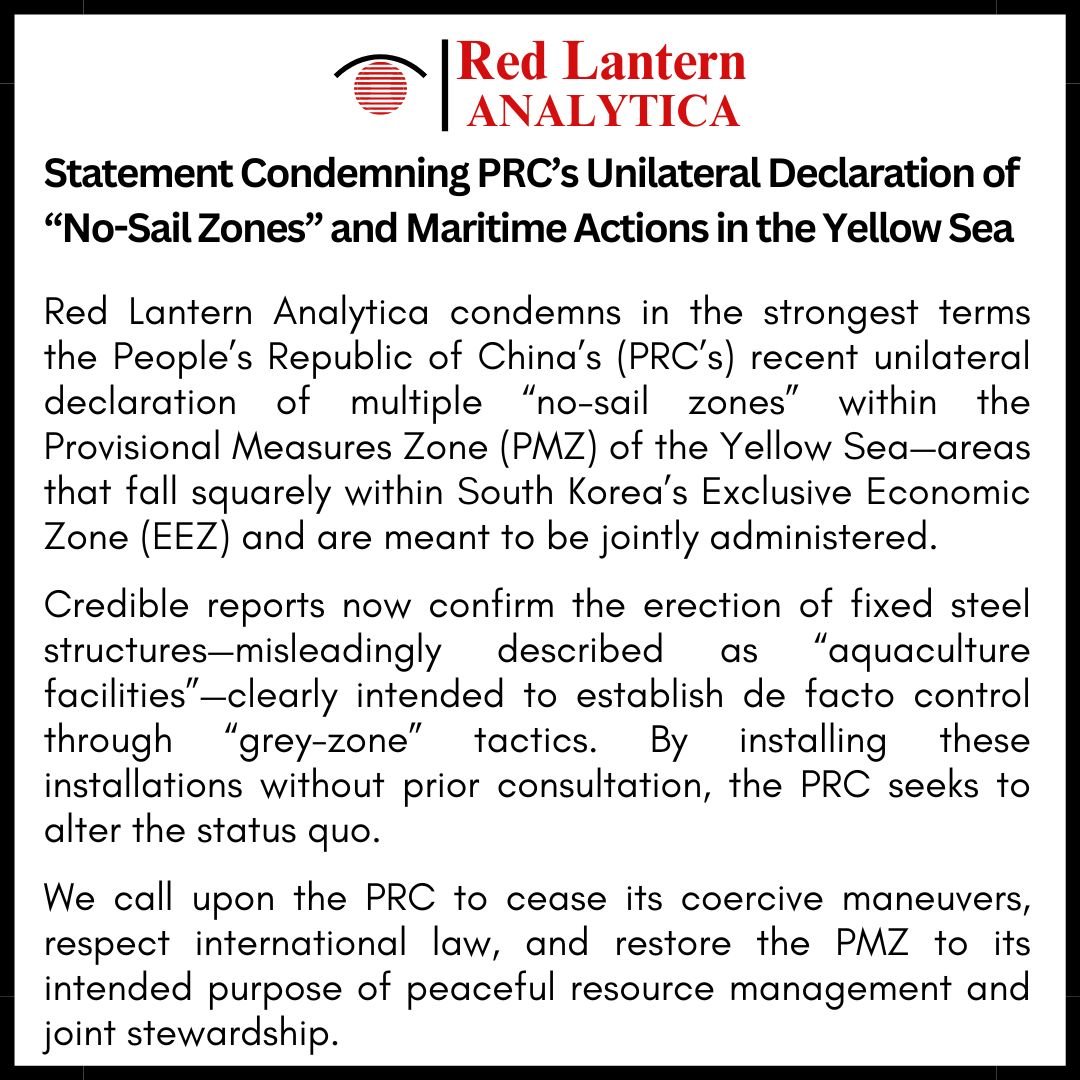
27/05/2025 Red Lantern Analytica (RLA) condemns in the strongest terms the People’s Republic of China’s recent unilateral declaration of multiple “no-sail zones” within the Provisional Measures Zone (PMZ) of the Yellow Sea—areas that fall squarely within South Korea’s Exclusive Economic Zone (EEZ) and are meant to be jointly administered. Beijing’s opaque rationale, reportedly linked to military exercises, flagrantly disregards the 2000 bilateral PMZ agreement and the United Nations Convention on the Law of the Sea (UNCLOS), which guarantees freedom of navigation and resource-sharing in overlapping waters Worse still, credible reports now confirm the erection of fixed steel structures—misleadingly described as “aquaculture facilities”—clearly intended to establish de facto control through “grey-zone” tactics. By installing these installations without prior consultation, the PRC seeks to alter the status quo incrementally, testing the limits of South Korea’s—and the international community’s—willingness to enforce existing norms. RLA underscores that: Unilateral maritime restrictions in overlapping EEZs undermine regional stability and erode the principle of transparent, rules-based cooperation. Military-linked “no-sail zones” severely restrict commercial shipping and fishing activities, threatening economic livelihoods and navigational safety. Grey-zone installations masquerading as civilian infrastructure represent a deliberate attempt to consolidate territorial control without triggering open conflict. Beijing must immediately clarify the purpose, coordinates, and duration of these zones; dismantle unauthorized structures; and engage in genuine, trilateral dialogue with Seoul and other Yellow Sea stakeholders. RLA reaffirms its commitment to democratic values, freedom of navigation, and a rules-based maritime order. We call upon the PRC to cease its coercive maneuvers, respect international law, and restore the PMZ to its intended purpose of peaceful resource management and joint stewardship.

TR
Team Red Lantern AnalyticaAnalyst
arrow_outward
When The Dragon Meets The Elephant In Africa
COMMENTARIESMAY 27, 2025
41

When The Dragon Meets The Elephant In Africa

In 2023 the world witnesses a watershed moment in geopolitics when under the presidency of India. The African Union joined the G20. This move was more than symbolic as it reflected the continent’s growing geopolitical relevance and the shifting axis of global power toward the Global South. But this inclusion also sharpened the spotlight on a silent contest already underway between China’s entrenched presence and India’s expanding engagement across Africa. With historical ties, soft power, and developmental diplomacy as key levers, India is now confronted with both an opportunity and a challenge as to how to engage a rising Africa without becoming a shadow of China’s state-capitalist model. While both India and China deploy state-backed finance to win friends and advance strategic interests in Africa, their approaches differ fundamentally in structure, cost, transparency and developmental impact. India primarily offers concessional Lines of Credit (LoCs) through EXIM Bank at low (1-2%) or zero interest rates, which often carries a long repayment horizon (15–20 years) with grace periods of 5–7 years. By keeping projects untied and rates concessional, Delhi minimizes the risk of debt distress and asset-for-debt swaps. China’s commercial interest rates can run as high as 3–6%, with ballooning penalty structures for delayed service, and shorter tenors (5-10 years) with minimal or no grace period. India does not wait for a country to default in order to extract political or territorial concessions. China on the other hand holds sway through “debt-for-equity” or “resource-backed” clauses: inability to service debt can lead to control of railways, ports or energy assets. This divergence in approach is increasingly resonating with African nations that are now seeking sustainable development rather than debt dependency. China’s ties with Africa dates back to 1950s when it supported post-colonial liberation movements in Africa. Since the early 2000s, China’s involvement at just face value has been nothing short of transformative in scale. Through initiatives like the Belt and Road Initiative (BRI) and the Forum on China-Africa Cooperation (FOCAC), being has poured over 180 billion dollars into the continent, financing over 3000 infrastructure projects. From railways in Kenya and Nigeria to ports in Djibouti and pipelines in Angola, China’s infrastructural footprint spans virtually every corner of Africa. The Addis Abba-Djibouti railway, the Nairobi-Mombasa Standard Gauge railway, and the massive hydropower dams in Zambia and Ethiopia are often cited examples of China’s visible contributions. However, behind the concrete and steel lie contracts laced with opacity, commercial loans with steep repayment terms and a financing model that increasingly resembles a predatory web. A growing number of African nations have found themselves ensnared in what is now referred to as China’s ‘debt-trap diplomacy’. The pattern is consistent, Beijing provides large loans with high commercial interest rates and short repayment windows, often secured against strategic national assets or resources. Crucially, these contract are shrouded in secrecy, rarely disclosed to parliaments or the public. The execution of the projects is dominated by Chinese state-owned enterprises, which import Chinese labour and materials, limiting the developmental spill overs for local economies. Djibouti is one of the clearest examples of Chinese debt-trap diplomacy. The small horn of Africa, strategically located at the mouth of the Res Sea, owes more than 70% external debt to China, largely tied to infrastructure projects like the Doraleh Multipurpose Port and the Addis Abba-Djibouti railway. In exchange of these investments, Djibouti granted China the rights to build its first overseas military base therefore serving geopolitical purposes for Beijing. Similarly, Zambia borrowed billions from Chinese lenders notably for Kariba Dam rehabilitation and the Kenneth Kaunda International Airport expansion, which finally led to it becoming the first African country to default on its debt. Under a ‘resource-backed loan’ model, Angola too pledged its future oil revenues to repay loans extended for roads, hospitals and office buildings. This arrangement has left Angola with crippling debt, poverty, illiteracy, and reduced fiscal flexibility. Kenya suffers the same dilemma as the Chinese funded Standard Gauge Railway has now pushed the country’s public debt to over 70% of its GDP. By 2017, the Republic of Congo’s debt had ballooned to over 115% of GDP, one of the major reasons for which was the weight of large debts to China. This situation was seen as a test case for International Monetary Fund, as it had issued a bailout for Congo, and many believed more countries in the African continent are going to turn to IMF for the very same reason. While Chinese investments have undeniably built roads, railways, and ports across Africa, the long-term development benefits remain highly questionable. In many cases, the infrastructure does not translate into real economic transformation due to poor integration, unsustainable financing, and low local ownership. The debt-trap narrative is not just rhetoric it is a real phenomenon that is stalling African development and threatening sovereignty. On the other hand, India’s relations with Africa is marked by long-standing, historical, emotional and ideological roots. While China has been treating Africa as investment, India is treating Africa as a partner. As several African countries grow wary of China’s opaque loans and aggressive asset control tactics, India is seizing the opportunity to position itself as a genuine development partner. This is most visible in its expanding presence in East, West, and Southern Africa. One of the most prominent examples of India’s constructive engagement is Ethiopia, where India has invested 5 billion dollars in pharmaceuticals, textiles, and agriculture, making it among the top three foreign investors. The Ethio-India Innovation Centre is a symbol of India’s focus on tech-driven, locally adapted development. India’s Lines of Credit worth over $12 billion have supported more than 200 projects in over 40 African countries like Kenya, Tanzania, Ghana etc. These projects are transparent, demand-driven, and mostly untied, meaning African nations choose their contractors and design the scope of the projects, avoiding the pitfalls of Chinese dependency on its own companies and labour. India financed the sectors like healthcare, and renewable energy in Uganda, areas often neglected by China. Under Vaccine Maitri, India has also been

TR
Team Red Lantern AnalyticaAnalyst
arrow_outward
MEDIA COVERAGEMAY 15, 2025
42

Arunachal is India: RLA Rejects China’s Cartographic Provocation

We unequivocally condemn China’s latest attempt to rename locations in Arunachal Pradesh, deeming it vain and preposterous. Under the leadership of the Ministry of External Affairs (MEA), the Government of India has reiterated in clear terms that such “creative naming” exercises do not and cannot alter the immutable fact that Arunachal Pradesh is, has always been, and will always remain an integral part of India. This is not an isolated development. In April 2024, China launched the so-called “Zhanna Provincial Renaming Program”, in which it arbitrarily assigned names to 30 geographical features, including mountains, rivers, and habitations—most of which lie well within Indian territory. India promptly and categorically rejected the move, reaffirming its sovereign claim over the region. China’s such claims hold no ground in international law or historical fact. As India’s External Affairs Minister Dr. S. Jaishankar aptly stated, “If I change the name of your house, will it become mine?” — a sentiment that encapsulates the absurdity of such unilateral assertions. This is not the first time China has resorted to renaming tactics to bolster its territorial claims. Similar lists were released in 2017 and 2021. Each time, India has firmly dismissed these moves as politically motivated attempts to fabricate territorial narratives. Such actions only serve to heighten tensions along the Line of Actual Control (LAC), where both nations have been engaged in protracted discussions aimed at de-escalation and disengagement. Despite existing bilateral agreements, unilateral actions like these continue to undermine the spirit of dialogue and mutual respect. India remains unwavering in its commitment to safeguarding its territorial integrity and sovereignty. We welcome the MEA’s swift and unambiguous rejection of China’s actions, sending a strong message that superficial cartographic maneuvers will not change realities on the ground. Arunachal Pradesh is not just a geographical territory—it is a vital part of India’s national identity, enriched by its culture, heritage, and the patriotic spirit of its people. We stand united in affirming that no amount of nomenclature engineering can dilute India’s rightful and enduring claim over it.

TR
Team Red Lantern AnalyticaAnalyst
arrow_outward
Press Release – Webinar on “Economic Crossroads: How the US-China Trade Rift Shapes India’s Strategic Future”
MEDIA COVERAGEAPRIL 28, 2025
43

Press Release – Webinar on “Economic Crossroads: How the US-China Trade Rift Shapes India’s Strategic Future”

April 27, 2025 In a time when the global economic landscape is undergoing fundamental realignments, Red Lantern Analytica organized a pivotal webinar titled “Economic Crossroads: How the US-China Trade Rift Shapes India’s Strategic Future.” The session brought together distinguished scholars and participants from across India and beyond, reflecting growing recognition that China’s destabilizing economic practices must be strategically countered, and that India’s rise must be firmly anchored on resilience, self-reliance, and global leadership. The event featured keynote addresses by two eminent speakers: Prof. Dr. Nagalaxmi M Raman, Director and Head, Amity Institute of International Studies, Amity University Uttar Pradesh, and Prof. Pavnesh Kumar, Professor, School of Management Studies, Indira Gandhi National Open University. In his welcome address, the Red Lantern Analytica representative emphasized the urgent need for India to view the shifting global economic order not as a mere disruption, but as a historic opportunity to position itself as a manufacturing, services, and strategic powerhouse — a clear rejection of the China-centric economic model that has shown itself to be unreliable and hegemonic. Prof. Dr. Nagalaxmi M Raman, in a detailed presentation, outlined six key dimensions that define India’s emerging role amidst the US-China trade rift. She underlined that the global supply chain realignments triggered by Western distrust of China offer India a once-in-a-generation opportunity to capture critical sectors such as electronics, semiconductors, pharmaceuticals, and renewable energy. Highlighting India’s demographic dividend, expanding digital economy, and strategic Indo-Pacific partnerships, she asserted that India must urgently reform its infrastructure, logistics, and regulatory environment to fully capitalize on these shifts. Dr. Raman warned that although India stands to benefit greatly, deep internal reforms and visionary leadership are imperative. She rightly pointed out that strategic autonomy must remain India’s guiding principle, and the competitive coexistence with China demands both caution and firmness. Prof. Pavnesh Kumar delivered an equally compelling address. With his extensive expertise in international business, he dissected the reasons behind the US-China economic rift, focusing on China’s exploitative trade practices, IP theft, and its loss of global credibility, especially after the COVID-19 pandemic. Prof. Kumar stressed that while global firms are exiting China, India must aggressively court them by providing a business environment marked by political stability, low logistics costs, and skilled human resources. He praised government initiatives like the Production Linked Incentive (PLI) schemes and liberalized FDI norms but cautioned that challenges in infrastructure and skill development still need urgent attention. Highlighting India’s youthful workforce, democratic stability, and strategic location on major global shipping routes, Prof. Kumar asserted that India has all the fundamentals to emerge as a preferred alternative to China — provided reforms are deep, implementation is swift, and policymaking remains investor-friendly yet national-interest driven. Both speakers emphasized that India must not merely aim to be a backup for Western firms leaving China, but should actively aspire to be a global leader in manufacturing, services, technology, and innovation — crafting an independent path and not becoming a cog in China’s game. During the interactive Q&A session, participants posed thoughtful questions regarding India’s potential to emerge as a global strategic leader. Both speakers agreed that while India has the potential, realizing it would depend on relentless pursuit of internal reforms, enhancing ease of doing business, deepening trade ties with trusted democracies, and above all, maintaining strategic clarity against China’s disruptive actions. As an international observers group committed to securing India’s strategic interests, Red Lantern Analytica firmly believes that blind engagement with authoritarian China is not a sustainable path. The emerging world order calls for countries like India to assert their sovereignty, resilience, and economic leadership without succumbing to Chinese manipulation or influence. Key Takeaways from the Session: India must leverage the supply chain diversification away from China and aggressively attract high-value investments. Building infrastructure, reforming land and labor laws, and skill enhancement are critical prerequisites. Strategic autonomy and balanced global partnerships (not China-centric dependencies) must remain central. India’s digital economy and manufacturing sectors must be globally competitive, innovative, and resilient. China’s model of coercive economics is unsustainable; India must present itself as the trustworthy alternative for the world.

TR
Team Red Lantern AnalyticaAnalyst
arrow_outward
Statement on India’s Decision to Rescind the Transshipment Facility for Bangladesh’s Export Cargo
MEDIA COVERAGEAPRIL 10, 2025
44

Statement on India’s Decision to Rescind the Transshipment Facility for Bangladesh’s Export Cargo

April 9, 2025 Red Lantern Analytica (RLA) notes with affirmation the Government of India’s recent decision to withdraw the transshipment facility for Bangladesh’s export cargo to third countries via Indian territory. This development comes in the backdrop of evolving strategic considerations in South Asia and renewed geopolitical assertions by Bangladesh in concert with external actors. As a sovereign nation with legitimate security interests, India has consistently demonstrated a commitment to regional connectivity, economic integration, and support for its neighbors. However, regional cooperation must be anchored in mutual respect, sensitivity to strategic red lines, and an appreciation of the complex geography and security architecture of South Asia—particularly in the fragile and vital Northeast Indian corridor. The recent comments by Professor Muhammad Yunus during his visit to China—advocating for Bangladesh’s strategic positioning as a maritime conduit for Chinese economic expansion into India’s landlocked Northeast—are deeply concerning. Such assertions risk undermining decades of goodwill, connectivity frameworks, and shared development goals fostered between India and Bangladesh. The proposition of extending Chinese influence into India’s sensitive Siliguri Corridor—often termed the ‘Chicken Neck’—is not only strategically provocative but misaligned with the spirit of regional trust and cooperation. India’s calibrated decision to rescind the 2020 transshipment circular underlines the importance of preserving strategic balance and safeguarding its territorial integrity while remaining committed to WTO norms and its broader regional obligations. It also serves as a reminder that transit privileges, while extended in good faith, are not to be misconstrued as avenues for strategic leverage. RLA encourages all regional stakeholders to pursue economic and strategic dialogues that enhance mutual trust, ensure transparency, and strengthen sovereign security concerns—particularly in geopolitically sensitive regions. Respectful engagement and adherence to shared norms must remain the foundation of regional partnerships in South Asia.

TR
Team Red Lantern AnalyticaAnalyst
arrow_outward
Silicon Battleground Report by Red Lantern Analytica
REPORTMARCH 22, 2025
45

Silicon Battleground Report by Red Lantern Analytica

Download Pdf Copy of the Report by clicking on the link below: Silicon Battleground Report by Red Lantern Analytica Download Pdf Copy of the Report by clicking on the link below: Silicon Battleground Report by Red Lantern Analytica

TR
Team Red Lantern AnalyticaAnalyst
arrow_outward
Siang Dialogue 2.0: Charting a Secure and Resilient Future in a Transforming Global Order (Both Days Brief)
UNTRADITIONAL SECURITYFEBRUARY 12, 2025
46

Siang Dialogue 2.0: Charting a Secure and Resilient Future in a Transforming Global Order (Both Days Brief)

New Delhi, February 8-9, 2025 Red Lantern Analytica successfully inaugurated its flagship event, Siang Dialogue 2.0, at the Foreign Correspondents’ Club – South Asia, bringing together policymakers, thought leaders, academics, and practitioners to discuss pressing geopolitical challenges shaping the global order. Inaugural Session: Global Horizons – Addressing Current Concerns in an Evolving World The event commenced with a ceremonial lamp lighting, followed by the inaugural session moderated by Dr. Ayanjit Sen. Mr. Sujeet Kumar, Member of Parliament (Rajya Sabha), emphasized India’s expanding soft power and its increasing diplomatic engagements on the global stage. He highlighted how India’s strategic partnerships and international outreach are shaping its position in global affairs. Mr. Vahan Zanoyan, an Armenian expert, provided a comprehensive analysis of the Nagorno-Karabakh conflict and its implications for India-Armenia relations. He elaborated on the geopolitical significance of the region and how India’s growing ties with Armenia could play a role in the broader Eurasian landscape. Mr. Abdulhakim Idris, Executive Director at the Centre for Uyghur Studies, addressed the ongoing human rights violations in Xinjiang. He critically analyzed China’s engagement with the Uyghur community, shedding light on the challenges faced by Uyghurs and the broader international response to these concerns. Dr. Rajiv Nayan, Senior Research Fellow at MP-IDSA, examined global arms control and disarmament efforts in the context of shifting power dynamics. He discussed the impact of emerging security challenges, the role of multilateral agreements, and how global realignments are influencing arms control policies. Mr. K.P. Fabian, Former Indian diplomat, underscored the urgent need for inclusive climate initiatives. He stressed the importance of implementing the Common but Differentiated Responsibilities (CBDR) principle, which advocates for a fair distribution of climate responsibilities among nations based on their historical emissions and capabilities. Aadil Brar, a journalist based in Taiwan, provided a detailed assessment of India’s border security challenges, with a particular focus on China’s military build-up along the Line of Actual Control (LAC). He highlighted the evolving nature of border tensions and their implications for India’s strategic defense policies. Mayank Singh, a senior journalist, expressed deep concerns regarding the credibility crisis in modern journalism. He examined the shift from print to digital media, analyzing its impact on journalistic integrity. Additionally, he explored the growing role of artificial intelligence in information warfare, highlighting both the opportunities and risks it presents in shaping public narratives. Dr. Sen concluded the session by thanking the esteemed panelists for their valuable contributions. Plenary Session 1: Navigating the Indo-Pacific – Strategic Maritime Security Dynamics Moderated by Dr. Sriparna Pathak (Associate Professor, O.P. Jindal Global University), the first plenary session featured key discussions on regional security and strategic maritime developments. Dr. Roger Chi Liu, Assistant Professor at Sun Yat-sen University, highlighted the significance of India-Taiwan collaboration in marine research, data sharing, and disaster management. He elaborated on Taiwan’s triple security framework, emphasizing its role in enhancing regional stability and fostering cooperative scientific research between the two nations. Mr. Jaydev Ranade, President of the Centre for China Analysis and Strategy (CCAS), provided an in-depth analysis of President Xi Jinping’s foreign policy strategies, particularly the concept of the ‘China Dream.’ He examined its implications for Taiwan and broader regional geopolitics, detailing how China’s strategic ambitions influence power dynamics in the Indo-Pacific. Mr. N.C. Bipindra, Editor of Defence Capital, discussed India’s cyber defense measures in countering China’s expansionist policies and cyber threats. He highlighted India’s ongoing efforts to strengthen its cybersecurity infrastructure, focusing on policy frameworks, defense collaborations, and emerging threats in cyberspace. Ms. Aarti Tikoo Singh, Editor-in-Chief of The New Indian, critically examined media biases influenced by foreign funding, particularly within the Indo-Pacific context. She discussed how external influences shape media narratives, the implications for national security, and the challenges of ensuring journalistic integrity in an era of information warfare. Mr. Ayanjit Sen, Chief Advisor at Red Lantern Analytica, elaborated on Pakistan’s role in information warfare, emphasizing its strategic use of pre-emptive information tactics. He analyzed the methods employed to manipulate narratives, influence public opinion, and challenge India’s position in the regional and global information ecosystem. Dr. Aparna, Assistant Professor at Central University of Jharkhand (CUJ), explored India’s position in the global AI race, contrasting it with China’s academic investments and technological advancements. She examined India’s growing AI sector, the need for enhanced research and development, and the challenges posed by China’s rapid technological progress. Dr. Tilak Jha, Associate Professor at Bennett University, emphasized the importance of narrative-building as a critical tool for shaping public opinion and power dynamics. He discussed how narratives influence policymaking, global perceptions, and geopolitical strategies, highlighting the role of media, diplomacy, and soft power in crafting influential narratives. The session provided valuable perspectives on regional security, technological advancements, and strategic communication. Plenary Session 2: Shaping the Future – India’s Role in a Transforming Global Order Moderated by Siddhartha Ghosh (Director, RLA), the second plenary session focused on India’s evolving role in global governance and strategic partnerships. Dr. Sriparna Pathak analyzed India’s economic ties with Southeast Asia, with a special focus on the technology sector. She highlighted India’s expanding trade partnerships, digital connectivity, and collaborative ventures in fintech and artificial intelligence, positioning India as akey player in regional economic growth. Major Amit Bansal, a defense strategist, examined India’s territorial disputes with China, assessing the strategic implications of growing military tensions. He also discussed the evolving China-Pakistan-Bangladesh nexus, highlighting how regional alliances impact India’s security landscape and necessitate a proactive defense strategy. Mr. Tenzin Tsundue, a Tibetan activist and poet, provided deep insights into Tibet’s ongoing struggle for independence. He discussed the political and cultural significance of the Dalai Lama’s reincarnation process, explaining its role in shaping Tibetan resistance against Chinese control and maintaining Tibetan identity. Mr. Vahram Ayvazyan, Founder & Chairman of The Network State, shed light on India-Armenia civilizational ties, tracing historical connections and their relevance in contemporary diplomacy. He also underscored the role of the Armenian diaspora in strengthening economic and cultural relations between the two nations. Dr. Devender Kumar, Assistant Professor at Reva University,

TR
Team Red Lantern AnalyticaAnalyst
arrow_outward
Diplomacy, Defence and Cybersecurity take centre stage at Siang Dialogue 2.0
MEDIA COVERAGEFEBRUARY 12, 2025
47

Diplomacy, Defence and Cybersecurity take centre stage at Siang Dialogue 2.0

New Delhi, February 11 : Red Lantern Analytica inaugurated its flagship event, Siang Dialogue 2.0, at the Foreign Correspondents’ Club – South Asia on February 8, bringing together policymakers, thought leaders, and academics to discuss pressing global challenges. The two-day event commenced with a ceremonial lamp lighting. Rajya Sabha MP Sujeet Kumar highlighted India’s growing soft power and its active diplomatic initiatives. Abdulhakim Idris, Executive Director of the Centre for Uyghur Studies, focused on the human rights crisis in Xinjiang, while Aadil Brar, a journalist based in Taiwan, discussed India’s border challenges, particularly China’s military presence along the Line of Actual Control (LAC). The first plenary session, “Navigating the Indo-Pacific: Strategic Maritime Security Dynamics,” featured Roger Chi Liu from Sun Yat-sen University, who emphasized collaboration between India and Taiwan in marine research and disaster management. Other speakers, included Jaydev Ranade, President of the Centre for China Analysis and Strategy, analyzed China’s foreign policy under Chinese President Xi Jinping, while NC Bipindra, Editor of Defence Capital, explored India’s countermeasures to China, such as cyber defense and bypassing the “Great Firewall.” The second plenary session, “Shaping the Future: India’s Role in a Transforming Global Order,” saw discussions on India’s economic ties with Southeast Asia, territorial disputes with China, and the growing influence of China, Pakistan, and Bangladesh in the region. Major Amit Bansal analyzed India’s strategic role as a net security provider in the Indo-Pacific, and Lt General Rakesh Sharma discussed the evolving nature of warfare, including information and space warfare. On the second day, discussions centered on building resilient economies and mitigating cyber threats. Paul, Editor of Greek City Times, proposed the India-Middle East-Europe Economic Corridor (IMEC) as an alternative to China’s Belt and Road Initiative. In a session on cyber security, experts like Jayanta Kalita and Namrata Hasija focused on China’s use of AI and disinformation to shape global narratives. The event concluded with a valedictory session where Arunachal Pradesh MLA Shree Ninong Ering, emphasized the need to counter Chinese authoritarianism and build resilience to global challenges.

TR
Team Red Lantern AnalyticaAnalyst
arrow_outward
China’s Two New Counties in the Aksai Chin: A Knee-jerk Reaction or Strategic Calculus?
COMMENTARIESJANUARY 23, 2025
48

China’s Two New Counties in the Aksai Chin: A Knee-jerk Reaction or Strategic Calculus?

On December 27, 2024, the People’s Government of Xinjiang Uygur Autonomous Region announced the establishment of the He’an and Hekang counties. It was approved by the Central Committee of the Communist Party of China and the State Council. The two new counties are established in the Aksai Chin – Kunlun region. They are carved out of existing Hotan and Pishan (Guma) counties of Xinjiang and the Aksai Chin region of India. These two new counties will be part of the Hotan (Khotan) prefecture of Xinjiang Uygur Autonomous Region. The administrative headquarters of He’an and Hekang will be Hongliu and Shahidullah (Xeyidula) townships respectively. Hongliu (Dahongliutan) town is located just outside India’s claim line (official border), based on the Johnson (1865) -Ardagh (1897) line. Shahidullah (Xeyidula) town was critical during “the Great Game” between the Russian and British empires. Ambassador Sujan. R. Chinoy writes “it was also critical for the Chinese because in 1890 they established hold over Shahidullah fort which was built by Maharaja Ranjit Singh of Jammu and Kashmir in 1865.” He further writes, “later the Chinese asserted their authority in some areas which were traditionally under the control of Mir of Hunza.” Ambassador P. Stobdan writes “the Chinese erected a new fort at Suget Karaul, close to Suget Pass, after the Indian guards were evacuated by 1892. Since then, China has continued its incursions into Aksai Chin and south of the Karakoram.” China is positioning He’an and Hekang counties for geostrategic, economic and historical reasons. India’s Immediate Response Soon after this announcement on January 03, 2025, the official spokesperson of the Ministry of External Affairs (Government of India) during their weekly press briefing said “Parts of jurisdiction of these so-called counties fall in India’s Union Territory of Ladakh. We have never [sic] accepted the illegal Chinese occupation of Indian Territory in this area. Creation of new counties will neither have a bearing on India’s long-standing and consistent position regarding our sovereignty over the area nor lend legitimacy to China’s illegal and forcible occupation of the same. We have lodged a solemn protest with the Chinese side through diplomatic channels on this matter.” The Chinese move also comes at a time when Indian and Chinese troops completed the disengagement process along the LAC on October 28, 2024. China’s Past Precedents It appears that the Communist Party of China’s (CCP) decision to create two new counties by subsuming Aksai Chin as part of Hotan prefecture draws similarities with the Government of India’s decision to abrogate Article 370 and create the Union Territory of Ladakh in 2019. During which China’s Foreign Ministry Spokesperson Hua Chunying stated “China is always opposed [sic] to India’s inclusion of the Chinese territory in the western sector of the China-India boundary into its administrative jurisdiction. This firm and consistent position remains unchanged. Recently India has continued to undermine China’s territorial sovereignty by unilaterally changing its domestic law. Such practice is unacceptable and will not come into force.” It can also be seen as counter to the recent Ministry of Home Affairs (MHA) decision (August 26, 2024) of the creation of five new districts (Changthang, Zanskar, Sham, Nubra and Drass) in the Union Territory of Ladakh. Herein, the Changthang district will have administrative control and jurisdiction over Aksai Chin and share its maximum border with Tibet. The district headquarter of Changthang district will be either at Nyoma or Durbuk, both are located 50-70 kilometres away from LAC. The CCP also draws inspiration from its recent Land Boundary Law adopted at the 31st meeting of the Standing Committee of the 13th National People’s Congress on 23 October, 2021. The Article 4 of the law states “the sovereignty and territorial integrity of the People’s Republic of China are sacred and inviolable. The state takes effective measures to resolutely safeguard territorial sovereignty and the security of land borders, and prevent and combat any acts that undermine territorial sovereignty and damage land borders.” It also appears that the recent disengagement agreement between India and China, wherein India withstood Chinese military might through its diplomatic and military manoeuvring only resulted in the projection of Xi Jinping’s weakness. Therefore the recent act of establishing two new counties is part of old tactics of projecting a strong stature of Chinese leadership, similar to the Galwan event in 2020 during the peak of the COVID-19 pandemic. This move by the Communist Party of China can also be seen as an attempt to sinicize Aksai Chin as He’an county, similar to its efforts to sinicize Arunachal Pradesh as ‘Zangnan’ and Tibet as ‘Xizang’. He’an and Hekang Counties Importance The maximum area subsumed within He’an County (See Map 1) is India’s Aksai Chin which was part of India till the 1962 Sino-Indian War. Similarly, a smaller portion of Aksai Chin is also included within the jurisdiction of Hekang County (See Map 2). The southern part of Hekang County is closer to the Shaksgam valley. The Shaksgam valley (5,180 square kilometres) was historically part of India however the area is presently under the control of China, which was transferred to China by Pakistan under the so-called China-Pakistan ‘Boundary Agreement’ signed in 1963. The valley was discovered by Francis Younghusband in 1887, on his way from Peking (Beijing) to India. At present Shaksgam is geostrategically crucial for China because of its closer proximity with India’s Siachen glacier and China-Pakistan Economic Corridor (CPEC) through Gilgit-Baltistan region. The southern portion of Hekang County is closely located near Karakoram Pass and Daulet-Beg Oldi (DBO). Hekang and He’an counties will also provide administrative and logistic support for the construction of the Tianshen Highway (G695) proposed to be completed by 2035. The other road Xinjiang-Tibet Highway (CNH-219) completed in 1957 also passes through Hekang and He’an county. The county of He’an is crucial for China’s semiconductor industry, Stobdan writes “the area has become a hot spot for rare metal mining due to the abundant resources of lithium, rubidium, beryllium, tantalum and niobium.” He further writes “it’s possible that Hongliu’s new administrative town is

TR
Team Red Lantern AnalyticaAnalyst
arrow_outward