INTELLIGENCE ARCHIVE

Media Coverage

83 published analyses, newest first.

India’s Call for Transparency in UNSC Terror Listings Deserves Global Support
MEDIA COVERAGEAUGUST 20, 2026
01

India’s Call for Transparency in UNSC Terror Listings Deserves Global Support

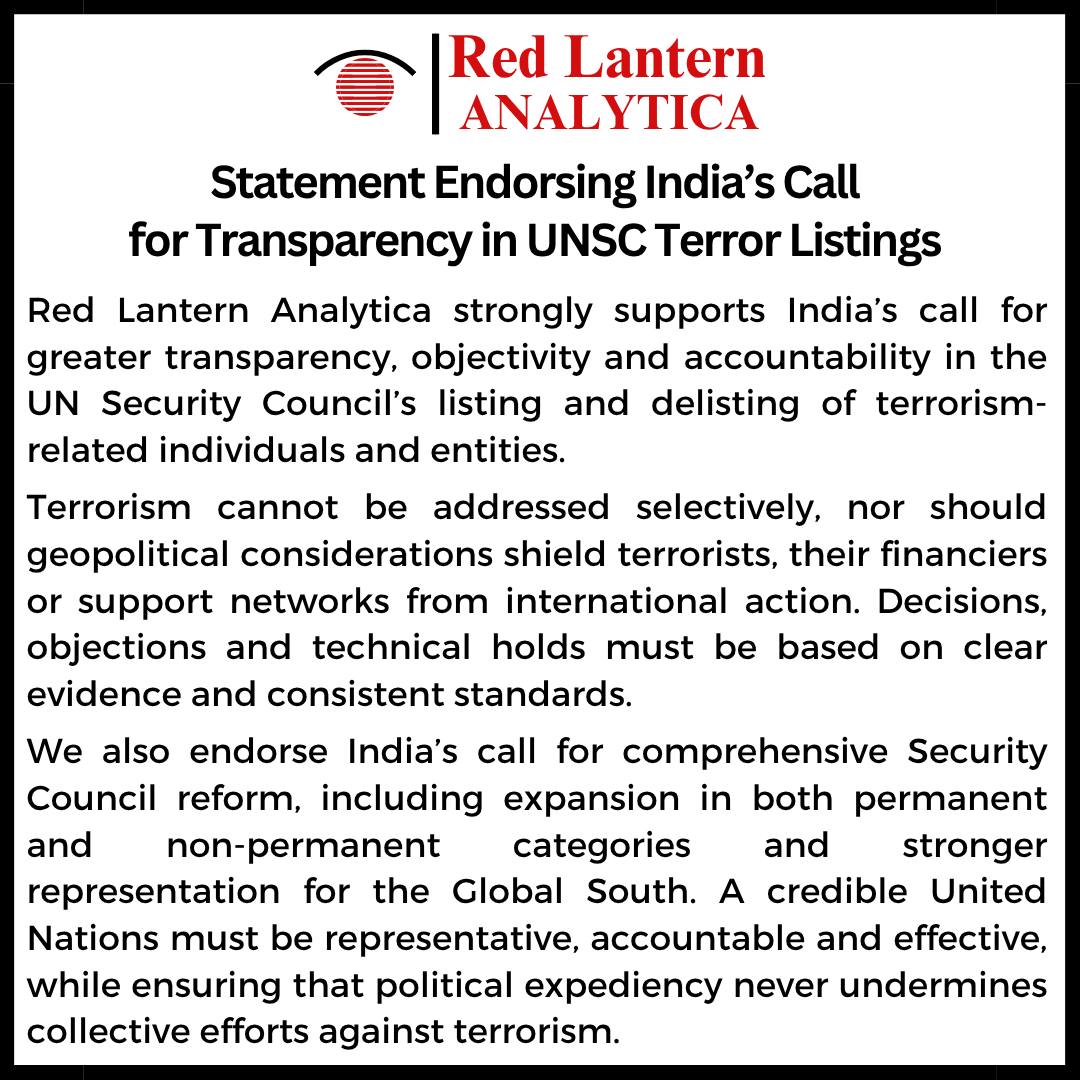
20th August 2026 Red Lantern Analytica welcomes and fully endorses India’s plea for increased UN Security Council transparency, objectivity, and accountability while addressing the challenge of listing and delisting terrorism-related persons and entities. India has brought a legitimate concern to the UN that has eroded the international community’s confidence in its counter-terrorism efforts. The member states of the UN cannot decide on terrorism through geopolitical convenience or the interpretation and consideration of terrorism in a selective manner. India also does not appreciate the fact that certain U.N. member states consider certain political individuals and groups as useful. The reality is that a terrorist who is a threat to one country cannot be treated differently from the terrorist who is a threat to another country. India has good reason to question the UN’s ability to respond to the threats it faces given India’s efforts to bring international sanctions against terrorists based in Pakistan and related to attacks on India. The obstructive behaviour of the UN Security Council has, on several occasions, created barriers to India’s efforts to respond to terrorism. China has used technical holds to obstruct proposals targeting Pakistan-based terrorists, including the head of the Jaish-e-Mohammed, Masood Azhar. This demonstrates that the international community cannot demand collective efforts to meet counter-terrorism goals while also ensuring that obstruction and opacity characterize the most important of the international community’s security efforts. The counter-terrorism efforts of the international community are not possible while countries continue to employ political considerations that are incompatible with counter-terrorism to provide indirect protection for terrorists, their financiers, and their supporters. The objections, requests for delisting, and holds must each be substantiated with reasons. The Security Council should never become a political arm of efforts to protect terrorists and those who support them financially. Red Lantern Analytica additionally advocates for comprehensive reform of the Security Council pertaining to the demands of the Indian government. The security structures and systems created post-World War II will not last forever. The UN has continued to grow, and there are now more emerging markets and centres. The Global South is also more important than ever before. This all further demonstrates the need for multi-faceted reform. India’s position for all categories, permanent and non-permanent, of expansion, as well as representation for developing nations and progress through negotiations, is legitimate and should be recognized internationally. The Security Council must focus on the present day and thus respond to the needs of the time and offer accountability and representation, as legitimate structures of the modern world order. India continues to support UN peacekeeping and international counter-terrorism efforts. It is therefore important for India that the Security Council responds to the challenges of the 21st century, and not just meet India’s request for representation. It is about the integrity of the UN as a whole. There can be no double standards on terrorism. Political expediency must never provide a shield for terrorists or their support networks. A strengthened UN should defeat terrorism and protect the people of the world.

TR
Team Red Lantern AnalyticaAnalyst
arrow_outward
Red Lantern Analytica Releases Report on Chinese Cyber-Enabled Narrative Operations
MEDIA COVERAGEAUGUST 3, 2026
02

Red Lantern Analytica Releases Report on Chinese Cyber-Enabled Narrative Operations

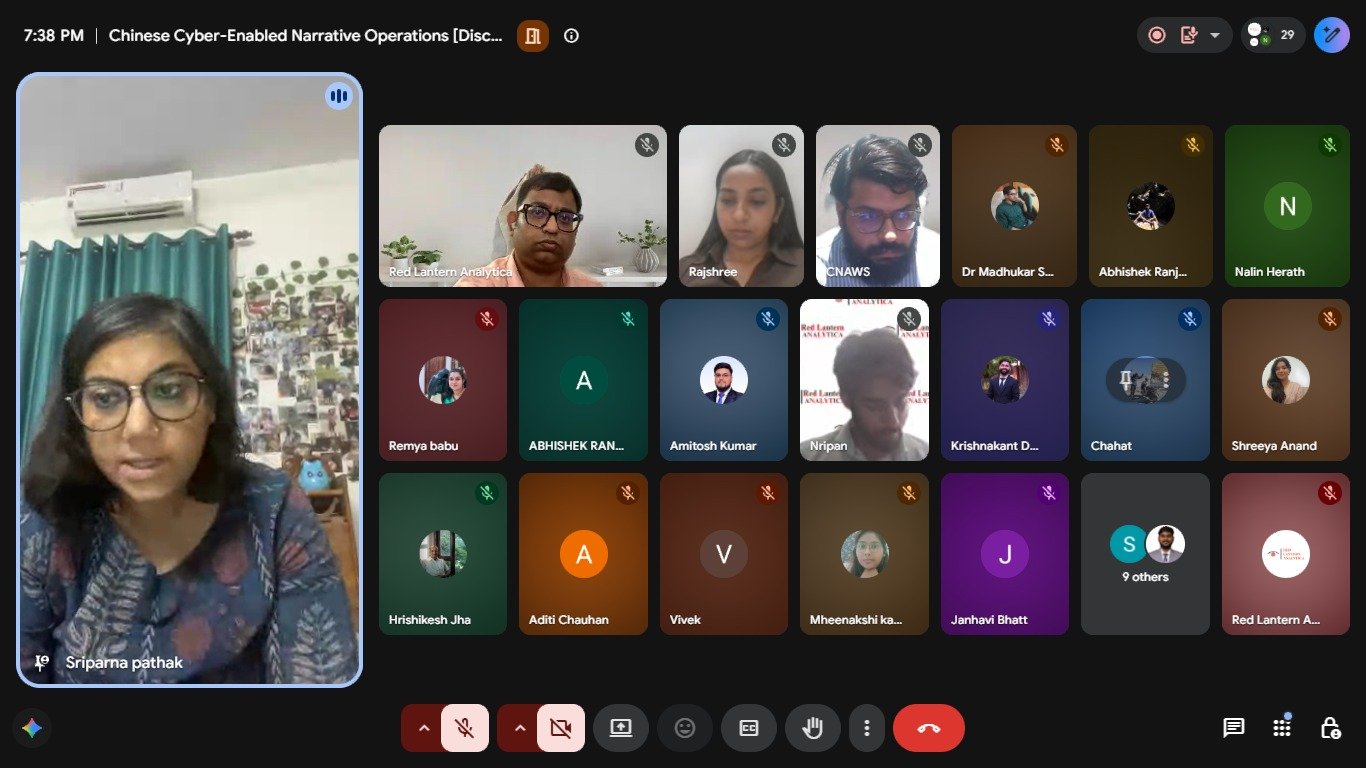
New Delhi, August 2, 2026: Red Lantern Analytica organised a discussion and report-release event titled “Chinese Cyber-Enabled Narrative Operations”, bringing together experts in China studies, cybersecurity, information warfare and strategic affairs to examine the growing use of digital platforms for influencing public opinion and weakening confidence in democratic institutions. The event also marked the release of Red Lantern Analytica’s report, “Chinese Cyber-Enabled Narrative Operations Around India’s 2026 Student Protest.” The study examines how domestic protests and public grievances in India were reframed across Chinese-language and international digital platforms as evidence of governance failure, institutional decline and political instability. The discussion featured Professor Sriparna Pathak, Professor of China Studies and Founding Director of the Centre for Northeast Asian Studies at O.P. Jindal Global University; Dr Madhukar Shyam, Assistant Professor in the Department of International Studies, Political Science and History at CHRIST (Deemed to be University), Delhi NCR; and Mohit Vashish, Founder and Executive Director of Intelligence at the Centre for New Age Warfare Studies. Opening the discussion, Professor Sriparna Pathak said Chinese narrative operations extend beyond attempts to influence elections or promote favourable perceptions of China. Their wider objective, she observed, is to polarise societies, amplify existing grievances and gradually undermine public trust in democratic institutions. She explained that such campaigns frequently rely on inauthentic social-media accounts, artificial intelligence-generated content, state-media proxies and fabricated digital personas. Open democratic information systems are particularly vulnerable because foreign narratives can circulate with relatively few restrictions, while China maintains a highly controlled domestic information environment. Professor Pathak noted that India has emerged as both a strategic target and a testing ground for these operations, particularly since the June 2020 Galwan Valley clash. Narratives linked to Chinese digital ecosystems have sought to question India’s military preparedness, intensify ethnic and regional tensions and portray democratic disagreements as evidence of political instability. Referring to campaigns concerning Northeast India, she highlighted attempts to exploit developments in Manipur, Nagaland and Arunachal Pradesh. Chinese-origin content, sometimes translated or adapted using artificial intelligence tools, has been circulated to amplify separatist claims, distort local grievances and complicate India’s border-management challenges. She also referred to bot-like accounts that sought to undermine confidence in the 2024 Lok Sabha elections by raising doubts about national security, governance and defence capabilities. Professor Pathak called for faster official responses, greater platform transparency, improved public-reporting mechanisms and media-literacy programmes in Indian languages. Dr Madhukar Shyam distinguished conventional cyberattacks from cyber-enabled narrative operations. While technical cyberattacks are designed to penetrate, disrupt or damage computer systems, narrative operations use the digital environment to shape emotions, attitudes and political perceptions. He referred to earlier cyber-espionage campaigns, including the 2009 GhostNet operation, which compromised computer systems across several countries and reportedly targeted institutions connected with the Tibetan community. He also discussed the Shadow in the Cloud investigation and cyberattacks against Tibetan institutions, illustrating the relationship between technical espionage and long-term information warfare. Dr Shyam further examined how Chinese messaging sought to exploit India’s 2024 National Eligibility-cum-Entrance Test controversy. Comparisons between China’s Gaokao examination and India’s NEET system were used to present protests and administrative disputes as evidence of systemic democratic failure. Such narratives, he said, deliberately misinterpret public protests, which are a normal feature of democratic accountability, as signs of political collapse and institutional instability. He also drew attention to attempts to manipulate cultural and civilisational narratives, including efforts to weaken India’s historical association with Buddhism and create differences between India and neighbouring countries. Mohit Vashish explained the operational structure of contemporary Chinese information warfare, describing it as a systems-based approach in which intelligence gathering, psychological profiling, content creation, social-media amplification and influencer engagement operate in coordination. According to Vashish, intelligence agencies and associated organisations first identify societal “fault lines”—issues capable of dividing communities—and then use psychological techniques to intensify those divisions. Anonymous posts may initially be amplified through bot networks and subsequently repeated by influencers, media platforms or political commentators, giving manufactured narratives an appearance of credibility and organic public support. He also warned that foreign-linked entities may approach students, researchers and young professionals through professional networking platforms such as LinkedIn. Individuals studying defence, international relations, security and political science may be offered unusually high payments for reports or research assignments. Vashish advised students and researchers to verify email addresses, carefully examine domain-name spellings, check the organisation’s official website and remain cautious about unsolicited financial offers. He also recommended reviewing suspicious accounts’ biographies, posting histories and interaction patterns, tracing the earliest appearance of particular phrases and conducting reverse-image searches before sharing sensational content. Presenting the findings of the report, Daney Antonio Martin of Red Lantern Analytica said the research examined content circulated through Chinese and international platforms, including WeChat, Weibo, Guancha and X. The report found no evidence that China initiated India’s 2026 student protests. It nevertheless identified strong evidence that Chinese digital ecosystems exploited and amplified the protests to advance broader geopolitical narratives about India. The study distinguishes between direct instigation and narrative exploitation. It assesses the evidence for coordinated amplification as substantially stronger than any claim of centrally directed technical interference in the protests. The speakers agreed that foreign narrative operations cannot be addressed solely through government regulation or technical cybersecurity measures. They called for a whole-of-society approach involving government agencies, digital platforms, researchers, educational institutions, journalists, civil-society organisations and citizens. The discussion underlined the need for rapid public communication, transparent platform practices, stronger verification systems and greater digital awareness among users. Participants also emphasised that democratic openness should not become a vulnerability that foreign actors can repeatedly exploit. The session concluded with a vote of thanks to the speakers, moderator, participants and organising team for contributing to the discussion on safeguarding India’s information environment. About Red Lantern Analytica Red Lantern Analytica is a New Delhi-based international observers and research organisation working on China, Tibet, the Indo-Pacific, cybersecurity, disinformation, strategic affairs and emerging geopolitical challenges. Through research reports, expert dialogues and public engagement, it seeks to promote informed debate and policy-oriented analysis.

TR
Team Red Lantern AnalyticaAnalyst
arrow_outward
Press Release: Strategic Dialogue Examining Shifting Power Dynamics
MEDIA COVERAGEMARCH 14, 2026
03

Press Release: Strategic Dialogue Examining Shifting Power Dynamics

Strategic Dialogue Examining Shifting Power Dynamics in the Indo-Pacific Red Lantern Analytica, in collaboration with Hegemoniq, convened a strategic dialogue on “Strategic Shifts in the Indo-Pacific: Connectivity, Coalitions and Great Power Competition” on 14th March 2026 (Saturday). The discussion brought together distinguished experts to examine the evolving geopolitical architecture of the Indo-Pacific and the implications of growing strategic competition, emerging partnerships, and regional security dynamics. The panel featured Col. Nalin Herath RSP (Retd.) , Amb. Tom Armbruster (Retd.) , Dr. Dattesh Parulekar, and Dr. Rahul Mishra, each offering perspectives on how regional states and major powers are navigating the rapidly changing strategic environment. Speaking from a Sri Lankan perspective, Col. Nalin Herath RSP (Retd.), Amry Veteran & Former Military Spokesperson, Sri Lanka, highlighted the growing importance of the Indian Ocean within the broader Indo-Pacific framework. He emphasized Sri Lanka’s strategic location along critical maritime trade routes connecting East Asia, the Middle East, Africa, and Europe. This positioning provides both opportunities and challenges for smaller states. While infrastructure development and connectivity initiatives—particularly port development and maritime logistics—offer avenues for economic growth, they also place Sri Lanka at the intersection of competing geopolitical interests. Col. Herath stressed the importance of balanced diplomacy and Sri Lanka’s traditional policy of non-alignment in navigating great power competition. Maintaining neutrality while engaging multiple partners, he noted, remains essential for ensuring stability and safeguarding national interests. Amb. Tom Armbruster (Retd.), Former US Ambassador to Marshall Islands focused on the role of Pacific Island states within the Indo-Pacific strategic landscape. He challenged the conventional perception of these countries as “small island states,” noting that they instead consider themselves “large ocean countries” due to their vast maritime territories. Despite relatively small populations, these nations wield significant diplomatic influence, particularly in global forums such as the United Nations. Amb. Armbruster highlighted that the primary concerns of Pacific Island states are not great power rivalry but rather climate change, sea-level rise, disaster preparedness, and sustainable development. He also pointed to the growing competition between the United States and China in the Pacific region, while emphasizing that meaningful engagement with island states must prioritize development partnerships, environmental resilience, and long-term economic cooperation. Dr. Dattesh Parulekar, Assistant Professor, School of International & Area Studies, Goa University examined China’s evolving maritime strategy and its impact on Southeast Asia, particularly in the South China Sea. He traced the evolution of China’s maritime ambitions from its 2012 declaration to become a maritime power to its current efforts to assert comprehensive national power in its near seas. Dr. Parulekar argued that China is attempting to redefine maritime norms by combining military capabilities with industrial, technological, and economic instruments. Through infrastructure projects, maritime development initiatives, and blue economy frameworks, Beijing is reshaping regional connectivity and strategic influence. At the same time, Southeast Asian states are adopting different strategies to manage China’s rise. Countries such as Vietnam pursue proactive balancing, Indonesia follows a calibrated approach combining economic engagement with strategic caution, while the Philippines has taken a more assertive stance in defending its maritime claims. These diverse responses illustrate the complex regional dynamics shaping the South China Sea. Providing a broader geopolitical assessment, Dr. Rahul Mishra, Associate Professor, Centre for Indo-Pacific Studies, SIS, JNU, discussed the structural shifts taking place within the Indo-Pacific order. He noted that the Indo-Pacific has firmly emerged as a central theater of global geopolitics, reflecting the growing strategic convergence between the Indian and Pacific Oceans. China’s rise as a revisionist power, he argued, has compelled many countries to reconsider their strategic alignments. This has contributed to the rise of flexible partnerships and minilateral groupings such as the Quad, which seek to address regional challenges ranging from maritime security to supply chain resilience.Dr. Mishra also emphasized that recent global crises—including conflicts in Europe and West Asia—demonstrate that the Indo-Pacific cannot be viewed as an isolated strategic space. Developments in other regions continue to influence the balance of power and security dynamics within the Indo-Pacific. In this context, he highlighted India’s approach of strategic autonomy and multi-alignment as a pragmatic framework for navigating complex geopolitical realities while maintaining constructive partnerships across multiple regions. The dialogue underscored that the Indo-Pacific is undergoing a profound transformation driven by shifting power balances, new connectivity initiatives, and evolving security partnerships. As the region becomes increasingly central to global politics, experts emphasized the need for sustained dialogue, cooperative frameworks, and balanced strategies to ensure stability, economic development, and a rules-based regional order.

A
AdminAnalyst
arrow_outward
Statement on Commemoration of the 65th Tibetan Democracy Day
MEDIA COVERAGESEPTEMBER 2, 2025
04

Statement on Commemoration of the 65th Tibetan Democracy Day

On this historic 65th anniversary of Tibetan Democracy Day, coinciding with the noble Year of Compassion, celebrating His Holiness the Dalai Lama’s 90th birthday, we join the global Tibetan community in commemorating in celebrating the vision, resilience, and unyielding spirit of the Tibetan people. We pay our deepest respects to H.H the Dalai Lama, whose visionary leadership and unwavering commitment to democratic values laid the foundation for the vibrant governance system that the Tibetan community in exile upholds today. At a time when Tibet’s culture, religion, and identity face increasing repression, we reaffirm our solidarity with the Tibetan people and their democratic aspirations. Red Lantern Analytica remains committed to amplifying their voices, advocating for religious freedom, human rights, and the preservation of Tibet’s unique heritage. Tibetan freedom movement continues to inspire movements for freedom and dignity worldwide. On this day, we call upon the international community, democratic nations, and civil society to stand united with Tibetans in their pursuit of freedom, equality, and self-determination.

TR
Team Red Lantern AnalyticaAnalyst
arrow_outward
Statement on the PRC’s Deplorable Response to Indian Greetings to H.H. the 14th Dalai Lama
MEDIA COVERAGEJULY 8, 2025
05

Statement on the PRC’s Deplorable Response to Indian Greetings to H.H. the 14th Dalai Lama

Red Lantern Analytica strongly condemns the Chinese Communist Party’s latest attempt to malign the revered spiritual leader of the Tibetan people, His Holiness the 14th Dalai Lama, by labeling him a “separatist” under the cloak of religion. These remarks are not only baseless and inflammatory, but they also reflect China’s ongoing strategy to delegitimize the Tibetan cause and suppress peaceful expressions of cultural identity. It is important to reaffirm that His Holiness the Dalai Lama is not a political agitator, but a global symbol of peace, compassion, and nonviolence. His advocacy has consistently emphasized in the preservation of Tibetan cultural and religious heritage. To portray such a spiritual leader as a political threat is not only misleading but underscores the deep insecurity of a regime that cannot tolerate even the softest voice of dissent. The Chinese government’s persistent efforts to reframe Tibet as “Xizang” are part of a broader campaign of cultural erasure. This renaming is neither benign nor linguistic—it is a deliberate attempt to overwrite Tibetan identity, heritage, and historical truth. China’s occupation of Tibet in 1950 was not a peaceful liberation but an ‘annexation’, and since then, it has continued to pursue aggressive policies of Sinicization. These include the forced assimilation of Tibetan children into state-run boarding schools, demolition of monasteries, restrictions on religious practices, and the surveillance and incarceration of those who express loyalty to their native culture. Beijing’s criticism of Indian leaders for extending greetings to H.H. the Dalai Lama on his 90th birthday is both absurd and offensive. India, as the world’s largest democracy and host to the Tibetan government-in-exile, has every right to honour a figure who symbolises moral courage and spiritual wisdom. The Chinese protest is yet another example of overreach and an attempt to dictate the diplomatic and moral choices of sovereign nations. Red Lantern Analytica not only condemns the PRC’s absurd claims but also urges the international community to see through PRC’s narrative manipulation and stand firmly in defense of Tibetan identity, cultural rights, and spiritual freedom. The world must not remain silent while the entire Tibetan civilization is slowly erased under the CCP’s authoritarianism.

TR
Team Red Lantern AnalyticaAnalyst
arrow_outward
Statement of Support for Quad’s Condemnation of the Pahalgam Terror Attack
MEDIA COVERAGEJULY 3, 2025
06

Statement of Support for Quad’s Condemnation of the Pahalgam Terror Attack

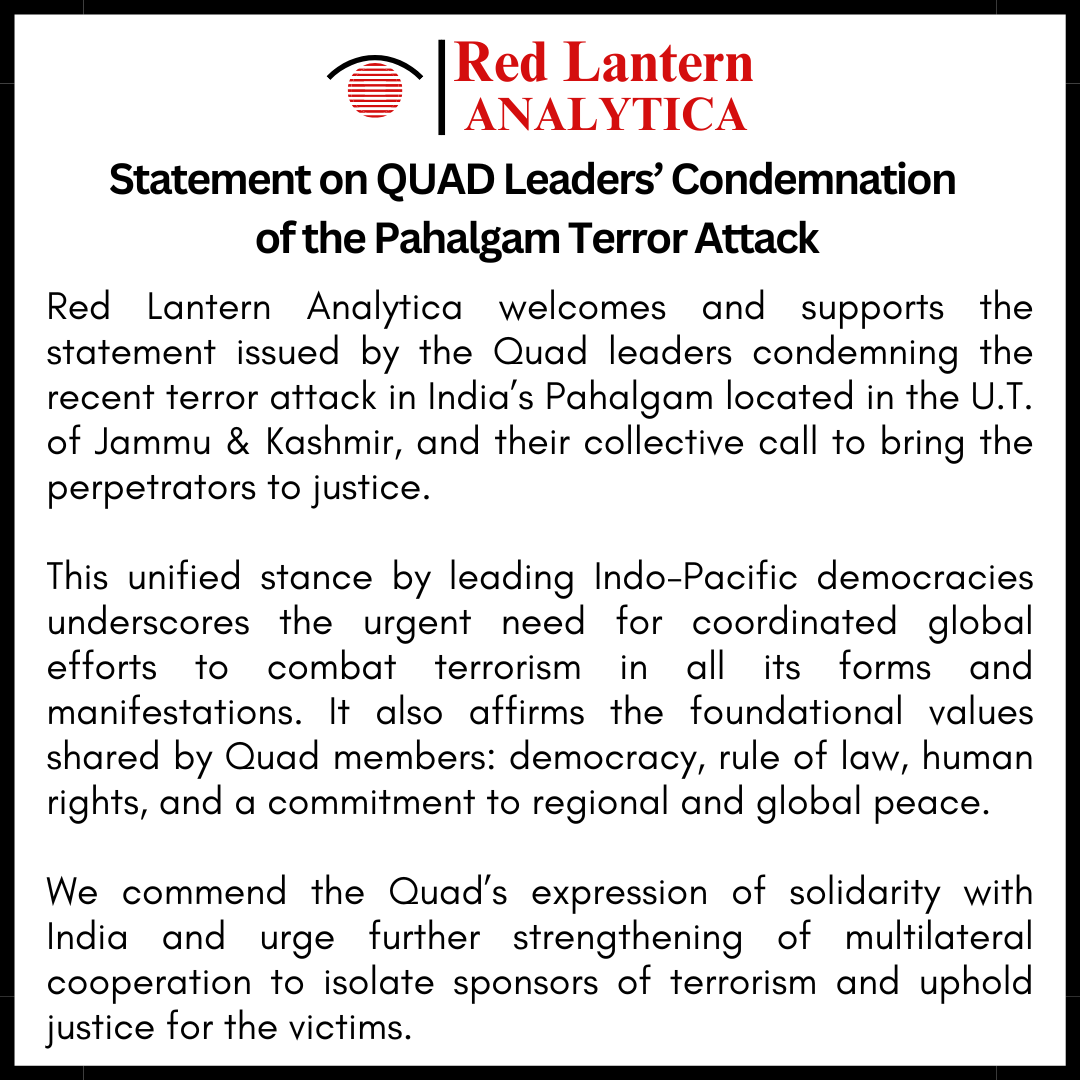
July 3, 2025 Red Lantern Analytica unequivocally supports the strong and principled statement issued by the foreign ministers of the Quadrilateral Security Dialogue (Quad) in the aftermath of the terrorist attack that took place in Pahalgam, Jammu and Kashmir, on April 22, 2025. The attack, which resulted in the tragic loss of 25 Indian nationals and one Nepali citizen, and caused injuries to several others, was a deeply reprehensible act of violence targeting innocent civilians. Such acts represent a gross violation of the fundamental principles of human dignity, security, and international law. We commend the Quad foreign ministers—representing the governments of India, the United States, Australia, and Japan—for their clear and unified condemnation of this atrocity, and for their firm call to ensure that the perpetrators, organisers, and financiers of this attack are identified and brought to justice without delay. This strong stance underscores the importance of sustained international cooperation in combating terrorism in all its forms and manifestations. Red Lantern Analytica further welcomes the Quad’s call for all United Nations Member States to fully cooperate, in accordance with their obligations under international law and relevant United Nations Security Council resolutions, with the competent authorities in this regard. The pursuit of justice must be collective, coordinated, and unwavering. Terrorism remains a persistent and transnational threat to peace, security, and stability. The international community must remain vigilant, united, and resolute in its commitment to upholding the rule of law and ensuring that such acts do not go unpunished. Red Lantern Analytica stands in solidarity with the victims of the Pahalgam attack, their families, and the people of India. We reaffirm our commitment to supporting efforts aimed at strengthening international mechanisms to combat terrorism and promote accountability.

TR
Team Red Lantern AnalyticaAnalyst
arrow_outward
Webinar on “China’s Grip, India’s Hand: Competing Visions for Africa’s Future”
MEDIA COVERAGEJUNE 22, 2025
07

Webinar on “China’s Grip, India’s Hand: Competing Visions for Africa’s Future”

22nd June 2025 In a time when the world is paying a closer attention to the African continent, Red Lantern Analytica organised a webinar titled “China’s Grip, India’s Hand: Competing Visions for Africa’s Future” on 22nd June 2025. The session brought together distinguished scholars and participants from across India. The distinguished panel had: Dr. Ruchita Beri, Senior Fellow at the Vivekananda International Foundation, Mr. Samir Bhattacharya, Associate Fellow at the Observer Research Foundation, and Dr. Rashmi Rani Anand, Assistant Professor at the Centre for African Studies, SIS, JNU. The first speaker, Dr. Ruchita Beri, Senior Fellow at the Vivekananda International Foundation (VIF), delivered a compelling talk analysing the evolving dynamics of Africa’s international partnerships, with a particular focus on China’s expanding footprint and India’s distinctive approach to engaging with the continent. Dr. Beri began by examining China’s economic and political influence in Africa, emphasizing Beijing’s strategic efforts to broaden its presence across the region. Through a combination of aggressive trade policies, large-scale infrastructure projects, and investments in natural resource extraction, China has established itself as a dominant external actor in African affairs. She noted that this engagement is largely state-driven, with Chinese government-backed entities playing a central role in financing and executing development projects. While this model has brought visible infrastructural benefits, it has also raised concerns about debt dependency, lack of local capacity-building, and limited long-term economic sustainability. In contrast, Dr. Beri highlighted India’s approach to Africa, characterizing it as more people-centric and collaborative. Unlike China’s state-led strategy, India’s partnership model is rooted in the priorities of African nations themselves. “India’s engagement is not just about economic returns,” she remarked, “but about building long-term, sustainable partnerships that respond to African aspirations.” She elaborated on three key pillars of India’s Africa policy: Capacity Building and Skills Development – India has invested significantly in training programs, scholarships, and technical cooperation to empower African human capital. Initiatives such as the Indian Technical and Economic Cooperation (ITEC) program have become hallmarks of this people-to-people engagement. Private Sector Participation – Indian businesses have increasingly made inroads into African markets, particularly in sectors like pharmaceuticals, IT, and agriculture. Unlike China’s reliance on state-owned enterprises, India’s Africa strategy is led by private entrepreneurs, creating opportunities for inclusive economic development. Civilian Oversight and Grassroots Engagement – Dr. Beri noted that India’s partnerships often emerge from civil society collaborations, academic exchanges, and diaspora linkages, reinforcing a bottom-up approach to diplomacy that resonates with local communities. Dr. Beri concluded by affirming that while both India and China are key external players in Africa, their engagement models differ fundamentally. China’s economic interests dominate its policy, whereas India’s approach is more aligned with African development goals and societal empowerment. The 2nd Speaker – Mr. Samir Bhattacharya, Associate Fellow, ORF opened his remarks examined China’s rising footprint in Africa, driven primarily through large-scale infrastructure investments and concessional loans. He pointed out that China’s presence is visible in nearly every corner of the continent, from transport networks and industrial parks to energy and mining sectors. While these projects have accelerated infrastructure development in many African nations, Mr. Bhattacharya emphasized that the terms of Chinese loans often lack transparency and come with conditionalities, which can undermine national sovereignty and burden local economies with unsustainable debt. Crucially, Mr. Bhattacharya noted a shift in recent years, highlighting the emergence of greater African agency in international partnerships. “African countries are no longer passive recipients of foreign aid and investment,” he said. “They are increasingly scrutinizing their external engagements and recalibrating their partnerships to align with national interests.” This, he argued, is influencing how nations like China and India are received and perceived across the continent. Turning to India-Africa relations, Mr. Bhattacharya drew a clear contrast between China’s state-centric, top-down approach and India’s more balanced, market-driven model. He described India’s engagement with Africa as rooted in cooperation rather than domination, emphasizing mutual respect, shared democratic values, and a deepening people-to-people connection. He highlighted three key aspects of India’s Africa policy: Transparent and Demand-Driven Investment – Unlike China’s model, India’s investments are guided by market forces and African priorities, reducing risks of debt dependency and promoting equitable growth. Respect for Sovereignty – India’s approach steers clear of imposing political conditions or opaque loan terms. Instead, it focuses on creating win-win partnerships where African governments retain decision-making authority over their development agendas. Strategic Alignment Without Overreach – Mr. Bhattacharya emphasized that India does not seek to dominate Africa geopolitically but rather aims to be a trusted development and trade partner, particularly in areas like technology, health, digital infrastructure, and education. In his concluding remarks, Mr. Bhattacharya called for a nuanced understanding of Africa’s geopolitical evolution, stressing that future global engagement with the continent must prioritize local ownership, sustainability, and long-term development over short-term strategic gains. The final speaker, Dr. Rashmi Rani Anand provided critical insights into India’s strategic partnership with Africa, especially in the context of green energy transitions and the rising influence of global powers such as China on the continent. Dr. Anand emphasized that Africa holds immense strategic value for India, particularly due to its abundance of critical minerals essential for green energy technologies, including lithium, cobalt, and rare earth elements. These resources are pivotal as India pursues ambitious climate goals and transitions toward renewable energy. She underscored that India’s engagement with Africa is not symbolic but rooted in real South-South cooperation, built on principles of equality, mutual respect, and shared development priorities. “This is not just a policy on paper,” she noted. “India is deeply committed to empowering Africa through capacity building, technology transfer, and sustainable development initiatives.” In stark contrast, Dr. Anand addressed the implications of China’s deepening investments in African infrastructure and technology sectors, particularly under the Belt and Road Initiative (BRI). She pointed out growing concerns related to sovereignty, debt distress, and lack of transparency in Chinese-funded projects. These concerns are amplified by the opaque nature of financing terms, tied aid, and the long-term strategic control that often accompanies such investments. Key takeaways

TR
Team Red Lantern AnalyticaAnalyst
arrow_outward
Statement Condemning the PRC’s unilateral declaration of “No-Sail Zones” within South Korea’s Exclusive Economic Zone (EEZ)
MEDIA COVERAGEMAY 27, 2025
08

Statement Condemning the PRC’s unilateral declaration of “No-Sail Zones” within South Korea’s Exclusive Economic Zone (EEZ)

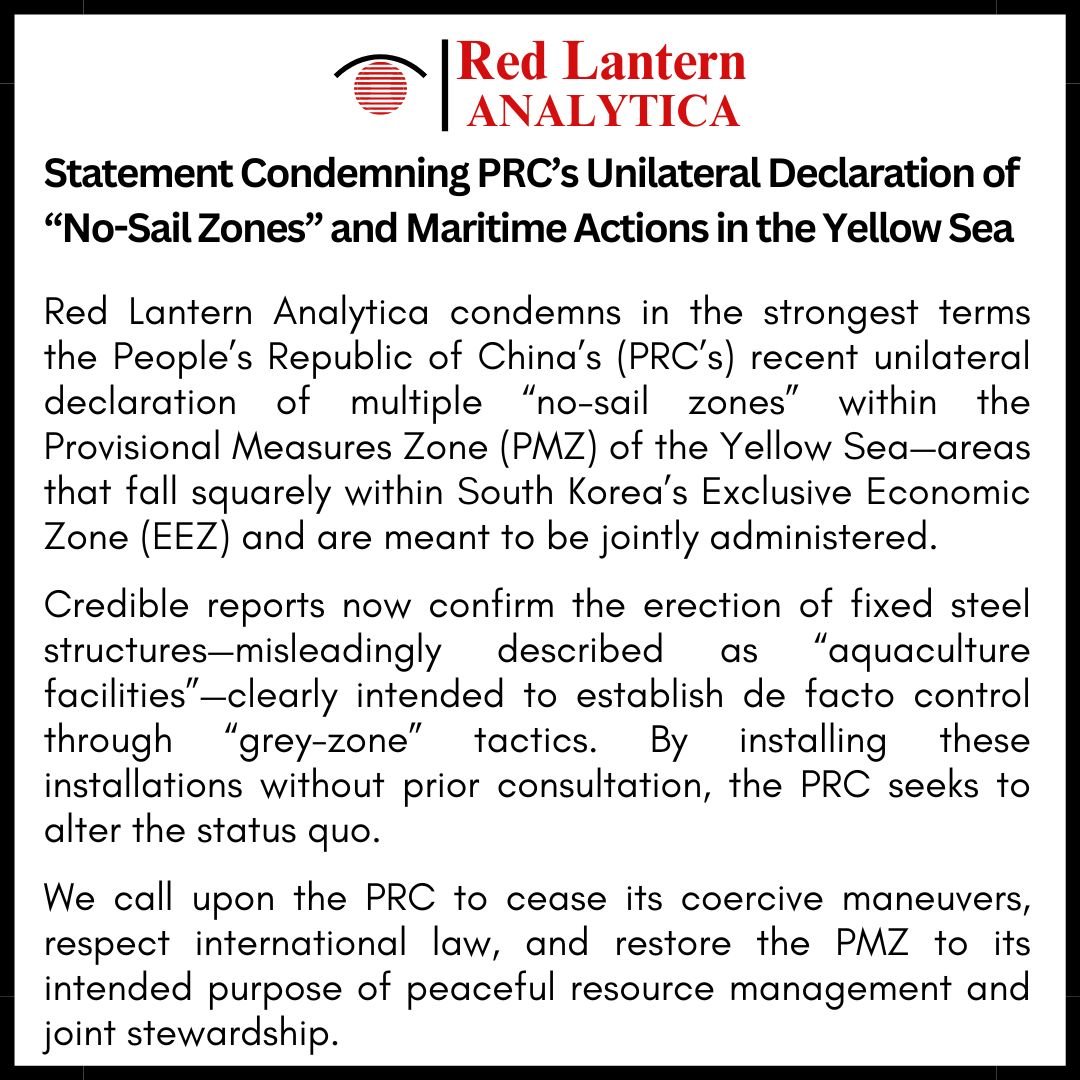
27/05/2025 Red Lantern Analytica (RLA) condemns in the strongest terms the People’s Republic of China’s recent unilateral declaration of multiple “no-sail zones” within the Provisional Measures Zone (PMZ) of the Yellow Sea—areas that fall squarely within South Korea’s Exclusive Economic Zone (EEZ) and are meant to be jointly administered. Beijing’s opaque rationale, reportedly linked to military exercises, flagrantly disregards the 2000 bilateral PMZ agreement and the United Nations Convention on the Law of the Sea (UNCLOS), which guarantees freedom of navigation and resource-sharing in overlapping waters Worse still, credible reports now confirm the erection of fixed steel structures—misleadingly described as “aquaculture facilities”—clearly intended to establish de facto control through “grey-zone” tactics. By installing these installations without prior consultation, the PRC seeks to alter the status quo incrementally, testing the limits of South Korea’s—and the international community’s—willingness to enforce existing norms. RLA underscores that: Unilateral maritime restrictions in overlapping EEZs undermine regional stability and erode the principle of transparent, rules-based cooperation. Military-linked “no-sail zones” severely restrict commercial shipping and fishing activities, threatening economic livelihoods and navigational safety. Grey-zone installations masquerading as civilian infrastructure represent a deliberate attempt to consolidate territorial control without triggering open conflict. Beijing must immediately clarify the purpose, coordinates, and duration of these zones; dismantle unauthorized structures; and engage in genuine, trilateral dialogue with Seoul and other Yellow Sea stakeholders. RLA reaffirms its commitment to democratic values, freedom of navigation, and a rules-based maritime order. We call upon the PRC to cease its coercive maneuvers, respect international law, and restore the PMZ to its intended purpose of peaceful resource management and joint stewardship.

TR
Team Red Lantern AnalyticaAnalyst
arrow_outward
MEDIA COVERAGEMAY 15, 2025
09

Arunachal is India: RLA Rejects China’s Cartographic Provocation

We unequivocally condemn China’s latest attempt to rename locations in Arunachal Pradesh, deeming it vain and preposterous. Under the leadership of the Ministry of External Affairs (MEA), the Government of India has reiterated in clear terms that such “creative naming” exercises do not and cannot alter the immutable fact that Arunachal Pradesh is, has always been, and will always remain an integral part of India. This is not an isolated development. In April 2024, China launched the so-called “Zhanna Provincial Renaming Program”, in which it arbitrarily assigned names to 30 geographical features, including mountains, rivers, and habitations—most of which lie well within Indian territory. India promptly and categorically rejected the move, reaffirming its sovereign claim over the region. China’s such claims hold no ground in international law or historical fact. As India’s External Affairs Minister Dr. S. Jaishankar aptly stated, “If I change the name of your house, will it become mine?” — a sentiment that encapsulates the absurdity of such unilateral assertions. This is not the first time China has resorted to renaming tactics to bolster its territorial claims. Similar lists were released in 2017 and 2021. Each time, India has firmly dismissed these moves as politically motivated attempts to fabricate territorial narratives. Such actions only serve to heighten tensions along the Line of Actual Control (LAC), where both nations have been engaged in protracted discussions aimed at de-escalation and disengagement. Despite existing bilateral agreements, unilateral actions like these continue to undermine the spirit of dialogue and mutual respect. India remains unwavering in its commitment to safeguarding its territorial integrity and sovereignty. We welcome the MEA’s swift and unambiguous rejection of China’s actions, sending a strong message that superficial cartographic maneuvers will not change realities on the ground. Arunachal Pradesh is not just a geographical territory—it is a vital part of India’s national identity, enriched by its culture, heritage, and the patriotic spirit of its people. We stand united in affirming that no amount of nomenclature engineering can dilute India’s rightful and enduring claim over it.

TR
Team Red Lantern AnalyticaAnalyst
arrow_outward
Press Release – Webinar on “Economic Crossroads: How the US-China Trade Rift Shapes India’s Strategic Future”
MEDIA COVERAGEAPRIL 28, 2025
10

Press Release – Webinar on “Economic Crossroads: How the US-China Trade Rift Shapes India’s Strategic Future”

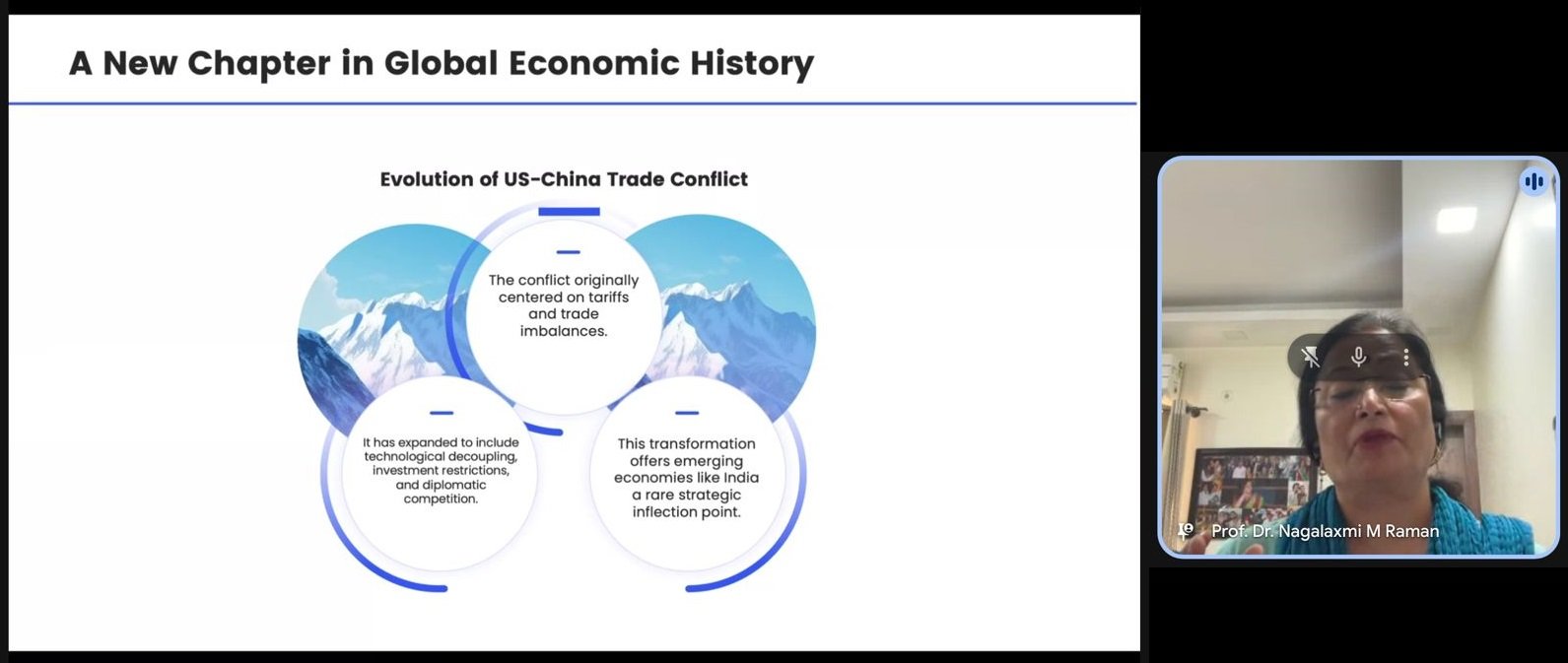
April 27, 2025 In a time when the global economic landscape is undergoing fundamental realignments, Red Lantern Analytica organized a pivotal webinar titled “Economic Crossroads: How the US-China Trade Rift Shapes India’s Strategic Future.” The session brought together distinguished scholars and participants from across India and beyond, reflecting growing recognition that China’s destabilizing economic practices must be strategically countered, and that India’s rise must be firmly anchored on resilience, self-reliance, and global leadership. The event featured keynote addresses by two eminent speakers: Prof. Dr. Nagalaxmi M Raman, Director and Head, Amity Institute of International Studies, Amity University Uttar Pradesh, and Prof. Pavnesh Kumar, Professor, School of Management Studies, Indira Gandhi National Open University. In his welcome address, the Red Lantern Analytica representative emphasized the urgent need for India to view the shifting global economic order not as a mere disruption, but as a historic opportunity to position itself as a manufacturing, services, and strategic powerhouse — a clear rejection of the China-centric economic model that has shown itself to be unreliable and hegemonic. Prof. Dr. Nagalaxmi M Raman, in a detailed presentation, outlined six key dimensions that define India’s emerging role amidst the US-China trade rift. She underlined that the global supply chain realignments triggered by Western distrust of China offer India a once-in-a-generation opportunity to capture critical sectors such as electronics, semiconductors, pharmaceuticals, and renewable energy. Highlighting India’s demographic dividend, expanding digital economy, and strategic Indo-Pacific partnerships, she asserted that India must urgently reform its infrastructure, logistics, and regulatory environment to fully capitalize on these shifts. Dr. Raman warned that although India stands to benefit greatly, deep internal reforms and visionary leadership are imperative. She rightly pointed out that strategic autonomy must remain India’s guiding principle, and the competitive coexistence with China demands both caution and firmness. Prof. Pavnesh Kumar delivered an equally compelling address. With his extensive expertise in international business, he dissected the reasons behind the US-China economic rift, focusing on China’s exploitative trade practices, IP theft, and its loss of global credibility, especially after the COVID-19 pandemic. Prof. Kumar stressed that while global firms are exiting China, India must aggressively court them by providing a business environment marked by political stability, low logistics costs, and skilled human resources. He praised government initiatives like the Production Linked Incentive (PLI) schemes and liberalized FDI norms but cautioned that challenges in infrastructure and skill development still need urgent attention. Highlighting India’s youthful workforce, democratic stability, and strategic location on major global shipping routes, Prof. Kumar asserted that India has all the fundamentals to emerge as a preferred alternative to China — provided reforms are deep, implementation is swift, and policymaking remains investor-friendly yet national-interest driven. Both speakers emphasized that India must not merely aim to be a backup for Western firms leaving China, but should actively aspire to be a global leader in manufacturing, services, technology, and innovation — crafting an independent path and not becoming a cog in China’s game. During the interactive Q&A session, participants posed thoughtful questions regarding India’s potential to emerge as a global strategic leader. Both speakers agreed that while India has the potential, realizing it would depend on relentless pursuit of internal reforms, enhancing ease of doing business, deepening trade ties with trusted democracies, and above all, maintaining strategic clarity against China’s disruptive actions. As an international observers group committed to securing India’s strategic interests, Red Lantern Analytica firmly believes that blind engagement with authoritarian China is not a sustainable path. The emerging world order calls for countries like India to assert their sovereignty, resilience, and economic leadership without succumbing to Chinese manipulation or influence. Key Takeaways from the Session: India must leverage the supply chain diversification away from China and aggressively attract high-value investments. Building infrastructure, reforming land and labor laws, and skill enhancement are critical prerequisites. Strategic autonomy and balanced global partnerships (not China-centric dependencies) must remain central. India’s digital economy and manufacturing sectors must be globally competitive, innovative, and resilient. China’s model of coercive economics is unsustainable; India must present itself as the trustworthy alternative for the world.

TR
Team Red Lantern AnalyticaAnalyst
arrow_outward
Statement on India’s Decision to Rescind the Transshipment Facility for Bangladesh’s Export Cargo
MEDIA COVERAGEAPRIL 10, 2025
11

Statement on India’s Decision to Rescind the Transshipment Facility for Bangladesh’s Export Cargo

April 9, 2025 Red Lantern Analytica (RLA) notes with affirmation the Government of India’s recent decision to withdraw the transshipment facility for Bangladesh’s export cargo to third countries via Indian territory. This development comes in the backdrop of evolving strategic considerations in South Asia and renewed geopolitical assertions by Bangladesh in concert with external actors. As a sovereign nation with legitimate security interests, India has consistently demonstrated a commitment to regional connectivity, economic integration, and support for its neighbors. However, regional cooperation must be anchored in mutual respect, sensitivity to strategic red lines, and an appreciation of the complex geography and security architecture of South Asia—particularly in the fragile and vital Northeast Indian corridor. The recent comments by Professor Muhammad Yunus during his visit to China—advocating for Bangladesh’s strategic positioning as a maritime conduit for Chinese economic expansion into India’s landlocked Northeast—are deeply concerning. Such assertions risk undermining decades of goodwill, connectivity frameworks, and shared development goals fostered between India and Bangladesh. The proposition of extending Chinese influence into India’s sensitive Siliguri Corridor—often termed the ‘Chicken Neck’—is not only strategically provocative but misaligned with the spirit of regional trust and cooperation. India’s calibrated decision to rescind the 2020 transshipment circular underlines the importance of preserving strategic balance and safeguarding its territorial integrity while remaining committed to WTO norms and its broader regional obligations. It also serves as a reminder that transit privileges, while extended in good faith, are not to be misconstrued as avenues for strategic leverage. RLA encourages all regional stakeholders to pursue economic and strategic dialogues that enhance mutual trust, ensure transparency, and strengthen sovereign security concerns—particularly in geopolitically sensitive regions. Respectful engagement and adherence to shared norms must remain the foundation of regional partnerships in South Asia.

TR
Team Red Lantern AnalyticaAnalyst
arrow_outward
Diplomacy, Defence and Cybersecurity take centre stage at Siang Dialogue 2.0
MEDIA COVERAGEFEBRUARY 12, 2025
12

Diplomacy, Defence and Cybersecurity take centre stage at Siang Dialogue 2.0

New Delhi, February 11 : Red Lantern Analytica inaugurated its flagship event, Siang Dialogue 2.0, at the Foreign Correspondents’ Club – South Asia on February 8, bringing together policymakers, thought leaders, and academics to discuss pressing global challenges. The two-day event commenced with a ceremonial lamp lighting. Rajya Sabha MP Sujeet Kumar highlighted India’s growing soft power and its active diplomatic initiatives. Abdulhakim Idris, Executive Director of the Centre for Uyghur Studies, focused on the human rights crisis in Xinjiang, while Aadil Brar, a journalist based in Taiwan, discussed India’s border challenges, particularly China’s military presence along the Line of Actual Control (LAC). The first plenary session, “Navigating the Indo-Pacific: Strategic Maritime Security Dynamics,” featured Roger Chi Liu from Sun Yat-sen University, who emphasized collaboration between India and Taiwan in marine research and disaster management. Other speakers, included Jaydev Ranade, President of the Centre for China Analysis and Strategy, analyzed China’s foreign policy under Chinese President Xi Jinping, while NC Bipindra, Editor of Defence Capital, explored India’s countermeasures to China, such as cyber defense and bypassing the “Great Firewall.” The second plenary session, “Shaping the Future: India’s Role in a Transforming Global Order,” saw discussions on India’s economic ties with Southeast Asia, territorial disputes with China, and the growing influence of China, Pakistan, and Bangladesh in the region. Major Amit Bansal analyzed India’s strategic role as a net security provider in the Indo-Pacific, and Lt General Rakesh Sharma discussed the evolving nature of warfare, including information and space warfare. On the second day, discussions centered on building resilient economies and mitigating cyber threats. Paul, Editor of Greek City Times, proposed the India-Middle East-Europe Economic Corridor (IMEC) as an alternative to China’s Belt and Road Initiative. In a session on cyber security, experts like Jayanta Kalita and Namrata Hasija focused on China’s use of AI and disinformation to shape global narratives. The event concluded with a valedictory session where Arunachal Pradesh MLA Shree Ninong Ering, emphasized the need to counter Chinese authoritarianism and build resilience to global challenges.

TR
Team Red Lantern AnalyticaAnalyst
arrow_outward
Statement on China’s Actions Concerning the Brahmaputra Dam and Aksai Chin Counties
MEDIA COVERAGEJANUARY 4, 2025
13

Statement on China’s Actions Concerning the Brahmaputra Dam and Aksai Chin Counties

Red Lantern Analytica strongly condemns China’s unilateral actions regarding the construction of a $137 billion dam on the Brahmaputra River near the Indian border and the establishment of two new counties in Aksai Chin (India’s Kashmir in occupation by Chinese forces). Such actions are blatant violations of India’s sovereignty and demonstrate a clear intent to undermine bilateral relations and regional peace. The Brahmaputra dam project raises serious ecological, hydrological, and geopolitical concerns. India unequivocally demands that China ensures no harm to downstream states, adheres to international conventions, and engages transparently with affected countries. China proceeded with the Brahmaputra dam approval, bypassing established conventions by failing to provide India with prior notice or consultation. Additionally, the establishment of new counties in the Aksai Chin region -He’an County and Hekang County further aggravates tensions by seeking to legitimize its illegal occupation of Indian territory violates India’s sovereignty. Aksai Chin is integral to India’s Union Territory of Ladakh, and China’s attempt to legitimize its occupation is unacceptable. India reaffirms that such actions are illegal and unjustified, and a formal protest has been lodged. Red Lantern Analytica urges China to cease its aggressive expansionism, respect international law, and engage in meaningful dialogue. India reserves its right to take all necessary measures to safeguard its territorial integrity and water security.

TR
Team Red Lantern AnalyticaAnalyst
arrow_outward
Statement Condemning Military Crackdown in Pakistan over civilians supporting the Ex-PM
MEDIA COVERAGEDECEMBER 27, 2024
14

Statement Condemning Military Crackdown in Pakistan over civilians supporting the Ex-PM

We at Red Lantern Analytica express our deep concern over the military court convictions of 85 civilians, including 60 announced on Thursday, for their participation in pro-Imran Khan protests. These trials, conducted in secrecy and devoid of judicial independence and transparency, undermine the fundamental rights of citizens and erode public trust in the rule of law. The use of military courts to try civilians for political dissent sets a dangerous precedent and reflects a troubling slide in Pakistan’s adherence to democratic norms. The lack of transparency in these proceedings, as highlighted by international condemnation from the United States, European Union, and the United Kingdom, underscores the urgent need for accountability and judicial reform. We strongly urge Pakistan’s leadership to uphold its constitutional commitments, ensuring that all citizens have access to fair trials in civilian courts. The international community must pay close attention to these developments and engage constructively to safeguard democratic principles in Pakistan. The ongoing crackdown on opposition voices, including former Prime Minister Imran Khan and his supporters, threatens the very fabric of democratic governance. It is imperative that the global community works collectively to support a free, fair, and transparent political environment in Pakistan. Red Lantern Analytica remains steadfast in its commitment to advocating for the rule of law, democratic values, and human rights worldwide.

TR
Team Red Lantern AnalyticaAnalyst
arrow_outward
Statement welcoming US sanctions on 4 Pakistan’s entities aiding its ballistic missile program
MEDIA COVERAGEDECEMBER 19, 2024
15

Statement welcoming US sanctions on 4 Pakistan’s entities aiding its ballistic missile program

We welcome the United States’ decisive action in sanctioning four entities contributing to Pakistan’s ballistic missile program. This proactive step underscores the critical importance of addressing proliferation risks that undermine regional and global security. Pakistan’s continued development of long-range ballistic missile capabilities poses a significant threat to South Asia. Pakistan’s National Development Complex – which is responsible for Pakistan’s ballistic missile program and has allegedly worked to acquire items to advance Pakistan’s long range ballistic missile program through Affiliates International, Akhtar and Sons Private Limited, and Rockside Enterprise. These according to the U.S. officials, have worked to supply equipment and missile-applicable items to Pakistan’s ballistic missile program, including its long range missile program The designation of entities such as the National Development Complex, Affiliates International, Akhtar and Sons Private Limited, and Rockside Enterprise highlights the persistent challenges of procurement networks facilitating the proliferation of weapons of mass destruction. Red Lantern Analytica commends the United States for demonstrating its commitment to curbing such activities through robust sanctions and constructive engagement with Pakistan. We believe this move reinforces the global non-proliferation framework and sends a clear message to those seeking to evade international norms. We encourage continued vigilance and collaborative efforts among the international community to counter the proliferation of technologies that threaten peace and security. Furthermore, we urge Pakistan to prioritize transparency and compliance with global non-proliferation standards, fostering a more stable and secure South Asia.

TR
Team Red Lantern AnalyticaAnalyst
arrow_outward
Statement on the Humanitarian Crisis in Syria
MEDIA COVERAGEDECEMBER 9, 2024
16

Statement on the Humanitarian Crisis in Syria

The recent developments in Syria mark a pivotal moment in the nation’s history, as the capital, Damascus, witnesses profound change after years of conflict. While this transition signifies the end of a prolonged era of suffering for many, it also underscores the urgent need to address the vast humanitarian crisis that continues to devastate the Syrian people. Over the past 13 years, Syria has endured immense hardship. Hundreds of thousands have lost their lives, millions have been displaced, and countless families remain in dire need of assistance. The collapse of basic infrastructure, limited access to healthcare, and the destruction of homes have left a lasting impact on communities across the country. As the situation evolves, the international community must prioritize humanitarian aid and support for those affected by this enduring conflict. Efforts should focus on ensuring safe and unhindered access for relief organizations, providing food, medical care, and shelter to the displaced, and fostering a pathway to stability and recovery. We urge all nations, humanitarian organizations, and stakeholders to come together in a spirit of unity and compassion. The Syrian people deserve the chance to rebuild their lives in dignity and peace. This is not just a call to action but a moral imperative to stand with those who have suffered the most. Let us remain vigilant, committed, and focused on alleviating the suffering of millions while supporting a peaceful and inclusive future for Syria.

TR
Team Red Lantern AnalyticaAnalyst
arrow_outward
Red Lantern Analytica Condemns Aggressive Territorial Claims of the PRC by Unilateral Renaming of islands and reefs in the South China Sea
MEDIA COVERAGENOVEMBER 12, 2024
17

Red Lantern Analytica Condemns Aggressive Territorial Claims of the PRC by Unilateral Renaming of islands and reefs in the South China Sea

Red Lantern Analytica deplores People’s Republic of China’s announcement of renaming of various islands and reefs in the South China Sea by it’s Ministry of Natural Resources and the Ministry of Civil Affairs. The PRC has also released the so-called map of territorial baselines around the Scarborough Shoal. This is in continuation with the Chinese Communist Party’s (CCP) unilateral attempts to claim the entirety of South China Sea. After the PRC government released a new so-called national map last year that demarcated its unlawful claim to the South China Sea by vague dash lines, this is an extension of CCP’s constant actions to solidify its superfluous assertions. It’s clear that the PRC has published the names of places in the South China Sea as a move against the Philippines’ “Maritime Areas Act” and the “Archipelago and Sea Lanes Act”. However, PRC maintains an innocuous image by stating that the renaming is “a national effort to standardize the management of place names” including spots that “have existed for hundreds of years,” thereby pretending to be a victim rather than the aggressor. Such a move of unilaterally naming places not only violates the territorial sovereignty and integrity of states but is also violative of international law. Feeding on CCP’s hegemonic ambitions, such acts are culpable for regional instability as they are inadvertently forced on other countries. Red Lantern Analytica vehemently condemns the published names in this so-called map, of some islands and reefs in South China and strongly opposes the PRC tactics of militarizing the islands of South China Sea.

TR
Team Red Lantern AnalyticaAnalyst
arrow_outward
Statement Welcoming former UK Prime Minister David Cameron’s statement on India’s Inclusion in the UNSC
MEDIA COVERAGEOCTOBER 24, 2024
18

Statement Welcoming former UK Prime Minister David Cameron’s statement on India’s Inclusion in the UNSC

Red Lantern Analytica heartily welcomes the former Prime Minister of the United Kingdom, David Cameron’s support and advocacy for India’s permanent membership in the United Nations Security Council. Mr. David Cameron expressed his belief in the “Indian Century” way back during this term of PM office in 2010. The former UK PM also believes that India is credible enough to mediate the Russia- Ukraine war. He further added that India, being the largest democracy and likely to be the largest economy in this century, must be assured of a permanent seat. He rightly remarked that,“A Permanent Seat on the Security Council should be India’s Right”. The question of including India in the UNSC permanent member list has garnered complete support from four permanent members as of now. The inclusion of India would be a step towards making the UNSC a more inclusive, just and representative body. China, due to its complex relationships with most of the Asian countries, is unable to play the role of a representative of the Asian countries. So, India, being a responsible and a democratic nation with regional compatibility, alternatively can emerge as the voice of the Global South and the developing world. Now that the question of India’s permanent seat rises again, this opportunity should not be missed once more!

TR
Team Red Lantern AnalyticaAnalyst
arrow_outward
Statement Welcoming the opening of the Taipei Economic and Cultural Centre (TECC) in Mumbai
MEDIA COVERAGEOCTOBER 21, 2024
19

Statement Welcoming the opening of the Taipei Economic and Cultural Centre (TECC) in Mumbai

Red Lantern Analytica extends a warm welcome and sincere gratitude to Taiwan for opening their third office of the Taipei Economic and Cultural Centre (TECC) in Mumbai, India. It is a step to further bolster India-Taiwan relations and improve bilateral trade, technological, and cultural ties which began in 1995. Trade between India and Taiwan amounted to $10.1 billion as of the fiscal year ending in March 2024, with both ways of trade amounting to more than $ 8 billion in 2023, thereby making India its 12th largest export market. This opening occurs amidst a joint venture of Taiwan’s Power Chip Semiconductor Manufacturing Corporation and India’s Tata Electronics to manufacture semiconductors in Gujarat. This is a way of reinforcing Taiwan’s “New Southbound Policy” and India’s “Act East Policy”. India and Taiwan’s collaboration in trade, investment, education, technology, and tourism shows their unfailing ties. The opening of the new office of TECC in Mumbai further boosts investment opportunities and deepens bilateral ties. The recent lodging of Chinese diplomatic protest with India over the newly established office of the Taipei Economic and Cultural Centre (TECC) of Taiwan in Mumbai is uncalled for since the deepening of ties between any two countries includes the establishment of such representative offices for each other. It’s high time for a stronger India-Taiwan Relationship as this also reflects India’s unwavering support for Taiwanese cause. RLA is in solidarity with the people of Taiwan and condemns any provocative Chinese comments involving India-Taiwan relations. Also, we would urge the world to engage more with TECC as they are the diplomatic voice of the free people of Taiwan.

TR
Team Red Lantern AnalyticaAnalyst
arrow_outward
Statement on Beijing’s Pressure Tactics towards Foreign Lawmakers attending IPAC Taiwan Summit 2024 in Taipei
MEDIA COVERAGEJULY 28, 2024
20

Statement on Beijing’s Pressure Tactics towards Foreign Lawmakers attending IPAC Taiwan Summit 2024 in Taipei

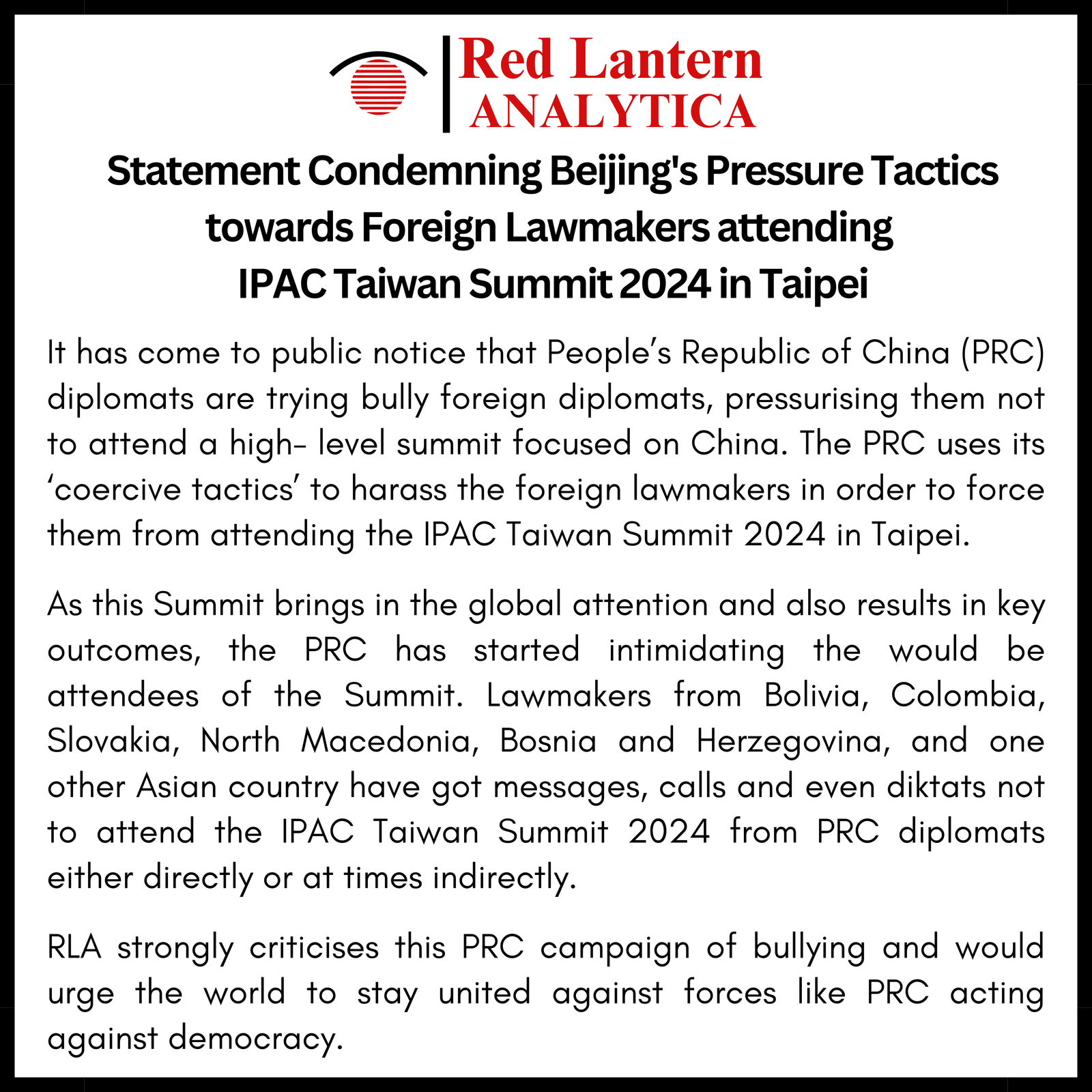
It has come to public notice that People’s Republic of China (PRC) diplomats are trying to bully foreign diplomats, pressurising them not to attend a high- level summit focused on China. The PRC uses its ‘coercive tactics’ to harass the foreign lawmakers in order to force them from not attending the IPAC Taiwan Summit 2024 in Taipei. IPAC Taiwan Summit 2024 is the annual parliamentarian summit organised by the Inter-Parliamentary Alliance on China (IPAC), an international organisation bringing together legislators from many countries, with a stated objective to uphold the rules-based system. This Summit gathers elected representatives from more than 20 countries making it the largest delegation of foreign parliament members ever to attend Taiwan. As this Summit brings in the global attention and also results in key outcomes, the PRC has begun to exert its undue influence. It has started intimidating the attendees participating in the Summit. Lawmakers from Bolivia, Colombia, Slovakia, North Macedonia, Bosnia and Herzegovina, and one other Asian country have got messages, calls and even diktats not to attend the IPAC Taiwan Summit 2024 from the PRC diplomats either directly or at times indirectly. The PRC’s tactics are autocratic because these messages impose absence. These egregious attempts to interfere into the domestic affairs of other countries, and also isolate Taiwan at the International level by the PRC exposes it’s hegemonic intentions. PRC’s hegemonic toolkit includes- plans to cut off the diplomatic partners of Taiwan, sending warnings to would be attendees who engage with Taiwan, dissuading countries from having economic exchanges with Taiwan, and punishing countries by sanctioning them if they establish relations with Taipei. The PRC also often seeks re-affirmations from countries to adhere to its so-called ‘One-China’ policy. However, this time, it has only bolstered the tenacity for the legislators to partake in the IPAC Taiwan Summit 2024 discussions in Taipei. RLA strongly criticises PRC’s campaign to dissuade representatives and confirm their absence at the gatherings in Taiwan. It’s high-time for the PRC to accept the reality that Taiwan is a democratic country which cannot be undermined by such Chinese Communist Party (CCP) directed influence operations. The PRC’s interference in the domestic affairs of other countries is also unfortunate and we urge the world to stay united against forces acting against democracy.

TR
Team Red Lantern AnalyticaAnalyst
arrow_outward
Statement Welcoming the U.S. Legislation ‘Resolve Tibet Act’ supporting the Rights of Tibetans
MEDIA COVERAGEJULY 14, 2024
21

Statement Welcoming the U.S. Legislation ‘Resolve Tibet Act’ supporting the Rights of Tibetans

Red Lantern Analytica extends a warm welcome and offers sincere gratitude to the United States for passing the legislation ‘Promoting a Resolution to the Tibet-China Dispute Act’ also known as the Resolve Tibet Act. This legislation by the U.S. represents a pivotal moment in advocating for the rights and autonomy of the Tibetan people. This act has strengthened the U.S. support for Tibet and fostered discussions between the PRC and His Holiness the 14th Dalai Lama aimed to peacefully resolve disputes regarding status and governance. The Act also empowers the U.S. to counter PRC’s propagation of disinformation about the history of Tibet, the Tibetan people, and Tibetan institutions, including that of the Dalai Lama by the Chinese Communist Party (CCP). This legislation advances support to Tibetan people to preserve their distinct religious, cultural, linguistic and historical identity, which has been systematically suppressed by the CCP’s policies. The U.S. promotes direct dialogue without preconditions between the PRC and the Dalai Lama, his representatives or democratically elected leaders of the Tibetan community to achieve a negotiated settlement on Tibet. As an organisation dedicated to fostering peaceful resolutions and upholding human rights, we extend our support for the Resolve Tibet Act’s objective to empower the Tibetan people to preserve their distinct identity. The Resolve Tibet Act is a significant move that aligns with international principles of human rights and self-determination. We believe that sustained international pressure and advocacy are crucial in compelling the PRC to engage in meaningful negotiations, ensuring a fair and just resolution for the Tibetan people. RLA stands in solidarity with the Tibetan people and commends the U.S. for its unwavering commitment to justice, human rights and self-determination. We urge the international community to support this landmark legislation and join the call for a Free Tibet.

TR
Team Red Lantern AnalyticaAnalyst
arrow_outward
Statement welcoming the U.S. Delegation meeting H.H. Dalai Lama at Dharamshala in India
MEDIA COVERAGEJUNE 19, 2024
22

Statement welcoming the U.S. Delegation meeting H.H. Dalai Lama at Dharamshala in India

On 19th June, a bipartisan US delegation led by former U.S. House Speaker Nancy Pelosi and Michael McCaul, the Republican chair of the House Foreign Affairs Committee, met the Tibetan spiritual leader, the 14th Dalai Lama in Dharamshala, India. This comes in line with the U.S. recently legislated ‘The Resolve Tibet’ Act by which the stance of the U.S. has been clearly delivered to the People’s Republic of China (PRC) that America stands with the people of Tibet against its illegal occupation of Tibet by the Chinese Communist Party (CCP) led PRC. The People’s Liberation Army (PLA) of People’s Republic of China invaded Tibet in 1950 after which their agenda of sinicization of Tibet has been running in its full fervour. Tibet has been eroded of social stability and harmony by the rising CCP authoritarianism in the region. A recent report by the human rights experts of the UN revealed the various oppressive practises the CCP has been inflicting upon Tibetans, in the form of forced assimilation of the Tibetan identity into the dominant Han identity of mainland China. Millions of ethnic Tibetan children are separated from their families early on to be sent to boarding schools funded by the CCP where they are taught Mandarin and brainwashed to embrace the Chinese culture; as a result of which the new generations have lost their ability to speak fluently in their own language and know little about their own-Tibetan history, culture and religion. Moreover, the PRC also vies for the rich natural resources of the Tibet and exploits them for its own authoritarian ambitions. It has disrupted the ‘Water Tower of Asia’ with its infrastructural activities and controlled the hydrological data and the flow of the rivers to disrupt the countries that are dependent on these rivers. Thus, the CCP ignores culture, identity, language and livelihoods to fulfil its hegemonic expansion. As the Indo-Tibet border disputes remain pertinent (the Tibet side being under control of the PRC), the reassertions of the PRC’s territorial dominance over Tibet is intensifying. At such a juncture, the U.S. delegation brings a fresh blow of progress in the efforts to contain and suppress PRC’s fiendish efforts to erode Tibet’s identity. The PRC has warned the U.S. of “So-called resolute measures” to firmly defend its sovereignty, security and development interests if the new ‘Tibet-China dispute bill’ is signed into law by the US President. However, the fact remains that the CCP has been and is committing gross human rights violations and other atrocities that the Tibetans are being subjected to for so many decades now and this must cease. Red Lantern Analytica extends its dedicated support and commitment to finding solutions to the longstanding Tibet’s occupation by the PRC and requests the global community stay vocal against the tyranny of the CCP-led PRC.

TR
Team Red Lantern AnalyticaAnalyst
arrow_outward
Statement condemning PRC’s stand over Indian PM’s reply to Taiwanese President’s greetings
MEDIA COVERAGEJUNE 9, 2024
23

Statement condemning PRC’s stand over Indian PM’s reply to Taiwanese President’s greetings

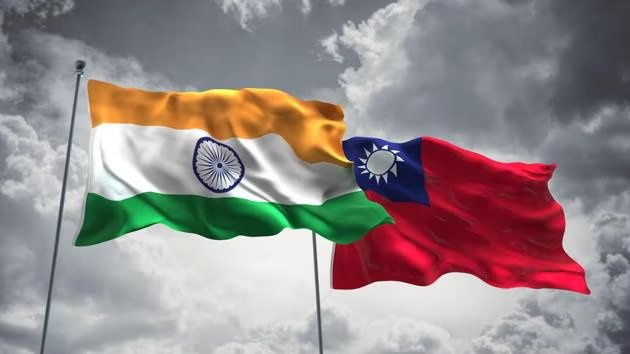
We strongly condemn People’s Republic of China’s (PRC) irrational behaviour in protesting a cordial exchange between the leaders of two democracies, namely India and Taiwan. The recent protest lodged by the PRC over Prime Minister Narendra Modi’s social media interaction with Taiwan President Lai Ching te is unjustified and unwarranted. It is disappointing that the PRC wants to assert control over India’s diplomatic engagements and attempts to dictate terms on whom India can communicate with. It is important to clarify that India’s relationship with Taiwan is based on mutual respect and shared interests, and does not necessitate PRC’s permission or approval. India upholds the principles of sovereignty and independent foreign policy decisions and will continue to engage with nations worldwide, including Taiwan, in the pursuit of national interests. The exchange of congratulatory messages between Prime Minister Modi and President Lai was simply ceremonial and reflects the spirit of mutual respect and goodwill between the two democracies. There is no justification for PRC’s exaggerated reaction and interference in India’s diplomatic affairs. PRC’s insistence on protesting such harmless exchanges only underscores its inability to tolerate the diplomatic freedom of other nations and its refusal to acknowledge Taiwan’s rightful place as a democratic entity on the global stage. India believes in fostering friendships based on mutual respect, shared values, and mutual benefit. Coercion and intimidation have no place in diplomatic relations, and India remains committed to building partnerships with Taiwan and other nations based on these principles. India reiterates its commitment to maintaining independent and sovereign relations with all nations, including Taiwan. It is well within India’s rights to engage with Taiwan on matters of mutual interest without seeking China’s permission. The One China principle, while respected by many nations, does not impede India’s right to engage with Taiwan on non-official, ceremonial matters. We call upon the PRC to respect India’s and Taiwan’s sovereignty and independence and to refrain from interfering in their diplomatic affairs. We stand firm in our commitment to upholding the principles of democracy, freedom and sovereignty in the face of unjustified opposition.

TR
Team Red Lantern AnalyticaAnalyst
arrow_outward
Statement over Egypt signing agreement with PRC on Belt and Road Initiative (BRI)
MEDIA COVERAGEJUNE 1, 2024
24

Statement over Egypt signing agreement with PRC on Belt and Road Initiative (BRI)

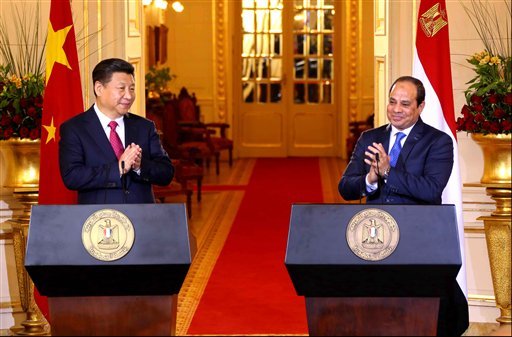
There were recent reports of Egypt signing a package of agreements with the People’s Republic of China (PRC) including the joint development plan for the Belt and Road Initiative. We urge Egypt to carefully evaluate the potential risks involved in agreements with the PRC under the Belt and Road Initiative (BRI) framework. The recent signing of joint agreements under the BRI between the PRC and the Arab Republic of Egypt has sparked concern regarding impact of Chinese-led initiatives. While Egypt has been a signatory of the BRI since 2016, questions arise about the credibility and effectiveness of PRC’s promises within this framework. The PRC’s over-promising and under-delivering track record with the BRI, coupled with significant international backlash, raises doubts about the true intentions behind these agreements. The rebranding of the BRI from the “project of the century” to “small and beautiful” appears more like a strategic maneuver to navigate criticism rather than a genuine commitment to sustainable development. Despite the joint agreements covering various sectors such as transportation, energy, and infrastructure, concerns persist about the lack of transparency and accountability within Chinese-led projects. Reports of distressed borrowers, unfinished projects, and compromised democratic values cast a shadow over the BRI’s legitimacy and effectiveness, especially in the Developing countries. Egypt should take heed of Italy’s example and thoroughly scrutinize the terms and conditions of any proposed BRI projects to ensure they align with the country’s strategic interests and uphold its sovereignty. Recently, Italy’s decision to withdraw from BRI agreements highlights the significance of conducting thorough evaluations and due diligence when entering into such partnerships. While infrastructure development is essential for economic growth, it is imperative that nations prioritize transparency, accountability, and long-term sustainability in their collaborative endeavors. Furthermore, the ambiguity surrounding the distinction between bilateral agreements and BRI projects raises serious questions about PRC’s motives and the true beneficiaries of these initiatives. The absence of formal rules and membership protocols within the BRI framework only adds to the skepticism surrounding PRC’s intentions. As Egypt contemplates its choices for infrastructure development and foreign investment, we urge the Egyptian government to explore a wide range of partnerships and financing mechanisms that prioritize mutual respect, transparency, and sustainable development. We would also request the Egyptian government to reconsider its decision on the BRI and avoiding any financial partnership with the PRC.

TR
Team Red Lantern AnalyticaAnalyst
arrow_outward