
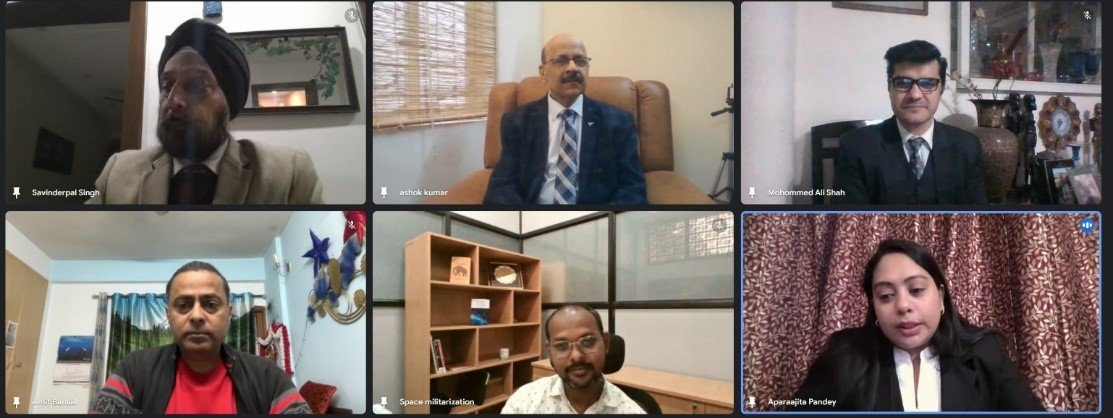
Press Release of Book discussion Session on ‘China Betrays Again’
Untraditional Security

Press Release of Book discussion Session on ‘China Betrays Again’

TR

Team Red Lantern Analytica

Directorate of Intelligence

Share:

On January 28, 2024, Red Lantern Analytica hosted a Book discussion on ‘China Betrays Again’. Maj. Gen. Ashok Kumar VSM, Author of the Book, Kargil War Veteran & Military Expert; Air Commodore S.P. Singh VSM, Strategic Analyst & Senior Fellow at Centre For Air Power Studies (CAPS); Major Amit Bansal, Defence Strategist and War Veteran; Major Aparajita Pandey, Army Officer (Retd.) and Cyber Expert and Dr Vinay Kumar, Assistant Professor at National Law University, Aurangabad were the expert speakers of the webinar.

Air Commodore S.P. Singh hailed the Book ‘China Betrays Again’ as the best on the India-China subject highlighting its comprehensive analysis of every issue in great detail. He elaborated on how the book offers in-depth insight into various aspects of India and China relations ranging from Buddhism to how the countries became victims of imperialism and all the conflicts after 1947.

Air Commodore Singh stressed on various issues which are the bone of contention between India and China in modern times. He mentioned that, in 1987, Arunachal Pradesh attained statehood, the problems between India and China surged and after that relations didn’t turn back to normal. He further added that after Pokhran, tensions grew even further. The other issues which impact India and China relations adversely include China opposing the proposal by India to blacklist the Pak-based Jaish-e Mohammed terrorist Mashoor Azhar case in the UN, China’s tilt towards Pakistan since 1962, China-Pakistan Economic Corridor (CPEC), string of pearls, border dispute, standoff along the border, etc. “India joining various multilateral forums I2U2, QUAD, Joint military exercise with Japan and France, etc. is helping the £Indoa to deter China,” asserted Mr Singh. He also added that India’s self-reliance in defence manufacturing has given India little edge in dealing with India. “There is a need to increase our diplomatic, multilateral forums and economic reach to keep a check on China and have a peaceful border,” he expressed. Mr Singh concluded by stating that the book is a great asset for all those who want to learn more about China and an absolute must-read. It will be of great help to academicians and MEA officials as well.

Maj. Gen. Ashok Kumar rejoiced, “The book is very close to his heart as it is his very first book.” He then mentioned instances when the Indian Army countered China successfully along the border after the 1962 debacle. He said that China faced humiliation at the hands of the Indian Army in the Nathu La in 1967 and the Sumdorong Chu standoff in 1986-87. Maj. Gen. Kumar said, “Our knowledge about China is very weak, be it among youth or defence officials. We can correct this only by adopting a whole of nation approach. In dealing with China, we need a 1971 war-like approach where we liberated East Pakistan in just 14 days and a new country was made.” He further added, “It is the character of China to backstab friends. An example of this is how China made Sri Lanka a victim of its debt-trap policy.”

Maj. Gen. Kumar while shedding light on China’s expansionist agenda noted that China has been troubling all its neighbours since 1947. It has captured Tibet, Xinjiang, Inner Mongolia, and islands in the South China Sea. “China’s map used to be small in 1947 but now it has grown larger by occupying other nations and regions forcefully”, he articulated. On India and China, he said that it is not a territorial issue but a sovereignty issue. “The buffer zone policy is disadvantageous to India.” Maj. Gen. Kumar briefly elaborated on the various topics including Line of Actual Control (LAC), the Siachen dispute, the Kargil war, the Land Boundary Law which came into act in China in October 2021, CPEC, the South China issue, etc in the book.

Major Amit Bansal stated, “Every article in the book is a small book in itself. It is a comprehensive book and a must read for everyone.” He added, “China has border disputes with all its neighbours – like disputes with Russia over an island and Amur-Argun Rivers, Border dispute with Mongolia, North Korea over Tumen River and the list goes on because this is China’s nature. It is the Chinese Communist Party (CCP) strategy to keep disputes open to backstab its friends as and when the right times come.” He then mentioned that China’s dispute with India is not just a territorial dispute, it is an economic dispute and a quest to become Asia’s sole superpower. “Each and every article of the book is a must-read to understand China’s ambitions and how its strategy with respect to India is working out,” he concluded.

Major Aparajita Pandey said, “The book will help policymakers, defence officials and academicians to better understand the India-China issue and deal with China more efficiently going forward.”“There is a long-standing struggle between China’s neighbours. China has territorial disputes with all its neighbours, along with maritime disputes with almost all countries – Japan, South Korea, Taiwan, Vietnam, the Philippines, etc,” affirmed Dr Vinay Kumar. He mentioned how China has reacted aggressively on almost every issue with India even when India has always shown a hand of cooperation and peace, for instance Panchsheel agreement and many more. He added that this book has covered a comprehensive Chinese foreign policy towards India and how to counter China’s territorial ambitions in the future.

Following the guest speaker’s address, there was an in-depth Q&A session. Maj. Mohd. Ali Shah, Former Army Officer and Motivational Speaker moderated the session. Ms Kritika Rajput, Research Associate at Red Lantern Analytica delivered the vote of Thanks. The session closed after the vote of thanks was given.

Related Intelligence

UNTRADITIONAL SECURITYOCTOBER 13, 2026
01

Why Calls to Revive SAARC Are About More Than Regional Cooperation

Why Calls to Revive SAARC Are About More Than Regional Cooperation Geopolitical positioning, institutional paralysis and the case for practical South Asian cooperation Rationale Founded in Dhaka in December 1985, SAARC brings together Afghanistan, Bangladesh, Bhutan, India, Maldives, Nepal, Pakistan and Sri Lanka. Its charter seeks to improve living standards, accelerate economic and social development, and strengthen collective self-reliance. Yet the organisation’s last summit was held in Kathmandu in November 2014. The 2016 Islamabad summit did not take place amid deteriorating India–Pakistan relations and the withdrawal of several participating states from the process. The result has been a prolonged institutional freeze, even as cross-border problems have become harder to manage in isolation. [1][2] The article notes call from Bangladesh and Maldives for SAARC to return to the negotiating table, alongside support for renewed regional engagement from Nepal and Bhutan. Bangladesh has also argued that SAARC and the Bay of Bengal Initiative for Multi-Sectoral Technical and Economic Cooperation (BIMSTEC) should work alongside one another rather than be treated as alternatives. Such statements matter, but a call for revival is not the same as an agreed roadmap, and neither necessarily indicates a willingness to resolve the political disputes that have paralysed the organisation. 1. The central obstacle is political, not merely administrative SAARC’s institutional design makes political goodwill indispensable. Article X of its charter requires decisions at every level to be unanimous and excludes bilateral and contentious issues from deliberations. The exclusion was intended to protect regional cooperation from being overwhelmed by disputes between neighbours. In practice, however, the combination of unanimity and deep bilateral mistrust has made it difficult to move forward when even one member is unwilling to participate. [1] This is the organisation’s central paradox: SAARC is designed to keep contentious disputes outside the room, but those disputes can determine whether the room is convened at all. India–Pakistan tensions have repeatedly obstructed summit-level engagement, while the deterioration of Pakistan–Afghanistan relations adds another layer of friction. The consequences are not confined to diplomacy. When leaders cannot meet, it becomes harder to secure political direction, approve ambitious initiatives and reassure officials that cross-border projects will survive the next crisis. Still, it would be too simple to attribute SAARC’s paralysis exclusively to one bilateral relationship. The consensus rule gives every member a veto, and weak implementation, limited institutional resources, uneven political commitment and low levels of regional economic interdependence have also constrained the organisation. A serious revival therefore requires more than a summit announcement. It requires a minimum political understanding that technical cooperation should continue even when high-level relations are strained. 2. Regionalism is also a tool of geopolitical balancing Smaller South Asian states do not make foreign-policy choices in a vacuum. They seek investment, infrastructure, security partnerships, market access and diplomatic support from multiple partners. China’s economic presence, the continuing importance of the United States, ties with Gulf countries and links with Southeast Asia all shape the choices available to governments across the region. Building such relationships is not, by itself, evidence of disloyalty to South Asian cooperation. It is a normal form of strategic diversification. The geopolitical question is how governments use these relationships. A renewed appeal to SAARC can help a state demonstrate that it wants a voice in regional affairs, avoid being seen as dependent on a single partner, or signal dissatisfaction with the limits of existing bilateral arrangements. It may also be a way of reminding India, the region’s largest economy and most geographically central state, that neighbouring countries value multilateral forums in which they can participate on a more formally equal footing. Bangladesh’s and Maldives’ efforts to deepen relationships beyond India illustrate the wider strategic setting described in the original draft. Chinese-backed infrastructure, potential security partnerships and engagement with Gulf states can expand policy options for these governments. But the inference must be handled carefully: external partnerships do not prove that calls for SAARC are insincere. A more defensible conclusion is that regional cooperation and geopolitical hedging can occur simultaneously. The real test is whether governments are prepared to translate their rhetoric into funded programmes, negotiated rules and sustained participation. For India, this creates a strategic dilemma. It may be reluctant to invest political capital in a forum where progress can be blocked and bilateral disputes may dominate the agenda. At the same time, prolonged disengagement can leave neighbouring states with fewer region-wide channels and make alternative groupings or external partners more attractive. A regional institution that is unable to deliver results can weaken India’s influence; an institution that works predictably could instead reinforce India’s role as a provider of regional public goods. 3. The economic case for cooperation remains compelling The weakness of SAARC is particularly striking when measured against the economic opportunities available to South Asia. The World Bank reports that intra-regional trade accounts for only about 5 per cent of South Asia’s total trade, compared with roughly 25 per cent in ASEAN. It estimates current trade among South Asian economies at around US$23 billion, well below an estimated potential of at least US$67 billion. High tariffs, non-tariff barriers, restrictions on investment, poor transport links and a persistent trust deficit all contribute to this gap. [3] These figures suggest that the region’s problem is not a lack of economic logic. It is the failure to convert geographical proximity into lower costs and dependable connections. Businesses can face more expensive and complicated trade with nearby countries than with distant markets. For landlocked Nepal and Bhutan, access to ports and efficient transit routes is especially important. For Bangladesh, improved links with India, Nepal and Bhutan can widen markets and make ports and transport corridors more productive. For India’s border states, regional commerce can support local firms, jobs and supply chains. The South Asian Free Trade Area (SAFTA), which came into force in 2006, has not delivered the depth of integration originally anticipated. A tariff agreement alone cannot overcome closed or inefficient border crossings, inconsistent standards, weak logistics, payment constraints and political restrictions. Nor can regional

A
AdminAnalyst
arrow_outward
UNTRADITIONAL SECURITYAUGUST 14, 2026
02

Myanmar at a Crossroad: Mapping Political Evolution & Future Pathways

Myanmar at a Crossroad: Mapping Political Evolution & Future Pathways Red Lantern Analytica presents a new research report, “Myanmar at a Crossroad: Mapping Political Evolution & Future Pathways,” authored by Lt Col Ujjwal Abhishek Jha, Retd. The report traces Myanmar’s political evolution from independence in 1948, examining the country’s transition from an early parliamentary democracy to prolonged military rule and the recurring cycles of political upheaval and resistance. It explores the historical foundations of Myanmar’s political fragility, the legacy of colonial rule, the country’s post-independence trajectory, and the major turning points that have shaped its contemporary political landscape. The analysis seeks to map Myanmar’s present political crossroads and examine the possible pathways shaping its future, offering a structured perspective on the forces influencing the country’s political evolution. To Download PDF of this report click here

A
AdminAnalyst
arrow_outward
UNTRADITIONAL SECURITYAUGUST 12, 2026
03

Europe Without Russian Energy

How far has Europe actually moved away from Russian energy? In this report, Aadvik Chauhan examines the EU’s transition from political commitments to legally binding restrictions on Russian gas imports, while assessing the continuing role of Russian energy in Europe’s supply structure. The analysis explores energy security, divergent positions among EU member states, infrastructure constraints, renewable energy growth, and the strategic implications of Europe’s attempt to reduce dependence on Russia. The report also examines the paradox of rising Russian gas imports during the early stages of the 2026 phase-out and considers why 2027 could prove decisive for assessing the depth of Europe’s energy transition. To Download PDF of this report click here

A
AdminAnalyst
arrow_outward