
Let the “Aryan” Debate become a Debate again
The last thirty years, there have been plenty of lectures, papers and now online videos promising to “debunk the Aryan Invasion Theory” (AIT). Their impact has been very poor, essentially limited to Hindu students, not even Hindu politicians. But outsiders, particularly the champions of that same AIT, have barely noticed this wave of attempted refutations, and certainly haven’t felt moved by them to rethink their assumptions.
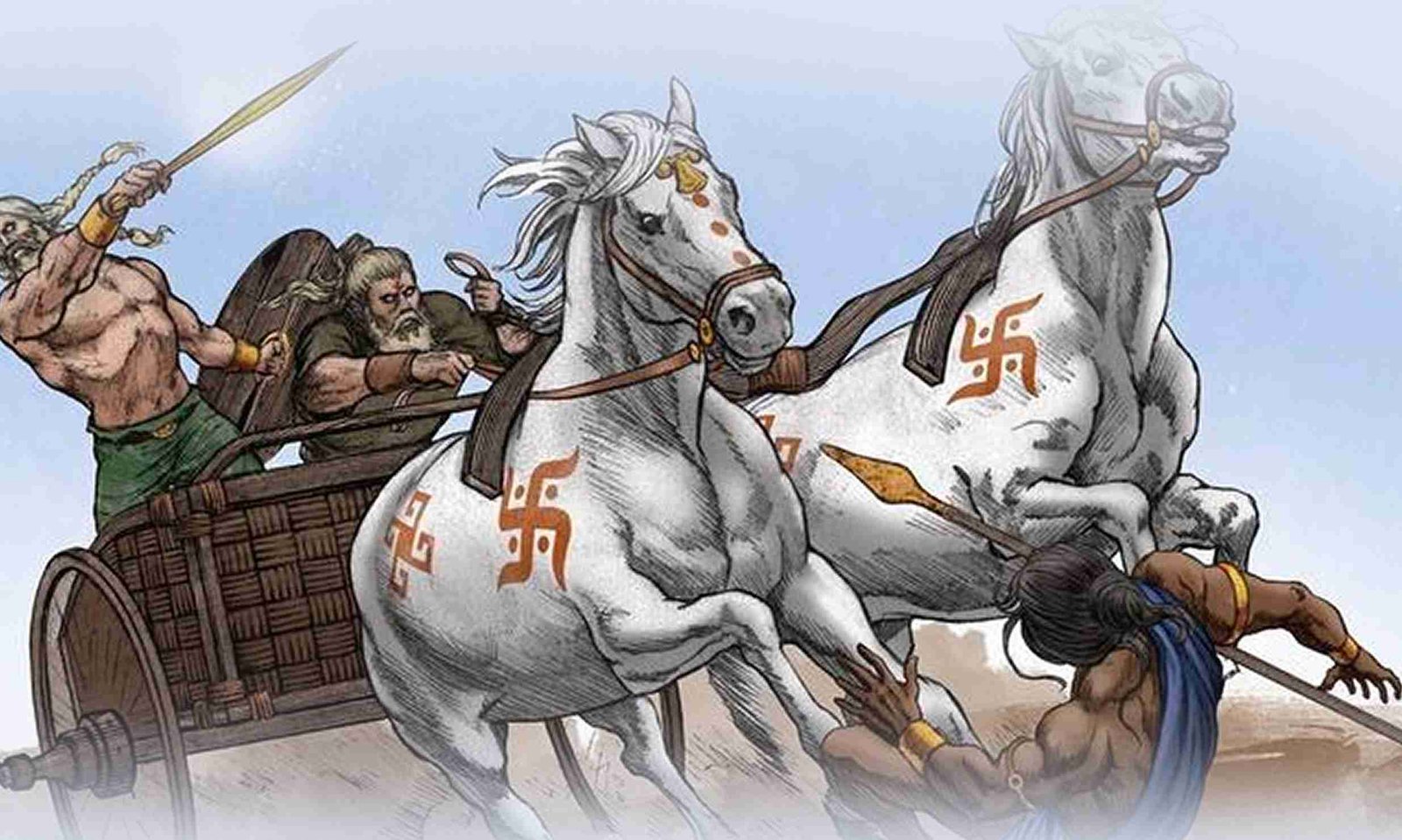
Let us first get our terminology straight. Squeamish AIT scholars are making everyone toe their line that instead of an “invasion” there was an “immigration”. They have to, for unlike in Europe, where the “Aryan” (meaning Indo-European-speaking, IE) invasion from the steppes ca. 2800 BCE was a dramatic and sometimes genocidal event, India presents no evidence at all of such foreign conquest in the period considered. So they shifted to the thesis of a subtle infiltration under the archaeological radar, yet revolutionary in its impact: unlike the Scythians, Greeks, Huns or Kushanas, these intruders succeeded in not just conserving their language and religion, but imposing both on the far more numerous natives. Well, the word “invasion” is not about the means used, but the resulting power equation: it’s an “immigration” if the foreigners adapt, but an “invasion” if they take power. And this is clearly what the supposed Aryan invaders did. So it was definitely an invasion, but we won’t insist: even with an “immigration”, it remains the “AIT”.
The IE language family was discovered by a French Jesuit living in South India, Gaston-Laurent Coeurdoux. In 1767, he sent a paper to the Academy in Paris in which he showed the close kinship of Sanskrit with Latin and Greek. The French freethinker Voltaire soon publicized it and concluded that European culture and its treasures had originated on the banks of the Ganga. This was taken over by other leading intellectuals like Immanuel Kant, and note that they spontaneously assumed India as the land of origin of the IE family. The Out-of-India Theory (OIT) is not a recent “concoction” by Hindu Nationalists, as widely alleged, but was thought up by 18th-century Europeans.
In India, the new insight was given currency by justice William Jones speaking in Kolkata 1786. Note about his speech what admiration he expresses for the Sanskrit language, deemed superior to Latin and Greek. Indomania was widespread at the time, best represented by Friedrich Schlegel’s 1808 book Language and Wisdom of the Indians. This goes completely against the widespread Hindu rumour that IE linguistics stemmed from “racist colonialism”. Most of India was not a colony yet, and the heyday of racial thought contaminating “Aryan” studies had yet to arrive.
However, another consideration started to undermine the dominant position of the OIT. Linguists realized that Sanskrit was not the mother but merely an elder sister of the other branches. There was a distance between the putative language of origin (Proto-Indo-European, PIE) and Vedic Sanskrit, and this translated into a possible distance between the Homeland and India. Not really compelling logic, for languages can evolve while staying in the same place; but this change of opinion won through.
What made the scales tip was probably August Schlegel’s proposal in 1834 that the Homeland lay in or near the Caucasus mountains. Bible-thumpers had already thought of Armenia, where Noah’s Ark had landed: the Aryans were deemed the descendants of Noah’s son Jafeth. Successive Homeland theories after this would rarely move away sharply from the Caucasus area. Since Gordon Childe’s choice in 1926 for the Don-Volga region, this area has mostly remained the favourite, today known as the Yamnaya (“pit-grave”) culture.
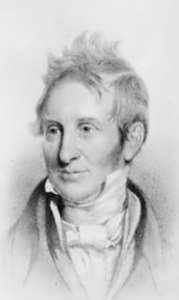
But the OIT school did not give up. The defence was taken up again by Europeans living in India. The most prominent and surprising figure here is Mountstuart Elphinstone, a proverbial colonialist. After his retirement as governor of Bombay, he wrote a History of India. Among his arguments, the most compelling is that no Hindu scripture gives any indication of a foreign origin: “There is no reason whatever for thinking that the Hindus ever inhabited any country but their present.” (1841)
Yet this could not save the OIT. In the mid-19th century, two developments served as nails in its coffin. One was the start of Linguistic Paleontology, the “science” of discovering a language’s habitat from its vocabulary. Thus, it was realized that PIE flourished in a society familiar with wheeled transport: six words for the cart and its parts exist throughout the daughter languages and must have existed in PIE. Now for the Homeland question, it was deemed significant that there were words for cold-climate species like birch tree, wolf and bear. This doesn’t really refute the idea of an Indian Homeland, for these species also occur in India, which has islands of cold climate. Recently, OIT mastermind Shrikant Talageri has shown that hot-climate species like ape, lion and elephant are equally present in the PIE lexicon, and they are hard to reconcile with a northern climate zone. But back then, the exclusion of India as a Homeland candidate won the day.
The other factor was the appearance of Veda translations which followed the then-emerging racial paradigm. Thus, in the Rg-Vedic description of the Battle of the Ten Kings, it was commonly pretended that the enemies were “black aboriginals”. In reality, the names of the kings and of their tribes (most notably Dâsa, Dasyu) are recognizably Iranian, and their characterization as “the black tribe” is a mistranslation. The word Asiknī does not refer to a skin colour, but to the area they come from, the basin of “the Black River”, the Vedic name of the Chenab. This way, several racialist distortions, perhaps made in good faith because of the racialist Zeitgeist, created the impression that an Aryan invasion into India had been described by the Vedic composers themselves. It thus became futile to deny the AIT.
The ensuing political abuse of the AIT by the British colonialists and even by the National-Socialists could not inspire the Indo-Europeanists to a rethink. After 1945, the “Aryan” political discourse went out of fashion in the West, but in India its political use by Christian missionaries, Ambedkarites (though not BR Ambedkar himself, an articulate opponent of the AIT), Dravidianists and Nehruvians continued. In the West this has not been noticed till today. Hilariously, the few Western scholars who have heard of the OIT at all, claim that it is “a politicized concoction”, when in fact it is their own AIT that has played a poisonous role in Indian politics all along.
The OIT started a second life in 1982, when KD Sethna published the book Karpasa (cotton), showing that cotton was common in the Harappan cities (starting 2600 BCE), and in Sanskrit writings younger than them, but not yet in the Rg-Veda. He concluded that the Rg-Veda largely predated them. This high chronology is detrimental to the AIT, which postulates an Aryan invasion (importing the Vedic language) only in the 2nd millennium.
In 1984 the US archaeologist James Shaffer showed that there is zero archaeological proof for an Aryan invasion, including a peaceful immigration. Indian archaeologists became more outspoken about their findings to the same effect. Even BB Lal, long the main archaeological supporter of the AIT, shifted to the position: “Vedic and Harappan are two sides of the same coin.” Several linguists and historians joined in, and latterly some geneticists: people of the same academic rank as any pro-AIT professors you can cite.
Until the millennium year 2000, there had been many voices doubting or plainly rejecting the AIT, and contributing many little arguments from linguistics or archaeology, all indirect evidence, but a clear alternative was lacking. Shrikant Talageri, after a preparatory book in 1993, then broke through the wall of ignorance about the enigmatic Vedic age. In The Rigveda, an Analysis, and its 2008 sequel, The Veda and the Avesta, he pioneered a convincing OIT, which should henceforth count as the OIT.
This work is, as I have been able to verify at Indo-Europeanist conferences, completely unknown in the West and also in India’s AIT camp. Whereas the mere handful of OIT thinkers know the AIT quite well and often write answers to it, the well-established AIT doesn’t really get beyond derogatory comments on the OIT and stonewalls all arguments in its favour. Around the year 2000 there was a little bit of dialogue, mostly thanks to the American scholar Edwin Bryant (the coiner of the term “OIT”), but this has remained a blip.
Today, the AIT camp is a happy valley protected from the rising waters of counter-evidence by a protective dam. But the waters keep rising, and the time can’t be far off when the waters will overcome the dam and drastically impact the cosy life in the valley.
Author:
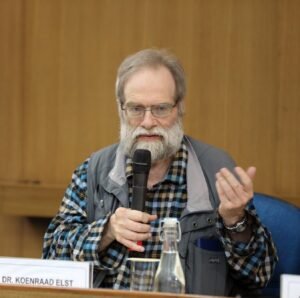
Dr. Koenraad ELST, °Leuven (Belgium) 1959, is an Oriental Philologist & Historian and a prominent old hand in the “Aryan” debate. He did his Masters in Indology, Sinology and Philosophy, followed by original fieldwork in BHU and Doctorate on Hindu nationalism. He wrote thirty books and was a foreign desk press editor, a foreign policy assistant in the Belgian Senate, and a visiting professor at two Indian universities.