INTELLIGENCE ARCHIVE

China

9 published analyses, newest first.

CHINAOCTOBER 16, 2026
01

How Chinese Activities Ecologically Impact Tibet and Downstream Regions

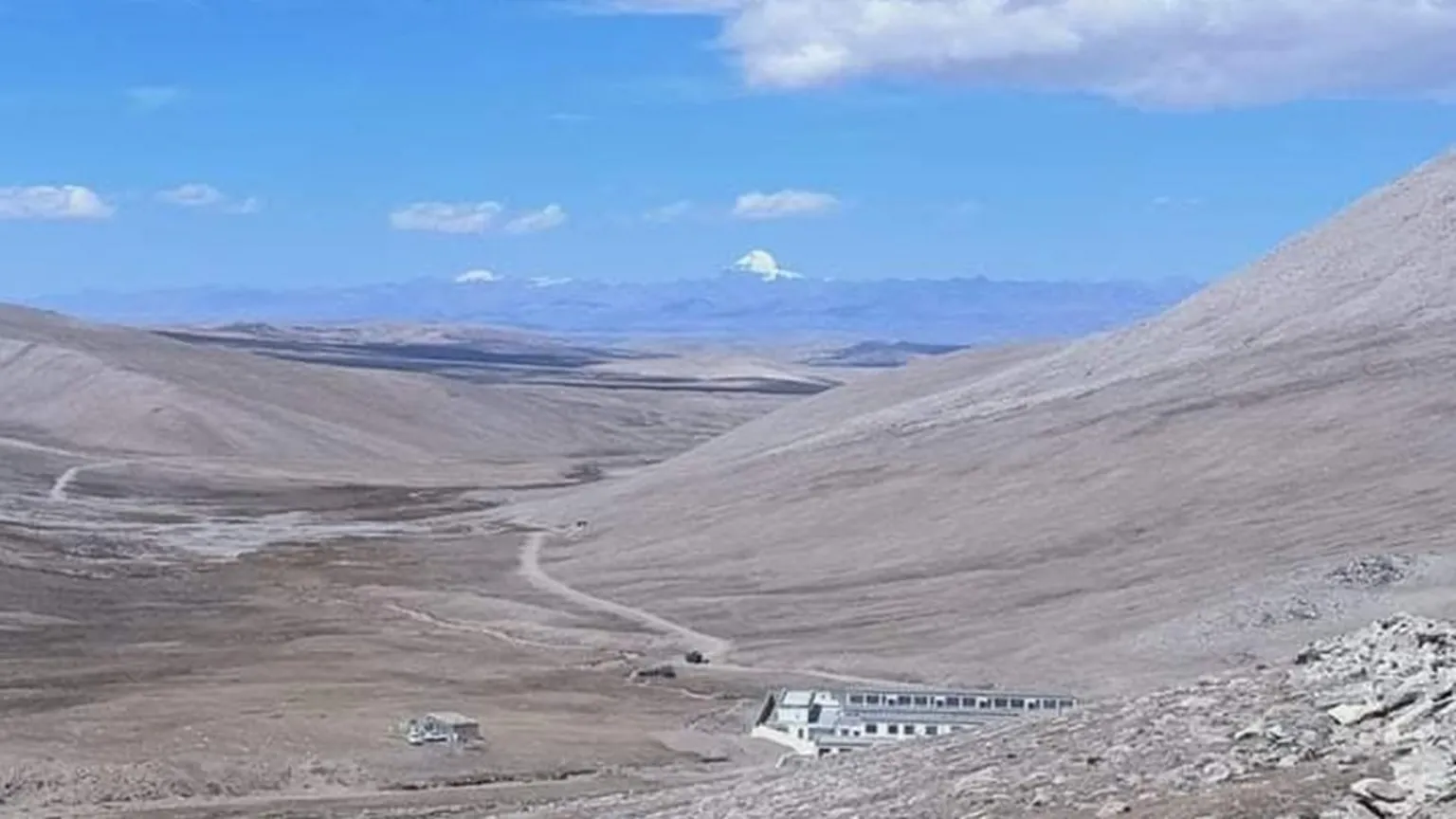
Executive Summary The Tibetan Plateau is the single most important source of fresh water in Asia. The Indus, Sutlej, Karnali, Gandaki, Koshi, Brahmaputra, Salween, Mekong, Yangtze and Yellow rivers all begin in its glaciers, snowfields, springs and high wetlands, and together they sustain well over a billion people across South, Southeast and East Asia. Since the People’s Republic of China took control of Tibet in 1950, this landscape has been treated less as a shared ecological commons and more as a frontier to be secured, engineered and extracted. Over the past two decades the pace of that transformation has accelerated sharply. Mainstream dams on the Yarlung Tsangpo, a mega hydropower project at the Great Bend in Medog, highways and railways driven through unstable valleys, fortified border settlements, expanding mining, the forced sedentarisation of nomads, and even large-scale attempts to modify the weather over the Plateau have all been pursued by Beijing with little transparency and almost no consultation with downstream countries. This report examines those activities against the background of the catastrophic flood of 26 August 2026, which tore through the Lhende Khola, Bhote Koshi and Trishuli corridors on the Nepal-Tibet border. By the end of September, Nepal Police were reporting 1,452 confirmed dead and 5,132 people listed as missing, while on the Chinese side Xinhua has held Tibet’s toll at 43 dead with 519 missing since 6 September. Hydropower plants, the Rasuwagadhi and Gyirong border crossings, dozens of bridges and long stretches of highway were wiped out, and Nepal’s Finance Minister estimated reconstruction costs at US$4 to 5 billion, close to a tenth of the national economy. The scientific consensus now places the trigger of the 2026 collapse on the Nepali flank of Langtang Lirung, and this report does not claim that any single Chinese project caused it. The disaster matters for a different reason. It came just thirteen months after the July 2025 flood that did originate in Tibet, from a supraglacial lake on the Purepu Glacier in Gyirong County, and it fits a long pattern of transboundary cryosphere disasters descending from the Plateau. More importantly, it exposed how little the downstream states know about what is happening upstream, how badly exposed critical infrastructure has been sited in the flood path, and how Beijing continues to treat hydrological and environmental information as a strategic asset rather than a humanitarian obligation. The central argument of this report is that Chinese policy on the Plateau is steadily raising the ecological risk carried by Tibetans and by the people of Nepal, India, Bangladesh and Bhutan, while denying them the information and voice they need to protect themselves. The report closes with a set of practical recommendations for downstream governments, regional bodies and the wider international community. Introduction: The Water Tower Under Management The Plateau is often called the Third Pole because it holds the largest store of ice outside the polar regions. It is also warming faster than most of the planet. Assessments of the Hindu Kush Himalaya have found that glaciers in the region disappeared 65 percent faster in the 2010s than in the the preceding decade, and that on current emissions pathways as much as 80 percent of present glacier volume could be gone by the end of the century. Even if warming is held below 2°C, a loss of roughly a third to a half of the ice is projected. More recent observations show that ice loss rates across the region have roughly doubled since 2000. Climate change is a global problem, and China alone cannot be blamed for it. But how a state manages a warming mountain system is very much a national choice. A government that recognised the fragility of the Plateau would slow down, map its hazards openly, share its data freely, and involve both local Tibetan communities and downstream neighbours in decisions about large projects. Beijing has done almost the opposite. It has treated the Plateau as an engine for national energy supply, a buffer for territorial security and a laboratory for top-down environmental engineering. Tibetans have had little say in any of this, and countries downstream have had even less. The consequences of this approach are visible at three levels. On the Plateau itself, rivers, wetlands, grasslands and pastoral communities have been reshaped by dams, drainage, mining and resettlement. Along the Himalayan border, construction for trade and military access has pushed roads, ports and settlements into narrow valleys exposed to floods and slope failures. And downstream, in Nepal, India and Bangladesh, people living along glacier-fed rivers face growing hazards with less and less warning. The August 2026 Flood: What Happened At about 8:37 in the morning on 26 August 2026, a very large slab of fractured rock and glacier ice broke away from the north face of Langtang Lirung, a peak of over 7,200 metres close to the border. The mass fell roughly 1,200 metres into the valley of the Lhende Khola, the stream that marks the boundary between Nepal’s Rasuwa district and Gyirong County in Tibet. It shattered into a mixture of pulverised rock, ice and meltwater, picked up loose sediment from a channel that had already been stripped and widened by the previous year’s flood, and became a debris flow of extraordinary speed. The energy released was strong enough to register on seismometers in the United States and Germany as the equivalent of a magnitude 5 earthquake, and early reports did in fact describe it as a quake. The surge smashed into the confluence at Rasuwagadhi and Gyirong Port, then roared down the Bhote Koshi and Trishuli through Timure, Syabrubesi and Betrawati. At Galchhi, about 100 kilometres downstream, the river rose around nine metres within half an hour. Bodies were later recovered as far away as Chitwan and Nawalparasi, which tells its own story about the reach of the flood. Nepal’s disaster authority classified two districts, Rasuwa and Nuwakot, as severely affected and put the number of people impacted at roughly 1.6 million. The damage to infrastructure was immense. Around
A
AdminAnalyst
arrow_outward
Chinese Cyber-Enabled Narrative Operations Around India’s 2026 Student Protests
CHINAJULY 29, 2026
02

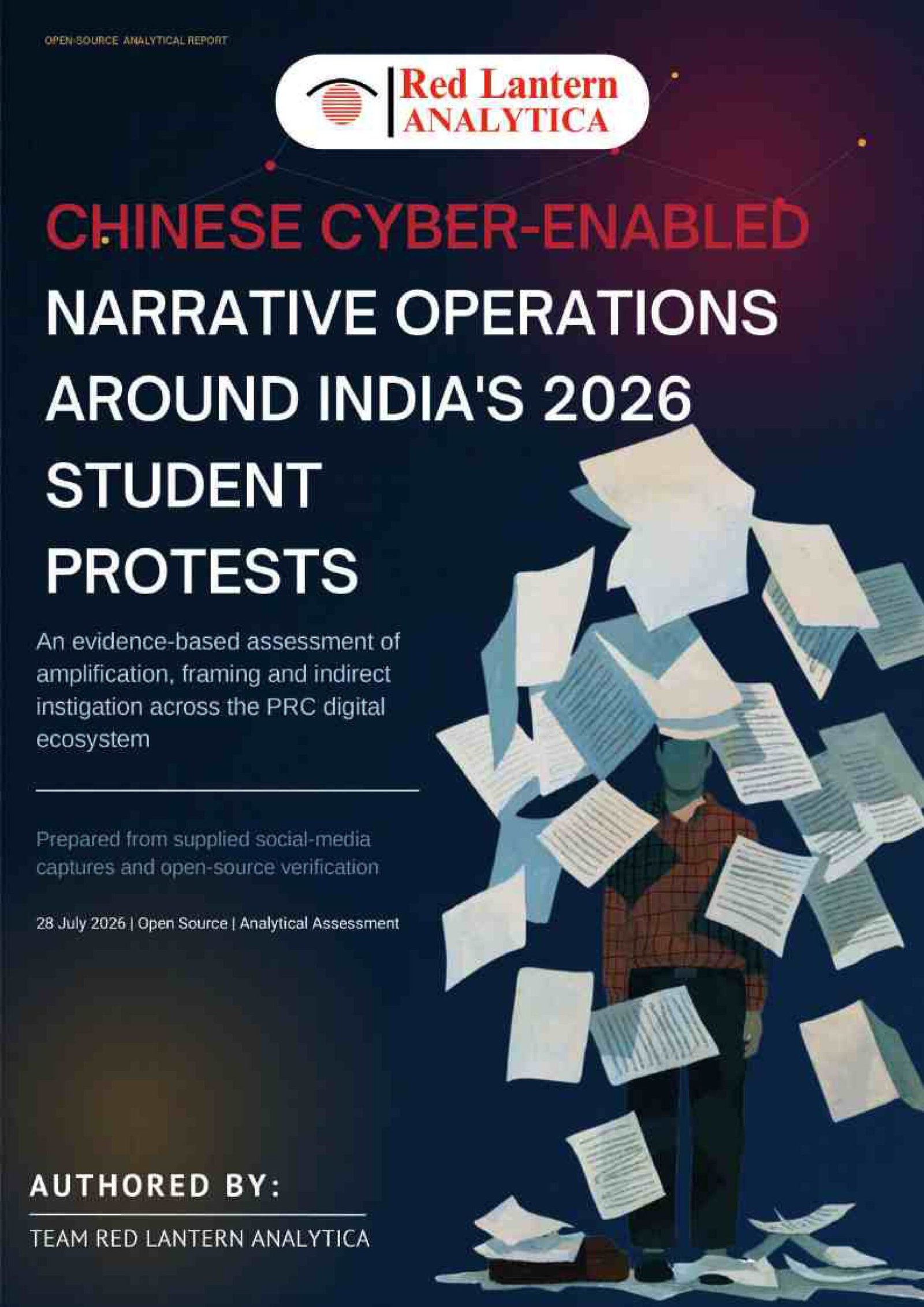
Chinese Cyber-Enabled Narrative Operations Around India’s 2026 Student Protests

We’re pleased to share Red Lantern Analytica’s latest analytical report, “Chinese Cyber-Enabled Narrative Operations Around India’s 2026 Student Protests.” Based on open-source evidence, the report examines how sections of the Chinese digital information ecosystem reframed India’s domestic student protests for Chinese audiences through narrative amplification, political framing, and indirect encouragement. The assessment documents how narratives evolved across platforms including WeChat, Weibo, Xiaohongshu, Guancha, Huxiu, China News Network, and Knews, highlighting recurring themes such as governance failure, democratic decline, political instability, and anti-India stereotyping. We welcome constructive feedback and informed discussion from the strategic affairs, cybersecurity, and policy research communities. To Download PDF of this report click here

A
AdminAnalyst
arrow_outward
China–Nepal Border Re Survey: Cartographic Invasion or Strategic Overture
ASIAJUNE 12, 2025
03

China–Nepal Border Re Survey: Cartographic Invasion or Strategic Overture

In early 2025, China and Nepal launched a comprehensive re survey of their 1,389-kilometre Himalayan border—the first such exercise since 2011. The joint effort, conducted under the provisions of the 1963 Boundary Protocol and revitalized through a bilateral understanding reached in June 2024, is framed as a technical necessity. Yet, the geopolitical undertones cannot be ignored. The question now being asked in Kathmandu, New Delhi, and beyond is whether this effort marks a mere cartographic modernization—or a more calculated strategic overture by Beijing. This re survey has emerged from the revival of the long-dormant Joint Expert Group, a bilateral mechanism that had fallen silent since 2006. Its recent activation comes with renewed energy. With both governments formally agreeing to resume ground work, teams of technicians equipped with satellite imagery, GPS instruments, drones, and digital cartographic tools began conducting on-site inspections of boundary pillars in early 2025. Chinese mapping experts, who possess a far superior technological edge, have been working alongside Nepali surveyors, ostensibly under the spirit of mutual cooperation. However, Nepalese stakeholders have expressed concern about the asymmetric nature of this collaboration—particularly the fear that technical superiority may translate into quiet leverage over physical terrain. For Kathmandu, the official narrative is one of modernization and clarity. Nepalese authorities have emphasized the survey’s potential to resolve minor discrepancies, update outdated maps, and facilitate future infrastructure planning in remote Himalayan regions. This includes better management of border crossings and improved access for development projects that traverse difficult topography. More importantly, government representatives point to the need to regularize trans-Himalayan trade corridors, particularly as Nepal’s reliance on China for trade diversification grows in the aftermath of its ruling leaders favouring Beijing due to political likeness. Despite this, the re survey has reawakened some longstanding concerns. Several areas remain disputed, notably the location of pillar No. 57 in Dolakha, discrepancies in Humla district, and disagreements in the Gorkha region. In these places, uncertainty over the precise boundary line leaves room for friction—not only between locals and authorities but also in terms of international diplomacy. A more recent concern emerged in June 2025, when pillar No. 71 near Kimathanka in Sankhuwasabha was buried due to a monsoon-triggered landslide. The replacement of this marker—how, where, and by whom it is reinstalled—will serve as a litmus test of the spirit of joint management or potential unilateral overreach. What complicates the matter is the simultaneous rise of large-scale Chinese infrastructure projects. The re survey is occurring alongside China’s push to integrate Nepal into its Trans-Himalayan Multi-Dimensional Connectivity Network. This includes the much-publicized Gyirong–Kathmandu railway line, for which feasibility studies are already underway and projected for completion in 2026. The re survey, by refining boundary coordinates and validating terrain assessments, supports these infrastructure plans both technically and diplomatically. Analysts suggest that the mapping exercise serves more than just border clarity—it is foundational to unlocking routes for Chinese investment and logistical presence in Nepal’s northern districts. Public perception in Nepal mirrors this ambivalence. While many welcome the potential for improved connectivity and development, skepticism persists. A recent poll conducted in Kathmandu in March 2025 found that 61 percent of respondents viewed trade and investment as the most valuable aspect of Nepal–China relations, but only 42 percent considered the bilateral relationship “strong,” compared to 57 percent who felt similarly about ties with India. This suggests that while Beijing’s material contributions are appreciated, they have yet to foster the same level of political or emotional trust that India retains. The political class in Kathmandu is therefore walking a tightrope—eager to harness the benefits of Chinese cooperation without ceding perceptual or territorial ground. India, meanwhile, is watching closely. The Sino–Nepali re survey has come at a time when Kathmandu’s own boundary tensions with New Delhi—particularly in the Kalapani–Lipulekh region—remain unresolved. Any perceived tilt toward Chinese narratives, especially if tied to digital mapping or the reinterpretation of pillar positions, could exacerbate tensions with India. New Delhi’s strategic concern centers around whether this re survey offers China more than data: it may offer leverage in the form of terrain familiarity, the legitimization of strategic infrastructure, and a deepening presence in Nepal’s northern periphery. Further complicating the picture is the issue of transparency. China’s prowess in geospatial intelligence, artificial intelligence, and surveillance capabilities is widely acknowledged. The concern within Nepal’s civil society and policy circles is that unless both parties are operating with equal access to mapping data, satellite imagery, and interpretive tools, the process might inadvertently cede informational sovereignty to Beijing. Nepalese lawmakers have demanded that any boundary-related agreements, particularly the proposed “Boundary Management System,” be formally ratified through Parliament and anchored in national law, not merely as memoranda. The public release of digital maps, field updates, and raw survey data has been requested by multiple transparency advocates, yet the details remain mostly behind closed doors. How Kathmandu and Beijing manage these sensitivities in the coming months will be telling. For example, the fate of the buried pillar in Kimathanka could set a precedent. If replaced jointly with public oversight and documented GPS coordinates made available to Nepal’s Survey Department and legal entities, it may reinforce mutual trust. However, if Chinese teams act independently or if mapping data is withheld or quietly revised, it would bolster narratives of cartographic intrusion. Similarly, if the Boundary Management System is passed through Nepal’s Parliament with full legal scrutiny, it will be seen as a sovereign endorsement. But any attempt to institutionalize new mapping standards through executive fiat may spark opposition, especially if linked to infrastructural projects involving land reallocation. What bears close watching is how this re survey becomes functionally integrated into Nepal’s broader policy trajectory. Should the updated boundary lines be used to expedite approvals for Chinese-built infrastructure—roads, railways, power corridors, or data cables—it will signal that the cartographic effort is not isolated, but deeply enmeshed in Beijing’s regional strategy. If those infrastructures are followed by increased security presence, surveillance installations, or joint patrol agreements, it may well amount to a silent shift in influence along

TR
Team Red Lantern AnalyticaAnalyst
arrow_outward
China’s Deceptive Playbook on Pledges and Provocations
ASIAJUNE 6, 2025
04

China’s Deceptive Playbook on Pledges and Provocations

In international diplomacy, consistency and good faith are the bedrock of trust. Only few powers have drawn as much scrutiny and criticism as the People’s Republic of China for its actions in disputed maritime and territorial zones. Boasting rapid economic growth, expanding military reach, and a growing appetite for regional leadership, Beijing has positioned itself as a global power. Beneath the veneer of “peaceful rise” rhetoric lies a consistent pattern of diplomatic duplicity: agreements signed in ink that are later eroded by deployments, infrastructure projects, and legal dismissals. A pattern has emerged over the past two decades in which China systematically disregards international judgments, bilateral agreements, and multilateral frameworks, asserting dominance through coercion, strategic infrastructure build-up, and selective adherence to legal norms. China has exhibited a pattern of calculated duplicity using diplomacy to stall while militarizing on the ground. This article examines major incidents where China promised peace but pursued power, unpacking the motivations, fallout, and wider geopolitical implications. 1. The Scarborough Shoal Standoff (2012) In mid-2012, the Philippine Coast Guard and Chinese maritime surveillance vessels became locked in a standoff at Scarborough Shoal, a traditional fishing ground well within Manila’s internationally recognized Exclusive Economic Zone. Initially, both parties agreed—even under U.S. auspices—to withdraw and negotiate under the umbrella of the United Nations Convention on the Law of the Sea (UNCLOS). But when Philippine boats pulled back, China seized the initiative: coast guard cutters moved in, establishing a blockade that prevented Filipino fishermen from returning. This maneuvers epitomized a “two-step” approach: publicly pledge cooperation, then exploit any opening to cement control. By cloaking its actions in diplomatic engagement, Beijing avoided international sanctions or direct military confrontation. In the weeks that followed, reports surfaced of Chinese vessels physically barring Filipino boats and harassing crews. The sudden conversion of Scarborough Shoal into a de facto Chinese outpost left Manila scrambling to protect its sovereign rights while grappling with domestic outrage over the loss of vital livelihood zones. Regionally, ASEAN’s credibility waned as smaller claimant states questioned whether the bloc’s consultative mechanisms possessed any real teeth. 2. Disregard for the ICA Ruling (2016) Perhaps the most blatant example of China’s defiance came in 2016 when the Permanent Court of Arbitration (PCA) in The Hague ruled overwhelmingly in favour of the Philippines in its case against China. In its landmark judgement the court held that China’s historic “Nine-Dash Line” held no legal standing, and its island-building, fishing restrictions, and hydrocarbon activities violated Philippine sovereign rights. Instead of accepting defeat, China branded the decision “null and void,” refusing to participate in the proceedings or implement any of the tribunal’s directives. Beijing’s dismissal of the PCA ruling underscored a cold calculation: international courts cannot enforce judgments without the cooperation of the losing party. By defiantly pressing on with land reclamation and military deployments, China signaled that its strategic objectives trumped any external adjudication. The immediate consequence was a profound erosion of faith in peaceful dispute resolution; Southeast Asian states, once hopeful that legal avenues might counter China’s heft, grew wary of challenging Beijing in court. Globally, allies of the United States and regional middle powers—Japan, Australia, and India—found themselves compelled to shore up “rules-based” coalitions, fearing a world where powerful states could ignore multilateral judgments with impunity. 3. Militarising the Spratly and Paracel Islands (2002) Under the 2002 ASEAN–China Declaration on the Conduct of Parties in the South China Sea, signatories vowed to exercise “self-restraint” and avoid “actions that would complicate or escalate disputes,” specifically militarization. Nonetheless, starting in earnest around 2013, China embarked on an unprecedented land reclamation campaign across the Spratly and Paracel archipelagos. Satellite imagery revealed dredged sand and coral piling up to form artificial islets, which soon sprouted airstrips capable of handling fighter jets, hardened aircraft shelters, radar installations, and surface-to-air missile batteries. The strategic logic was unmistakable: transform outposts into “unsinkable aircraft carriers” that could extend China’s anti-access/area-denial (A2/AD) envelope hundreds of miles from its mainland coasts. Such installations not only consolidate Beijing’s claims but also pose a direct challenge to U.S. naval operations tasked with maintaining freedom of navigation. ASEAN members fiercely protested this violation of the 2002 pledge, but with no formal enforcement mechanism in the South China Sea regime, China’s island-fortresses became a new status quo. Consequently, the U.S. ramped up its Freedom of Navigation Operations (FONOPs), sailing warships within 12 nautical miles of contested features, while Quad partners (Australia, India, Japan, and the U.S.) began coordinating patrols and exercises to reassure Southeast Asian states of their security commitments. 4. The ADIZ in the East China Sea (2013) In November 2013, Beijing announced an Air Defense Identification Zone that encompassed nearly all of the East China Sea, including the Senkaku/Diaoyu Islands—administered by Japan but claimed by China. Without prior notice to Tokyo or Washington, China required all foreign civilian and military aircraft to submit flight plans and identify themselves, or face “emergency defensive measures.” This abrupt extension of airspace claims breached existing Sino-Japanese crisis-management arrangements designed to prevent accidental escalation. China’s motive was to assert aerial sovereignty over an increasingly contested space and test both Japan’s resolve and the U.S. alliance pledge. Predictably, Tokyo rejected the ADIZ and, with U.S. encouragement, continued its own flights without filing into Beijing’s identification system. U.S. B-52 bombers deliberately traversed the zone without notifying Beijing, underscoring both Washington’s rejection of unilateral revisionism and its commitment to uphold open skies. The incident entrenched mutual suspicion: Japan accelerated defense modernization, deepening cooperation with the U.S., Australia, and India, while China’s rhetoric glorified the ADIZ as a symbol of its “new stature,” further polarizing Northeast Asia. 5. The Haiyand Shiyou 981 Oil Rig Incident (2014) April 2014 witnessed another pivotal showdown when China deployed the Haiyang Shiyou 981 deep-water drilling rig into waters within Vietnam’s Exclusive Economic Zone. Though Hanoi and Beijing had once pursued joint hydrocarbon exploration, Beijing’s unilateral placement of the rig violated both the spirit and letter of their prior understanding. Accompanied by a flotilla of Chinese coast guard and naval

TR
Team Red Lantern AnalyticaAnalyst
arrow_outward
2023 in Review for the People’s Republic of China
CHINAJANUARY 3, 2024
05

2023 in Review for the People’s Republic of China

For People’s Republic of China (PRC), 2023 has been a roller-coaster ride. A few recurring themes were present in the Chinese politics and Foreign Policy approach like the Human Rights violations in Xinjiang and Hong Kong, the Trade war with Western countries, the stand on Russia-Ukraine and Israel-HAMAS war, etc. Here we try to break down a few of these events throughout the year: Downward economic trend On 5 December, Moody’s downgraded its outlook for Chinese sovereign bonds from stable to negative, citing concerns over China’s ability to repay government borrowing. The credit rating agency highlighted the ripple effects of a crisis in the property sector, warning that Beijing might need to bail out local and regional governments and state-owned enterprises struggling with rising debts. This move highlights global concerns about the level of debt in the world’s second-largest economy and suggests that China’s credit rating could be cut in the future. This came amid the reports in August that the Chinese Economy is slipping into deflation as consumer prices fell year on year in July for the first time in over two years. The decline is attributed to slowing domestic spending and weaker demand for Chinese products globally. Lesser domestic spending can be attributed to the decline in population. According to the reports released by the government in August, China’s fertility rate had hit an estimated record low of 1.09 in 2022, making it the lowest among countries with a population over 100 million. The working-age population contracted by over 40 million between 2019 and 2022. The decline in the economy prompted Evergrande, China’s heavily indebted property developer, to file for bankruptcy protection in a US court under Chapter 15 of the US bankruptcy code. The company’s collapse fears sent shockwaves through China’s economy. The step came as China’s property sector continued to face challenges, impacting economic growth. Another shock came from Country Garden, once China’s largest developer by revenue, which faced the risk of default. Until August, the company had missed two-dollar bond payments last week and has until early September to address concerns of a potential default. This negative economic trend prompted the Chinese government to suspend the release of youth unemployment figures when youth unemployment had hit a record high of 21.3% in June, citing the need to “further improve and optimize labour force survey statistics.” In contrast to its declining trend, according to news reports in November, China has become the world’s largest debt collector, with the money owed to the country from developing nations surging to between $1.1 trillion and $1.5 trillion. However, as the debts to Chinese lenders have mounted, the number of suspended or cancelled projects increased which raised concerns in China about the risk of defaults. Chinese lenders are also increasing penalties for late repayments, although this move may alienate borrowers. Human Rights Violations in Hong Kong, Xinjiang and Tibet On 18 January, Hong Kong police raided a Lunar New Year shopping fair, arresting six people for selling a “seditious” book related to the 2019 anti-government protests, just days before the celebrations. The individuals, aged between 18 and 62, were accused of producing and publishing a “seditious book about a series of riots that occurred in Hong Kong from June 2019 to February 2020.” These actions spread terror and are part of the ongoing political crackdown on freedom of speech and expression in Hong Kong under the national security law. Then in February, United Kingdom’s MPs through an inquiry by the All-Party Parliamentary Group (APPG) on Hong Kong accused HSBC Bank of complicity in human rights abuses against Hong Kong residents by siding with Chinese authorities and denying pension payouts to those who fled the authoritarian crackdown. The APPG argues that HSBC’s decision has hindered Hong Kong residents from establishing new lives in the UK and deems the bank complicit in human rights abuses. On 4 March, three former members of a Hong Kong organization that arranged annual vigils commemorating China’s Tiananmen Square crackdown were convicted of failing to comply with a national security police request for information. The group disbanded in September 2021, and the charges against its former members were part of a broader crackdown on pro-democracy activists and organizations in Hong Kong. Later that same month, Hong Kong’s national security police arrested two men for possessing children’s books deemed seditious. The arrests were the first known incidents where individuals were detained for possessing books considered seditious which raised concerns about vague definitions of sedition charges in Hong Kong. On 24 July, Hong Kong’s national security police detained the daughter, son, and daughter-in-law of activist Elmer Yuen, accusing them of aiding wanted activists. Elmer Yuen is accused of encouraging foreign countries to impose sanctions on Hong Kong officials and promoting Hong Kong’s self-determination. The arrest was part of a broader crackdown on pro-democracy figures in exile. Authorities in Hong Kong had issued bounties for the arrest of eight activists based overseas, including the UK, US, and Australia. Not only Hong Kong, there are Human Rights violations in Xinjiang as well. On 24 September, Rahile Dawut, a prominent Uyghur professor specializing in Uyghur folklore and traditions, who disappeared six years ago, was sentenced to life in prison by Chinese authorities for “endangering state security.” Dawut is one among more than 300 Uyghur intellectuals detained since 2016, while an estimated 1.5 million Uyghurs have been held in re-education camps. On 13 October, a report based on a four-year long investigation by the Outlaw Ocean Project revealed the extensive use of forced labour in China’s government-backed fishing industry, including the deployment of Uyghur forced labour in seafood processing facilities. The investigation sheds light on the appalling conditions faced by workers on China’s distant-water fishing fleet and underscores the large-scale use of Uyghur forced labour in seafood processing. The report warns that Beijing’s persecution of Uyghurs has evolved, with some being moved into forced labour after facing global scrutiny. In another case in November, a Uyghur filmmaker Ikram Nurmehmet alleged that he

TR
Team Red Lantern AnalyticaAnalyst
arrow_outward
List of China’s aggressive behavior both across the Himalayas and Taiwan Strait in recent years (since 2019)
ASIAMARCH 3, 2023
06

List of China’s aggressive behavior both across the Himalayas and Taiwan Strait in recent years (since 2019)

The larger geo-political landscape has witnessed significant changes with the rise of China dividing the world into two spheres — countries siding with China’s domestic order through alliances and partnerships, or countries reacting to its aggression by joining international security mechanisms to control its hegemonic tendencies. In recent times China has forced countries, especially in the Indo-Pacific region and South Asia to rethink their security interests because of its aggressive and encroaching behaviour. In the Himalayan region China has had a rocky relationship with India and Tibet (Chinese autonomous region) since late 1950s preceding to the Sino-Indian War in 1962 and 1967. With these events China in the Himalayan region has always had a presence of a sleeping dragon, lest it awake. Across the Taiwan strait, China has been at crossroads since Taiwan broke away from China in 1945. China has vehemently opposed the ‘two China’ system by not recognising Taiwan’s sovereignty because it believes it has a historical claim over this extended territory and wants to reinforce its dominance by expansion. Since 2019 China has been stealthily manoeuvring both these contentious geopolitical regions in order to reach its goal of displacing America as a global powerhouse and pursue the Chinese government global goal of building “a modern socialist country that is prosperous, strong, democratic, culturally advanced and harmonious” till 2049, set under the ODI’s Global China 2049 initiative. By looking at the ways it has manifested itself across the Himalayan, Taiwan and Indo-Pacific, we can figure our the trends of China’s foreign policy and understand how it sees the world. In the first part, China’s historical claim of the South China Sea under the nine-dash line theory saw territorial disputes occurring with ASEAN countries (Brunei, Cambodia, Indonesia, Lao, Malaysia, Myanmar, Philippines, Singapore, Thailand and Vietnam) as well as Taiwan. There was a major pushback from major powers such as the US for the South China Sea has major trade routes in the world with abundant natural resources and fishing areas on which China was illegally establishing its authority. In the second part and most recently, China’s contemptuous response after the U.S House of Representatives Speaker Nancy Pelosi’s Taiwan trip dictated that China would never let Taiwan go from its nationalist agenda. China’s political and strategic behavior lies on the fact whether the US will deter China from trying to take Taiwan by force leading to global woes and chaos. One can be certain any aggressive decision on Taiwan by China will lead to a destabilized global security architecture affecting every country. In the third part specifically, in examining the Himalayan region, Beijing’s revisionist ambitions have been continuously belligerent in erasing Tibet’s territorial integrity, national sovereignty, regional influence and cultural identity. With the ‘One China’ policy, the Chinese position in Tibet remains confrontational to this day. China’s constant standoffs with India along the LAC border also translates to a more volatile Himalayan region as China desperately tries to assert dominance fearing America’s global dominance. In the fourth part China also hasn’t been cordial to its immediate East Asian neighbors. It’s maritime and land issues with Japan over the Senkaku Islands and Ryukyu Islands have been ongoing along with a conflict over the Socotra Rock (Ieodo) in the East China Sea with South Korea. China’s overreaching ambitions of territorial claims and disbanding of internationally signed peace treaties puts it under a lens of scrutiny and distrust by the world. China says its intention is to only reclaim back of what was once theirs as the territorial area of such countries is ‘illegal’. These conflicts are only expected to rise with increasing geopolitical conflicts with Russia’s war with Ukraine and might lead to China taking an even more aggressive stance. Therefore, a study of China’s approach to foreign policy is important to predict the future of international politics as existing relations are put to a test in the Taiwan and Himalayan region. With China’s ‘wolf-warrior diplomacy’ China’s claim on these regions has been whitewashed and only spoken under terms of China’s national interests in the media. Due to these reasons, the world sees China as a black box. Events Covered: Taiwan: 2022: China’s largest ever military military excise in the air and seas around Taiwan, including the firing of ballistic missiles after Nancy Pelosi, Speaker of the US House of Representatives, visit to the island. 2021: Chinese warplanes made 159 incursions into Taiwan’s air defence zone which is the second-highest month on record as Beijing continues to pile military pressure on the democratic island. 2020: According to Taiwan’s defense minister, the PLA has engaged in 49 military aircraft sorties across the Taiwan Strait median line in 2020, the highest number since 1990. In response, Taiwan conducted its own exercise, deploying its F-16 fighter jets. The United States has stepped up its diplomatic and military support to Taiwan. The U.S. has also agreed to a major arms package for Taiwan worth almost $2 billion. The total package may increase to as much as $5 billion to boost Taiwan’s capacity to defend itself from China. 2018-2019: China Holds Long-Range Air Combat Drill Near Taiwan with Su-35 Fighters Over Bashi Channel for the first time. Himalayan Strait and India: 2022: The India-China Tawang crisis came as a consequence of military face off at the Yangtse valley in Arunachal Paresh. The entire state itself, and within it, Tawang, are areas of serious contestation between India and China. 2021: Another face-off at Naku La in north Sikkim, an Indian state sandwiched between Bhutan and Nepal, east of the Ladakh area left troops injured on both sides. This was followed by the deadly Galwan Valley clash. 2020: Ladakh’s Galwan Valley in the Pangong Tso area witnessed a violent clash between the Armies of India and China. The clash, in which 20 Indian soldiers were killed, was one of the worst in 45 years, and led to a military standoff with China and at least 11 rounds of military talks for the disengagement process. 2019: Chinese third White paper on Tibet in the

TR
Team Red Lantern AnalyticaAnalyst
arrow_outward
The US-China rivalry, Cold War or cold war?
ASIAJANUARY 17, 2023
07

The US-China rivalry, Cold War or cold war?

Scholars differentiate between the terms Cold War and cold war to distinguish between what might seem like a regular cold war (i.e., the rivalry between two countries which is quite normal in international relations) and the Cold War between the USA and Russia. Moreover, it makes sense, especially today, when many view the USA-China rivalry through the lens of the cold war and try to draw an analogy with the US-Russia Cold War. A cold war is one manifestation of the long-duration rivalry between states, and the USA- China rivalry is further one manifestation of this cold war; hence, many find it unsuitable to use ‘Cold War’; instead, they prefer sticking to just the cold war. Many leaders might even deny any cold war between the two countries to cool things down, but it is also quite evident that a new cold war is brewing between them, and it was long ago predicted, looking at China’s rise. Every country that rises to the extent of becoming a superpower would threaten the existing superpower. Obviously, China has not reached that stage yet and has a long way to go; still, the USA would try to dim its influence to save or maintain its own. This cold war has a new player, i.e., China and one older one, the USA but one way this is different from the earlier one is that the USA already has a structure (thanks to its Cold War past) which it can use now to strengthen it further. It has maintained its military bases and partners in different regions to keep its presence worldwide. However, the US has also felt a need for new alliances, which has also meant shifting alliances (as realists say, in international relations, alliances are for convenience’s sake only) China’s adversaries are now USA’s friends or at least are allies in the making. Both countries are trying hard to expand their reach and influence and get as many countries as possible on their side. India has had a history of turbulent relations with China since their independence. Both countries have specific border issues which spark up now and then. In addition, China has a problem with India giving asylum to Dalai Lama, competing to become a larger economy and growing influence in South Asia and the Indo-Pacific. USA and India, on the other hand, have always had a convenience’s sake relationship. USA supported Pakistan during the cold war to get better access to its neighbouring area and gave it immense military aid after 9/11 to help prevent terrorism from springing from Pakistan (despite Pakistan not being a democracy which goes against the USA idealist claims). However, this changed when India acquired nuclear weapons- with sanctions on it- most challenging by the USA. However, in 2005, the Bush administration brought a historic change in their relations by waving off the sanctions and bringing the two countries closer. Meanwhile, Pakistan was getting closer to China, getting the desired help to develop its own nuclear weapons. The USA-India relations are now stronger than ever, with the House of Representatives passing an amendment approving “a waiver to India against the punitive CAATSA sanctions“, which made an exception for India despite putting sanctions on Turkey for doing the same (importing the S-400 missile system from Russia), so why make an exception for India? “The US sees India as an important ally in its fight against China. If sanctioned, the Quad collective, of which India is part, could be significantly impacted”. Then, India’s neutrality in the Russian- Ukraine war did not affect the relations much. Despite pressure from the USA to take a stand against Russian aggression on international platforms, India managed to escape that without welcoming any severe repercussions. India is now part of every significant alliance grouping of the USA. They have initiated a new West Asian QUAD called I2U2 (India, Israel, the USA and the UAE) in the Middle East and the QUAD in the Indo-Pacific. It shows how both countries are coming together for security and peace, i.e., against their common enemy- China. India has always been reluctant to invite the USA to help with its border or other issues with China but having the USA on its side does no harm. Both countries benefit from this relationship. Who needs who more is a topic for another debate. India is the only country in South Asia capable of countering China hence, becoming a vital strategic partner for the USA, especially after its Afghanistan blunder, the USA has lost its control over the region. China’s main card of getting countries to ally with it has been giving loans, massive infrastructure projects or development projects, but those are proving to fail, as seen in Sri Lanka and Pakistan. Countries are now looking for alternatives as they see how China gets control over territories by using diplomacy, which is a game-changer. The USA underestimated how China would play out in the new world order, i.e., post-World War 2. China which at one time seemed a potential communist country that could be liberalized and eventually democratized, has proved many optimists wrong in their analysis of it- it has chosen its own path, one that makes it stand head-to-head against the USA. Moreover, China prepared itself well for a situation like this; many worry about its influence and consequences. Then, the growing relationship between Beijing and Moscow makes some people believe that we are moving closer to another cold war. Both have stayed close despite the Russian aggression in Ukraine and China’s stance of being neutral.

TR
Team Red Lantern AnalyticaAnalyst
arrow_outward
Statement on US House Speaker’s Plan to Address the ‘Rise of Chinese Communist Party’
ASIAJANUARY 12, 2023
08

Statement on US House Speaker’s Plan to Address the ‘Rise of Chinese Communist Party’

The former US House of Representatives Speaker, Nancy Pelosi’s visit to Taiwan in August 2022 ignited the most severe Taiwan Strait Crisis ever with the Chinese President Xi Jinping being left insecure about his dreams of a national reunification with the island nation. What followed was a series of Chinese air strikes in Taiwan’s Air Defence Identification Zone (AIDZ) to instil fear among the Taiwanese government and people. The world, however rose in support of the democratically elected nation and the Chinese Communist Party (CCP) is once again huffing and puffing to pursue its hegemonic desires. The newly elected Speaker of the House of Representatives, Kevin McCarthy, swooned the Americans with his inaugural speech where he pledged that the house will address the ‘rise of the Chinese Communist party’ and further went on to say that he wanted the US to win the economic competition which China as well. The trade war between the US and China had been the talk of the town for the recent few years. To tackle this, he proposed to create a bipartisan Select Committee on US-China Strategic Competition to investigate thoroughly on how the hundreds of thousands of jobs that went to China needed to be brought back. The world will agree to the fact that while the global leaders followed policies to help China grow for decades, the CCP has returned only betrayal, oppression and put out aggressive desires to alter the global order, both economically and ideologically. The newly elected speaker made it absolutely clear that “the era of trusting communist China is over” as most of its military and economy grew at the expense of democracy, freedom and human rights. Mr. McCarthy emphasized that the bipartisan task force will not only focus on economic arenas but will also look into crucial matters like China stealing the intellectual property rights, American farmlands being bought by the CCP, Chinese propaganda in schools and lobbying efforts in the US, and how China controlled so much of the pharmaceutical sector that it created a total havoc during Covid-19 pandemic,etc. So this committee will offer comprehensive recommendations for policy matters encompassing economic investment, technological progress and national security. The speaker further mentioned that he wanted to prevent trillions of the American dollars from financing communist genocide and military modernisation. While the speech acknowledges that CCP is a common hurdle for all and the promises made look really enticing, it is now time for the world to mirror this enthusiasm and initiate a collective action to put an end to the CCP authoritarianism.

TR
Team Red Lantern AnalyticaAnalyst
arrow_outward
China’s aggression across the Taiwan strait in 2022
ASIAJANUARY 3, 2023
09

China’s aggression across the Taiwan strait in 2022

What’s in the menu US speaker Nancy Pelosi’s visit to Taiwan in August 2022 saw a record number of Chinese aircraft incursions near to Taiwan, however, this ‘new normal’ aggression didn’t stop at that. For the umpteenth time, December’22 again surprised the observers of the difficult China-Taiwan relations, but this time with the highest ever number of aircraft incursions by China, including warplanes, some of which crossed over the Taiwan strait center line. China’s flimsy justification often quotes the reasons of such a response as a reaction to interference by external agents (read “US”), and the provocation by Taiwan independence forces. The month of August saw heavy incursions that were a response to US speaker Nancy Pelosi’s visit to Taiwan, which China took negatively, for known reasons (one china policy- Taiwan is only another system under overall ‘People’s Republic of China’). The December incursions are by all means a reply to recent US commitments to increase defense and arms assistance to Taiwan. The relations between China-Taiwan are once again in a limbo. THE RECIPE The Taiwan strait in recent couple of years has emerged has one of the most restive regions of our times when seen via lens of great games. It has become a pawn in the US-China rivalry that won’t abate anytime soon. The pro-democracy forces are in power in Taiwan, and China being an authoritarian regime, doesn’t seem to take well how Taiwan aligns with the democracies of the world. China hasn’t however ruled out the possibility of a ‘bloody reunification’ with Taiwan. Taiwan’s forced unification with china, one that will lead it to share a fate similar to Hong Kong, Tibet, Xinjiang is a nightmare that the world fidgets about. While some strategic analysts foresee a reunification happening soon, with or without any alarms, others say that neither China, nor the US can be lame-ducks enough to fight off each other in an era of economic interdependence and ever weaker supply chain resilience. However, the ongoing Russia-Ukraine war bears testimony to the fact that idiosyncratic factors and waves of populism, in the guise of nationalism can precipitate into worst nightmares of the global community. It’s not unknown that China’s zero covid strategy and its crumbling economy may lead to making of a restive Chinese populace that may stand against the Xi regime. Where can it then take recourse in such a situation? Answer is simple and predictable in the realm of international relations- trigger issues, create enemy states, and invoke nationalism by rabble rousing. A similar move is in play even in The United states. The bait is Taiwan this time. It’s a tough spot for Taiwan that its largest trade partner is also its greatest enemy. But enemy’s enemy is a friend (in line with Kautilyan wisdom), and that drags in US to the scene. Kurt Campbell, US based indo pacific strategist advised that US intensify its trade relations with Taiwan to deepen the strategic relationship. US hence also wants Taiwan to initiate decoupling its economy with China. Such a directive however can trigger a direct clash in the strait with the two important powers in a direct face off. The whole logic of deterrence may take a backseat, however to say if it for sure will, will be an over statement. United states is the most important global power that has the back of Taiwan in case of aggression by china. Its ‘Taiwan policy act’of 2022 is a direct commitment by US in providing weaponry and technical assistance to Taiwan to build a credible defense capability. US has pursued the policy of strategic ambiguity vis-à-vis Taiwan wherein it affirms to one china policy, while refuting any attempts by china to coercively incorporate Taiwan into itself. However, The US has shown more certitude and less ambiguity on the Taiwan issue ever since Biden has assumed power. This means an even hotter pacific (not even counting in climate change here). The US finds itself embroiled in Taiwan for a couple of reasons- A china free Indo-pacific. Critical components like electronic chips’ manufacturing being concentrated in Taiwan. To prevent choking of critical supply lines in an era global interdependence. SALT TO TASTE PLEASE Retired General Lee of Taiwan believes that china is only short of sufficient firepower before it can wage a war for Sinicizing Taiwan. What then are the current developments in Taiwan to handle an improbable yet possible militarily forced unification? Taiwan has changed its conscription policy to make its military voluntary. This has been a positive step as it’ll aid in infusing expertise and competence to its military which otherwise engaged in a “half-hearted, good for nothing and short periods of training. However yet again the Tsai government has decided to extend compulsory military service to one year from four months from 2024 citing insufficient preparedness. Moreover, it has increased its defense budget, while drawing further from technical expertise and arms sale of its most trusted ally- US. However, many scholars point to the possible heavy reliance on US that can make Taiwan to bandwagon after US thus creating a hierarchy of power. There are 3 options that small states usually have -Bandwagoning, balancing and hedging. Taiwan can’t afford to bandwagon entirely after China, or balance against it out rightly, considering its reliance on China economically and a possible blockade that it may be subjected to. Strategic hedging thus seems a better option. Through this Taiwan can pursue the dual poles of balancing and bandwagoning, with inclination towards any one as the context demands. Currently, the inclination is in favor of balancing against China, by forging its ties with the democratic regimes. Whatsoever, the wargames by China in and around the strait have become sharper in its character, with such incursions having become a normal daily news for the Taiwanese. China’s greyzone activities pose conundrum to the analysts who find it difficult to judge if China is crossing or will cross the fine line between its war of attrition on one hand

TR
Team Red Lantern AnalyticaAnalyst
arrow_outward