
Understanding The Syrian Civil War – Past and Present
Commentaries

Understanding The Syrian Civil War – Past and Present

TR

Team Red Lantern Analytica

Directorate of Intelligence

Share:

Syria and Lebanon, also referred to as the Levant States (1923–1946), were initially governed under a mandate system established by the erstwhile League of Nations after the collapse of the Ottoman Empire and in the aftermath of the First World War. Under the mandate, the governing country sought to act as a trustee until the people were considered “eligible” to self-govern; at this point, the mandate would terminate, and a sovereign nation would be born. By the end of the war in 1918, by the Sykes-Picot Agreement, Britain held Iraq and the southern part of Ottoman Syria, including Israel, Palestine, and Transjordan regions, while France controlled the rest of Syria, which comprised Lebanon, Alexandretta (a province of Turkey), and portions of Cilicia. Even though after the fall of the Ottomans in Syria, Faisal, son of Hussein bin Ali, King of Hejaz (leading the Arab Revolt), established the first post-war Arab government in Damascus in October 1918 and the British forces withdrew on 26 November 1919, the Arab government had to face France, which demanded full control of Syria under the Treaty of Sevres. Also, the outcome was despite the conclusions of the American King-Crane Commission, which confirmed the opposition of the majority of Syrians to the mandate and the Balfour Declaration as per its remit of the 36 major cities, 300 villages, and petitions numbering more than 3000. Later, General Gouraud (France) issued an ultimatum to Faisal with the choice of either a submission or an abdication. Faisal, realizing the weak balance of power, decided to cooperate. Youssef al-Azmeh, the Syrian minister of war, however, decided to revolt, following which the Franco-Syrian War was fought in which the French decimated the Arab forces and Azmeh died on the battlefield.

On 29 September 1923, France was assigned the mandate to govern Syria by the League of Nations (part of the claim included the acknowledgment of France as the protector of minority Christians during the Ottoman Empire), and the administration of the region was carried out under a host of different governments and territories, including the Alawite State, the Jabal Druze State, the Mandatory Syrian Republic (1930–46), the State of Syria (1925–1930), and the Syrian Federation (1922–24).

Levant Crisis and Syrian Independence
Later, in 1936, the Franco-Syrian Treaty of Independence, also known as the Vienot Accords, was signed, which provided for Syrian independence. However, fearing that the French withdrawal from the mandated states would propel Nazi Germany to fill the vacuum, France continued to occupy Syria, whereupon riots broke out in the region, especially in Aleppo, and the fighting escalated between Syrian youths and French forces in Hama and Homs, resulting in more than 1000 Syrian deaths and countless homes being destroyed while the new president, Hashim al-Atassi, resigned.

When the news of the immense casualty loss reached the UK Prime Minister, Winston Churchill sent Charles de Gaulle a message: “In order to avoid a collision between British and French forces, we request you immediately order French troops to cease fire and withdraw to their barracks.” The order being ignored, Britain intervened with troops and tanks from the 31st Indian Armoured Division invading Syria from Transjordan and striking Damascus while cutting off communications of the French forces. Finally, at gunpoint, the French were forced to accept the safe return to their barracks.

Syria became fully independent on 17 April 1946, even as both the British and French forces withdrew from Syria and Lebanon, respectively. In October, both Syria and Lebanon were recognized as independent states and admitted as founding members of the United Nations.

Syrian Diplomatic Crisis of 1957
Between 18 August and October 1957, severe diplomatic confrontations broke out between Syria and the Soviet Union on the one hand and the United States and its allies along with the Central Treaty Organization (CENTO), also known as the Baghdad Pact (Iraq, Iran, Pakistan, Turkey, and the United Kingdom). Apprehensiveness began when the Western governments accused the Syrian government presided over by Shukri al-Quwatli of making the appointment of Col. Afif al-Bizri as chief of staff of the Syrian Army, alleged to be a Soviet sympathizer, and other institutional changes in line with “Soviet understanding.” Thereafter, suspecting that a Soviet takeover had been organized in Damascus, the neighboring states of Iraq, Lebanon, and Jordan started considering support for an Arab/Western military intervention to overthrow the Syrian government.
The then US Secretary of State, John Foster Dulles, described the situation as “totally unacceptable” and called for further efforts to prevent Syria from becoming a “Soviet satellite.” Under the advice of Dulles, President Dwight Eisenhower made some unclear statements on the events during a press conference while Syria responded with its press conference, stating that Syria was committed to a foreign policy doctrine called “positive neutralism,” which was in stark contrast with the “paternalism” of the Cold War superpowers.

A telegram from the US Embassy in Saudi Arabia to the State Department stated as follows – “Time approaching, if indeed not already arrived, when Syria will cease to be effectively an independent nation but will have been taken over as was Czechoslovakia in 1948 and made into a Soviet satellite having independence only in name and not in substance. We are also convinced that once the present group now in control of Damascus has consolidated its position in Syria, it will reach out in efforts to subvert surrounding countries, thus propagating the Communist virus and paving the way for control by elements subservient to Moscow.”

While Turkey was the only country to deploy thousands of troops along the Syrian border, Nikita Khrushchev, the first Secretary of the Communist Party of the Soviet Union, threatened to launch missiles at Turkey if it would attack Syria, the United States intimidated the Soviet Union in case it would launch an assault on Turkey. Later, in October, following pressure from the United States, Turkey withdrew its forces from the Syrian border, and Khrushchev made a surprise visit to the Turkish embassy in Moscow, and the crisis ended.

Current Crisis and the Involvement of Foreign Actors (2011-Present)
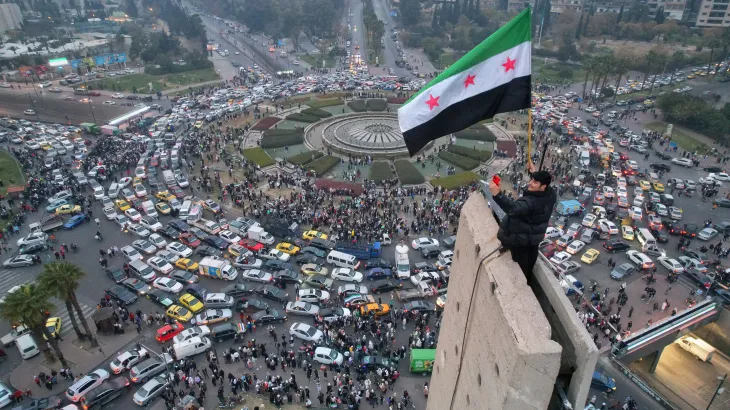
As part of the wider Arab Spring protests, pro-democracy rallies and large-scale demonstrations broke down in Syria in March 2011 due to the mass discontent with the Baathist government, a vanguard party with a socialist revolutionary agenda with the ideology to promote and develop a unified Arab state. The protests were violently suppressed by security forces in deadly crackdowns ordered by former President Bashar al-Assad. That resulted in thousands of deaths and detentions which eventually turned into a full-blown civil war in 2012 with the formation of resistance militias across the country, transforming the Syrian revolution into an insurgency.

The war was fought on several fronts with the Syrian Arab Armed Forces representing the Assad government and the Syrian Arab Republic. In opposition stood the pro-democratic, nationalist opposition groups such as the Syrian National Army and Free Syrian Militias, along with the faction of the Syrian Salvation Government represented by a coalition of Sunni militias led by Tahrir al- Sham, along with the Arab majority force led by the Kurdish People’s Defense Units (YPG) and other competing factions, including the branches of the jihadist organization of Al-Qaeda and the Islamic State.
Meanwhile, several foreign countries, such as the United States, Iran, Turkey, and Russia, have been directly involved in the war in Syria. While Iran, Russia, and non-state actor Hezbollah have been supporting the Syrian Arab Republic, with Russia conducting ground operations and airstrikes since 2015, the United States has been conducting air and ground operations against the Islamic State and pro-Assad forces along with providing military and logistical support to factions such as the SDF and the Revolutionary Commando Army.

Turkey, on the other hand, has been occupying the northern portion of Syria and has fought the ISIS, SDF, and the Assad government even as fighting spilled over to neighboring Lebanon. Though Ankara has an officially neutral stance, Israel has exchanged fire and conducted repeated strikes against Iran and Hezbollah in western Syria. Iran has been a strategic ally of Syria and has provided considerable support, including technical support, combat troops, and more than 9 billion dollars in financial support for the Assad regime. The Syrian city of Zabadani is critically important to Iran because the city has served as an important base for the Islamic Revolutionary Guard Corps for supplying Hezbollah while Iran’s Supreme Leader Ali Khamenei was vocally in favor of the Syrian government back in 2011. In October 2015, Iran signed the 2012 Geneva Communique, which provided the roadmap based on two rounds of Syria talks in Vienna, and after the meeting with Vladimir Putin in Tehran on 23 November 2015, Iran is said to have unified its stance on Syria with that of Russia. As of 2023, Iran holds more than 70 percent of its foreign military sites in Syria, including 55 military bases and 515 other military posts, the majority in Aleppo, Deir Ezzor, and the Damascus suburbs.

On the other hand, Russia has also been a strategic ally of Syria since 1956 and has been actively supplying the Syrian government with arms, training the Syrian soldiers to use Russian weapons, and helping them to repair and maintain Syrian weapons by sending military and technical advisors to Syria along with transporting hundreds of tons of banknotes by airplane. Russia also manned some of its anti-aircraft defenses with military personnel adorning the garb of military advisers back in December 2012. Russia also launched a direct military intervention in Syria consisting of airstrikes against ISIL, the Al-Nusra Front, and other enemies of the Syrian government.

However, Iran’s regional influence has receded through its “Axis of Resistance” (the strategic non- state militant actors), which suffered significant setbacks given the elimination of the supreme commander of Hezbollah, Hassan Nasrallah, on 27 September 2024, and the killing of General Qassem Soleimani, a pivotal figure in Iran’s Revolutionary Guard Corps, in January 2020, along with other key military personnel, while Hamas, along with the Houthi rebels in Yemen, has also been diminished in power after they attacked Israel and faces mounting pressures from Israel and the United States.

Amid a power vacuum in Syria, Israel is expected to be more assertive against Iran and its affiliated organizations in the region. While Saudi Arabia and the UAE are expected to build their diplomatic leverage in Syria by engaging and backing various factions to stymie the political aspirations of Turkey and Iran, other Sunni Arab groups such as ISIS could try to build their operational presence in the region. Turkey’s footprint in northern Syria is likely to continue to thwart Kurdish autonomy movements, with the US and other European nations likely to continue their diplomatic measures and exert pressure through coordinated military presence.

Authored By:
Gaurav Sharma ,
Guest Writer

Related Intelligence

COMMENTARIESAUGUST 20, 2026
01

Evergrande’s Fall Exposes the Deeper Fault Lines in China’s Property-Led Growth Model

The sentencing of Hui Ka Yan, Xu Jiayin, founder of the China Evergrande Group, to life in prison marks the conclusion of more than just the fall of one of China’s biggest businessmen. Hui was found guilty of eight offenses, including fraud, misappropriation of funds, securities violations, and bribery. Evergrande, formerly the largest real estate developer in China by contracted sales, turned to almost all of its $300 billion plus liabilities. Hui’s trial may mark the end of a significant legal case, but the Evergrande case does not end the massive economic case Evergrande came to represent. China’s real estate bubble was not a tale of just increasing house prices. It involved a tightly connected system of households, developers, banks, and local governments. Property became the main wealth purchasing and saving vehicle for Chinese households. In a survey by the People’s Bank of China, 59.1% of urban households’ assets were held in the form of housing, and the home ownership rate was 96%. Increasing house prices had an effect beyond an increase in construction. House prices had a positive effect on household wealth perceptions, confidence, and consumption. For developers, the system was designed to incentivize expansion. Land was bought and presold apartments, loans made it possible for developers to start new projects, and growing property evaluations enabled more borrowing. Evergrande was one of the developers who pushed the system the farthest. It can be described as the “three highs” consisting of high turnover, high costs, and high leverage. Evergrande’s model was to raise capital, buy land on a massive scale, and begin development while also borrowing against their land and starting the cycle over. So long as lenders continued to lend and buyers continued to buy, investors and developers alike continued to benefit from the cycle and the land and housing prices continued to grow. Local government interests were aligned with the developers. After the 1994 tax-sharing reform, the central government gained more revenue, leaving local governments shouldering a greater financial burden. To offset some of the burden, local governments sold land to developers and used land as collateral for loans. By 2019, it is calculated that local governments’ reliance on land finance was at 38.6 percent, with over 50 percent in many large cities. Property prices and local government finance and debt fuelled a cycle of increasing infrastructure spending. This outlines how vital property investment became for China. The IMF put the contribution of property to the economy at up to 20 percent. However, this number does not even come close to capturing the extent of property’s reach. Building property creates the need for the transport of raw materials. That includes steel, cement, and glass, as well as the machines to build the property, appliances, and furniture. Glass and machinery need to be transported using logistics and financial services. Property building employs contractors. Developers take out mortgages and corporate loans. Local governments earn money from the sale of land. So, property not only includes one of many sectors of the economy, but becomes a complete economic system. It becomes very clear how this system would collapse if the opposite of what is expected were to occur. This is the nature of a bubble. Every apartment does not become worthless. It means that the cost of the property, along with construction and the loans used to finance the purchase, became more dependent on whether people thought the price and demand for property would continue to rise. If people begin to think the cost of property will fall, then the same thing happens in the opposite order. Buyers will delay purchases, developers will not earn presale income, government revenue will fall, and banks will be more cautious of extending loans. Beijing recognized the risks so they began to tighten financial regulations starting in 2016. In 2020, The “Three Red Lines” Framework was established. Beijing’s goal was to limit debt for highly leveraged developers. From a macroeconomic standpoint it was necessary to limit debt. The problem was that leverage had become endemic throughout the system. It was really wishful thinking that it would discipline poorly managed developers because it made the business models of other driven companies more dependent on constantly selling new property and taking out new loans to continuously refinance debt. Evergrande exemplified the most famous case of China’s real estate collapse. Their failure impacted far more than themselves. Suppliers weren’t getting paid, construction companies went bankrupt and halted their projects, buyers had to wait to get their newly financed homes, and the creditors began to doubt the feasibility of their investments. Media states that Evergrande’s liquidation is slow and only $255 million of assets were sold by August of 2025 with claims against those assets totalling $45 billion. The possibility of China suffering a sudden replication of America’s 2008 “Lehman moment” is low. China’s financial system is more state-controlled, and the major banks are capable of being directed to provide support. Further, the capacity of Beijing to avoid excessive failure is far higher than the capacity of America at that same part in its history. The more likely threat is a prolonged balance-sheet adjustment where weakness in the property market will slow economic activity for many years. This trend continues through 2026. In July, Chinese new-home prices fell by 3.2% compared to the previous year. Of the 70 cities monitored, only 17 showed an increase in prices from the previous month. The first 7 months of the year also showed declining trends in property sales, investment, and new construction. During this period, the revenue of the Chinese government from land sales declined by 31.5% and was recorded at 977.8 billion yuan. These figures show a weakening trend in property and reflect declining private investment and local government finances. This trend is most problematic for households. When the primary investment of a household falls in value, households become more conservative. Household wealth falls and household members that own houses feel poorer, even if they have no intention of selling.

TR
Team Red Lantern AnalyticaAnalyst
arrow_outward
COMMENTARIESJULY 25, 2026
02

𝐀 𝐃𝐢𝐯𝐢𝐝𝐞𝐝 𝐇𝐨𝐮𝐬𝐞 – 𝐋𝐞𝐠𝐚𝐜𝐲 𝐯𝐬 𝐑𝐞𝐚𝐥𝐢𝐭𝐲: 𝐅𝐫𝐚𝐜𝐭𝐮𝐫𝐞 𝐢𝐧 𝐍𝐒𝐂𝐍 (𝐈𝐌) & 𝐑𝐢𝐬𝐞 𝐨𝐟 𝐭𝐡𝐞 𝐑𝐢𝐯𝐚𝐥 𝐏𝐫𝐨𝐯𝐢𝐬𝐢𝐨𝐧𝐚𝐥 𝐆𝐨𝐯𝐞𝐫𝐧𝐦𝐞𝐧𝐭 𝐢𝐧 𝐌𝐲𝐚𝐧𝐦𝐚𝐫

N𝐞𝐰 𝐏𝐮𝐛𝐥𝐢𝐜𝐚𝐭𝐢𝐨𝐧 | 𝐑𝐞𝐝 𝐋𝐚𝐧𝐭𝐞𝐫𝐧 𝐀𝐧𝐚𝐥𝐲𝐭𝐢𝐜𝐚 Red Lantern Analytica presents a new strategic analysis: “𝐀 𝐃𝐢𝐯𝐢𝐝𝐞𝐝 𝐇𝐨𝐮𝐬𝐞 – 𝐋𝐞𝐠𝐚𝐜𝐲 𝐯𝐬 𝐑𝐞𝐚𝐥𝐢𝐭𝐲: 𝐅𝐫𝐚𝐜𝐭𝐮𝐫𝐞 𝐢𝐧 𝐍𝐒𝐂𝐍 (𝐈𝐌) & 𝐑𝐢𝐬𝐞 𝐨𝐟 𝐭𝐡𝐞 𝐑𝐢𝐯𝐚𝐥 𝐏𝐫𝐨𝐯𝐢𝐬𝐢𝐨𝐧𝐚𝐥 𝐆𝐨𝐯𝐞𝐫𝐧𝐦𝐞𝐧𝐭 𝐢𝐧 𝐌𝐲𝐚𝐧𝐦𝐚𝐫.” Authored by Lt. Col. Ujjual Abhishek Jha, DCPP (Retd.), this examines the recent organisational split within NSCN (IM), the emergence of the Eastern Flank-led Provisional Government, and its implications for the Naga peace process, cross-border insurgency, and India’s security landscape in the Northeast. Download Link: A Divided House Legacy vs Reality Fracture in NSCM-IM and Rise of the Rival Provisional Government in Myanmar

TR
Team Red Lantern AnalyticaAnalyst
arrow_outward
COMMENTARIESAUGUST 21, 2025
03

Reimagining Oman as an Indian Ocean Green Hub: Looking at a Post-Carbon Future

The few stereotypes that persist regarding the Gulf are of its importance as a hydrocarbon centre over the past eight decades, since Bahrain and Saudi Arabia struck Oil in the 1930s. Oman, in comparison, struck Oil in Fahud in 1962, and shipped its first container from Mina Al Fahal in 1967. The oil revenues formed the bedrock of rebuilding the country during the 1970s, during which the Dhofar rebellion was still on. Oman is a Shell country, like Brunei, where Shell has been strategic in the country’s hydrocarbon exploration through a major stake in Petroleum Development Oman, or PDO, as commonly known. Many PDO employees have worked for Shell Brunei and Shell Sarawak as a part of their career circulations in the global MNC network. Oman was never a massive producer of petroleum as its wealthier neighbours in the GCC, even though its natural gas imprint is significant. Natural Gas is a key transition fuel, and Quriyat LNG in Sur has many long-term contracts with Korea, China, and Japan. However, Oil and Gas still form a major chunk of the GDP in Oman. Diversification has been on the agenda since the late 1980s, as localisation has always been a priority. Years of peak oil prices have led to the creation of avant-garde infrastructure and the education of a couple of generations overseas on scholarships, which was a byproduct of oil income. Now, the scenario has evolved as Oman’s population has increased, and the youth seeking work is often the refrain, as gauged from the comments section in the social media feeds. The cause of the Arab Spring protests in Sohar was corruption and lack of jobs, which led to a few heads turning. The post Sultan Qaboos era, under the able leadership of His Majesty Sultan Haitham Bin Tarik has moved towards diversification in a major way, seeking relationships far and wide. His Majesty has had meetings with the Dutch Leadership, President Putin in Moscow, Prime Minister Modi in Delhi, and the UK Minister Starmer within the past few months. The rich legacy of Oman being the Switzerland of the Middle East helps in its vital role in mediating the Yemeni crisis and as a trusted participant in the Iran paradigm, helps. Oman also controls half of the crucial Straits of Hormuz. Ibadhi Oman’s history as a littoral maritime empire has its long shadow in the present. Muscat is a diverse place, full of Zanzibaris, Baluchis, Ajmi’s, Lawati’s, and Hindu Bania’s, and other communities who were a part of the Omani imperial grid. The strategic culture of the Omani elite is transnational, with many Omani having ties across East Africa to Africa. Pankaj Khimji, an advisor to the Omani government, is a key Bania interlocuter between Muscat and Delhi via Mandvi. India and Oman have finalised the FTA negotiations recently. Aden was governed by the Bombay Presidency until 1937. These close ties entail prospects of power being exported to India/ Pakistan/East Africa via a subsea cable in the future. The engineering and program management excellence achieved by the national building efforts of PDO, especially in terms of talent development for the renewable sector, over the past decades. The first solar project was helmed by PDO as seen in the Amin Solar project. This is similar to the Aramco State, where the best expertise in Saudi Arabia lies with the engineers in the oil major. A glimpse of it was illustrated in Ellen R Wald’s book[1], which showed the role National Oil Companies have played in nation-building. Oman’s location as an Indian Ocean actor was confirmed with it hosting the Indian Ocean Conference this year in Muscat, where Member of Parliament Naveen Jindal ji spoke. Jindal operates one of the largest steel mills in the Middle East in Sohar. The ACME Group is coming up with a green hydrogen facility in the special economic zone in Duqm on the Arabian Sea coast. Duqm is also home to a naval base, which plays host to many navies, as it is close to the Horn of Africa piracy corridor. The green hydrogen corridor in Al Wusta and Dhofar is underway as ACWA Power from Saudi Arabia is investing in a green hydrogen facility in the southern Dhofar region. Another ACWA Power project in the form of Ibri 2 IPP is a project I know rather intimately. I was the lead social specialist for an impact assessment report for a multi-million-dollar 500MW solar park on the Saudi border. Long-term migrant workers from South Asia were identified as camel farmers in the desert on project land., However, during a recce visit and after speaking to long-term migrant workers looking after camels, we discovered that they were extremely precarious, relying on a solar-powered battery charger for mobile phones and to light a bulb. These workers, who were heavily reliant on precarious work, were being moved away from their off-grid homes to build a Chinese-funded solar park in relatively prosperous Oman. The irony was not lost on me. Globally accepted ESG governance norms kicked in, the move triggered an independent Resettlement Action Plan for these workers. Climate and Local developmental politics intersect in the middle of nowhere. The Beijing-based Asian Infrastructure Investment Bank or AIIB is the backer for the Ibri 2 Project, and Chinese contractors were the hands on Ibri 2. Belt and Road is right on our doorstep. Indian Engineers and Consultants work on these Chinese-funded projects as the technical hands behind the scenes. There are numerous other solar projects in the pipeline in the Wilayat of Manah. These areas are close to the Saudi Border and could be a part of an integrated GCC power grid. Oman’s great strength in terms of land needed for renewable projects is a plus, along with its positioning between the Gulf, South Asia, and East Africa, which makes it an Indian Ocean Green Hub[2] in the making. [1] https://www.amazon.in/Saudi-Inc-Arabian-Kingdom%60s-Pursuit/dp/168177660X [2] https://mem.gov.om/en-us/Our-Business/Renewable-Energy-and-Hydrogen/Renewable-Energy-and-Hydrogen-Projects Authored By: Manishankar Prasad PhD Scholar, University of Malaya

TR
Team Red Lantern AnalyticaAnalyst
arrow_outward