
THE STATUS OF MINORITY WOMEN IN PAKISTAN
Commentaries

THE STATUS OF MINORITY WOMEN IN PAKISTAN

TR

Team Red Lantern Analytica

Directorate of Intelligence

Share:

“Women’s rights are an essential part of the overall human rights agenda, trained on the equal dignity and ability to live in freedom all people should enjoy.”

– Ruth Bader Ginsburg

INTRODUCTION
“An ethnic, religious or linguistic minority is a group of people who constitute less than half of the population in the entire territory of a State whose members share common characteristics of culture, religion, or language”– according to the Office of the United Nations High Commissioner for Human Rights (OHCRC)[1].

The discrimination faced by people in minority groups is a significant issue. Women, especially, are often marginalized in traditional patriarchal societies. Women from minority groups encounter discrimination on multiple levels, both for their gender and their minority status. Muhammad Ali Jinnah, the founder of Pakistan, was a staunch supporter of women’s rights and their active involvement in public life and nation-building. The Government of the Islamic Republic of Pakistan is committed to eradicating discrimination against women as enshrined in the country’s Constitution. Pakistan was among the first nations to endorse the Universal Declaration of Human Rights (UDHR) in 1948 and has subsequently ratified seven out of nine other international human rights treaties, including the Convention on the Elimination of All Forms of Discrimination against Women (CEDAW)[2], adopted by the UN in 1979 and ratified by Pakistan in 1996. However, in reality, the condition of women in Pakistan is such that in 2021 it ranked 167th in its Women Peace and Security Index by the Georgetown Institute for Women, Peace, and Security. Over 1000 women of minority communities are abducted, forcefully converted, and forcefully married every year, according to the Human Rights Commission of Pakistan. This article aims to examine the experiences of women and their families belonging to religious minorities such as Ahmadiyya, Christians, Hindus, Hazaras, and Shias in Pakistan.


SOCIAL, RELIGIOUS AND CULTURAL MARGINALIZATION
Pakistan’s deeply patriarchal society enforces strict gender norms and roles, which are even more rigid for minority women. They often experience increased levels of discrimination and violence, including domestic violence, sexual harassment, and honor killings. The economic vulnerability of minority women is further worsened by poverty. Many live in impoverished conditions with limited access to clean water, sanitation, and healthcare. This economic marginalization traps them in a cycle of poverty and dependence. According to the World Economic Forum’s report on the Gender Gap, Pakistan was ranked 142 out of 146 countries.[3] Minority women encounter significant economic hurdles. They are frequently confined to low-paying, informal sector jobs offering minimal job security and legal safeguards.

Employment discrimination is widespread, and minority women often receive lower pay than their Muslim counterparts for performing the same work. Hindu women from various sub-communities are traditionally expected to fulfill specific roles. For instance, women from the Marwari community are expected to sell dried fruits in public and market areas along the roadsides. Engaging in this occupation has both positive and negative aspects. On the positive side, women work together in groups and have more freedom to move around the town, resulting in less restricted mobility. However, the downside is that women cannot pursue other occupations or receive proper education. If they attempt to change jobs, they are accused of disrupting domestic and married life within the community. Moreover, women from the Marwari community, as well as women from other Hindu sub-communities, are expected to adhere to specific occupational roles. In many Hindu communities, women are expected to work as maids in various sub-communities, while both men and women are employed as sweepers in government and private sectors. Another example is that Christian women from meagre socioeconomic backgrounds are expected to adopt specific occupational roles primarily only considered for sanitation work, whether at the domestic level or in any institution. Additionally, minority women, predominantly Christian and Hindu women, are often perceived as immodest individuals whose sense of fashion is indecent and who have questionable characters.

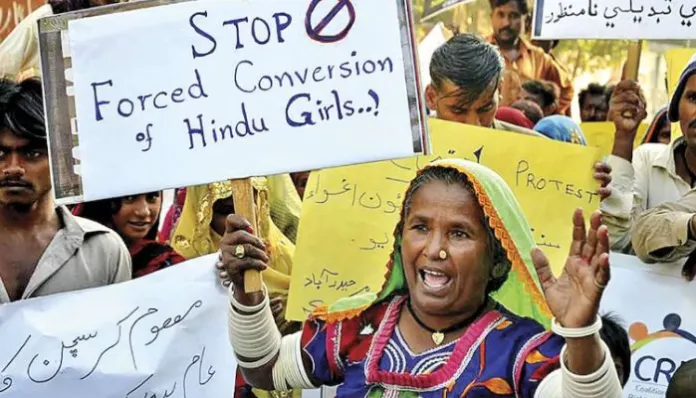
Furthermore, women belonging to the minority group are forced to convert to Islam and are forcefully married to Muslim men. Christian and Hindu girls are especially at risk of forced religious conversion, abduction, trafficking, early and forced marriage, domestic servitude, and sexual violence. According to the law, “A woman’s right to choose a spouse and freely enter into marriage is central to her life, dignity, and equality as a human being and must be protected and upheld by law” but on 13 March 2024, a 13-year-old Christian girl [4]was allegedly abducted, forcibly converted to Islam, and married to her abductor after her age was recorded as 18 on the marriage certificate. Regardless of children’s right to freedom of thought, conscience, and religion by Article 14 of the Convention on the Rights of the Child, changing the religion or belief must always be voluntary and free from coercion or undue inducement.

Moreover, Pakistan’s political system includes reserved seats for minorities and women in legislative bodies. However, the representation of minority women in politics remains minimal. Only around 5.5% of minority women are members of a political party, 0.4% hold office, and 1.5% are representatives. Among them, 18% are not part of the decision-making process, and only 4% take part in decision-making[5]. Those who hold political office often face significant obstacles, including discrimination, harassment, and threats. Cultural and societal norms restrict their participation, and they often lack the support and resources to engage effectively in political activities.

LEGAL AND INSTITUTIONAL FRAMEWORK
The Constitution of Pakistan contains various provisions aimed at safeguarding the rights of minorities, including minority women. These constitutional protections are intended to ensure equality, non-discrimination, and security for all citizens, irrespective of religion or gender. Here are the key constitutional provisions relevant to the rights of minority women in Pakistan:

  • Article 20: Freedom of Religion – This article guarantees every citizen the right to profess, practice, and propagate their religion. It also provides for the right to establish, maintain, and manage religious institutions.
  • Article 25: Equality of Citizens- Article 25 ensures that all citizens are equal before the law and are entitled to equal protection of the law. It explicitly prohibits discrimination based on sex and religion. Sub-clause 2 of Article 25 states: “There shall be no discrimination based on sex alone. Sub-clause 3 allows the state to make special provisions for the protection of women and children.
  • Article 26: Non-Discrimination in Respect of Access to Public Places-This article guarantees that every citizen shall have access to places of public entertainment or resort without discrimination based on race, religion, caste, sex, residence, or place of birth.
  • Article 27 ensures that no citizen otherwise qualified for appointment in the service of Pakistan shall be discriminated against in respect of any such appointment on the grounds of race, religion, caste, sex, residence, or place of birth.
  • Article 32: Representation in Local Government Institutions emphasizes the promotion of local government institutions and ensures special representation of peasants, workers, and women in these institutions.
  • Article 34: Full Participation of Women in National Life mandates that steps shall be taken to ensure the full participation of women in all spheres of national life.
  • Article 36: Protection of Minorities specifically directs the state to safeguard the legitimate rights and interests of minorities, including their due representation in the federal and provincial services.

Even though Pakistan’s constitution guarantees certain rights, it fails to protect the rights of minority women. These women are deprived of basic human rights, such as the freedom to practice the religion of their choice and other basic fundamental rights.

Convention on the Elimination of all Forms of Discrimination Against Women (CEDAW): Pakistan ratified the Convention on the Elimination of All Forms of Discrimination Against Women (CEDAW) on April 12, 1996, 17 years after it was adopted by the UN General Assembly in 1979. In 2005, the country submitted its combined initial, second, and third periodic reports, showing progress on gender equality, women’s access to political and public life, education, health, and employment. In 2018, Pakistan submitted its fifth periodic report, demonstrating policy reforms in compliance with treaty obligations. The CEDAW Committee’s concluding observations in March 2020 requested Pakistan to submit a follow-up report within two years, including requests to criminalize all forms of gender-based violence against women, adopt a national plan of action to combat all forms of GBV against women, ensure effective enforcement of anti-trafficking and anti-smuggling laws, and increase school enrollment among girls while reducing their dropout rate.

It is important to remember that despite constitutional protections, the real challenge lies in implementing these rights. Minority women in Pakistan often encounter systemic barriers and societal discrimination that prevent them from fully realizing their constitutional rights. To address these issues, continuous efforts are needed to strengthen the legal framework and ensure effective enforcement of laws protecting minority women.

CONCLUSION
The circumstances of minority women in Pakistan mirror broader issues of gender and religious bias in the country. Despite some positive advancements, significant barriers still exist. Overcoming these challenges necessitates a comprehensive approach involving legal reforms, economic empowerment, political engagement, and societal transformation. Through persistent advocacy for the rights and respect of minority women, Pakistan can move towards a more inclusive and just society. Significant changes are needed to empower women and girls who are abducted, forcibly converted, or coerced into marriage. We must also work towards transforming the communities where these incidents occur so that such atrocities become unthinkable. There is never a valid justification for the violence and mistreatment of women and girls, regardless of when and where it occurs. Pakistan is a powerful reminder that challenges to women’s rights are not limited to a specific region. It highlights the vulnerability of hard-earned progress in gender equality and women’s rights, underscoring the global significance of advocating for women’s rights and gender equality as a universal cause.


REFERENCES
About minorities and human rights. (n.d.). https://www.ohchr.org/en/special-procedures/sr-minority-issues/about-minorities-and-human-rights

Jivan, J. (n.d.). Life on the margins: A Study on the Minority Women in Pakistan. https://www.europarl.europa.eu/meetdocs/2009_2014/documents/droi/dv/811_lifemargins_/811_lifemargins_en.pds

Gill, M., Aqeel, A., Dogra, B., Rabeeah Malik, Jessica Bakhshi, Sonia Patras, Jayaa Jaggi, Safina Javed, Anita Saleem, & Shamshad Malik. (2022). Stories of Resilience and Resolve: an intersectional study on the plight of Non-Muslim women and girls in Pakistan. https://thesouthasiacollective.org/wp-content/uploads/2023/02/ResearchPaper_MinorityWomen_Pakistan.pdf

UN Women. (2023). NATIONAL REPORT ON THE STATUS OF WOMEN IN PAKISTAN, 2023 – A SUMMARY. https://pakistan.unwomen.org/sites/default/files/2023-07/summary_-nrsw-inl_final.pdf

[1] Office of the United Nations High Commissioner for Human Rights works to promote and protect human rights

[2] The CEDAW treaty is a tool that empowers women throughout the world to effect change in their daily lives. In countries that have joined the treaty, CEDAW has proven helpful in combating the effects of discrimination, such as violence, poverty, and a lack of legal safeguards, as well as the denial of inheritance, property rights, and credit.

[3]Global Gender Gap Report 2023 Benchmarking gender gaps, 2023 – Global Gender Gap Report 2023 | World Economic Forum (weforum.org)

[4] Pakistan: UN experts alarmed by lack of protection for minority girls from forced religious conversions and forced marriage.(n.d.).https://www.ohchr.org/en/press-releases/2024/04/pakistan-un-experts-alarmed-lack-protection-minority-girls-forced-religious

[5] Life on the margins: A Study on the Minority Women in Pakistan(2012) https://www.europarl.europa.eu/meetdocs/2009_2014/documents/droi/dv/811_lifemargins_/811_lifemargins_en.pds


AUTHOR
G K Rhiya Jency,
Loyola College, Chennai
Currently Intern at Red Lantern Analytica

Related Intelligence

COMMENTARIESAUGUST 20, 2026
01

Evergrande’s Fall Exposes the Deeper Fault Lines in China’s Property-Led Growth Model

The sentencing of Hui Ka Yan, Xu Jiayin, founder of the China Evergrande Group, to life in prison marks the conclusion of more than just the fall of one of China’s biggest businessmen. Hui was found guilty of eight offenses, including fraud, misappropriation of funds, securities violations, and bribery. Evergrande, formerly the largest real estate developer in China by contracted sales, turned to almost all of its $300 billion plus liabilities. Hui’s trial may mark the end of a significant legal case, but the Evergrande case does not end the massive economic case Evergrande came to represent. China’s real estate bubble was not a tale of just increasing house prices. It involved a tightly connected system of households, developers, banks, and local governments. Property became the main wealth purchasing and saving vehicle for Chinese households. In a survey by the People’s Bank of China, 59.1% of urban households’ assets were held in the form of housing, and the home ownership rate was 96%. Increasing house prices had an effect beyond an increase in construction. House prices had a positive effect on household wealth perceptions, confidence, and consumption. For developers, the system was designed to incentivize expansion. Land was bought and presold apartments, loans made it possible for developers to start new projects, and growing property evaluations enabled more borrowing. Evergrande was one of the developers who pushed the system the farthest. It can be described as the “three highs” consisting of high turnover, high costs, and high leverage. Evergrande’s model was to raise capital, buy land on a massive scale, and begin development while also borrowing against their land and starting the cycle over. So long as lenders continued to lend and buyers continued to buy, investors and developers alike continued to benefit from the cycle and the land and housing prices continued to grow. Local government interests were aligned with the developers. After the 1994 tax-sharing reform, the central government gained more revenue, leaving local governments shouldering a greater financial burden. To offset some of the burden, local governments sold land to developers and used land as collateral for loans. By 2019, it is calculated that local governments’ reliance on land finance was at 38.6 percent, with over 50 percent in many large cities. Property prices and local government finance and debt fuelled a cycle of increasing infrastructure spending. This outlines how vital property investment became for China. The IMF put the contribution of property to the economy at up to 20 percent. However, this number does not even come close to capturing the extent of property’s reach. Building property creates the need for the transport of raw materials. That includes steel, cement, and glass, as well as the machines to build the property, appliances, and furniture. Glass and machinery need to be transported using logistics and financial services. Property building employs contractors. Developers take out mortgages and corporate loans. Local governments earn money from the sale of land. So, property not only includes one of many sectors of the economy, but becomes a complete economic system. It becomes very clear how this system would collapse if the opposite of what is expected were to occur. This is the nature of a bubble. Every apartment does not become worthless. It means that the cost of the property, along with construction and the loans used to finance the purchase, became more dependent on whether people thought the price and demand for property would continue to rise. If people begin to think the cost of property will fall, then the same thing happens in the opposite order. Buyers will delay purchases, developers will not earn presale income, government revenue will fall, and banks will be more cautious of extending loans. Beijing recognized the risks so they began to tighten financial regulations starting in 2016. In 2020, The “Three Red Lines” Framework was established. Beijing’s goal was to limit debt for highly leveraged developers. From a macroeconomic standpoint it was necessary to limit debt. The problem was that leverage had become endemic throughout the system. It was really wishful thinking that it would discipline poorly managed developers because it made the business models of other driven companies more dependent on constantly selling new property and taking out new loans to continuously refinance debt. Evergrande exemplified the most famous case of China’s real estate collapse. Their failure impacted far more than themselves. Suppliers weren’t getting paid, construction companies went bankrupt and halted their projects, buyers had to wait to get their newly financed homes, and the creditors began to doubt the feasibility of their investments. Media states that Evergrande’s liquidation is slow and only $255 million of assets were sold by August of 2025 with claims against those assets totalling $45 billion. The possibility of China suffering a sudden replication of America’s 2008 “Lehman moment” is low. China’s financial system is more state-controlled, and the major banks are capable of being directed to provide support. Further, the capacity of Beijing to avoid excessive failure is far higher than the capacity of America at that same part in its history. The more likely threat is a prolonged balance-sheet adjustment where weakness in the property market will slow economic activity for many years. This trend continues through 2026. In July, Chinese new-home prices fell by 3.2% compared to the previous year. Of the 70 cities monitored, only 17 showed an increase in prices from the previous month. The first 7 months of the year also showed declining trends in property sales, investment, and new construction. During this period, the revenue of the Chinese government from land sales declined by 31.5% and was recorded at 977.8 billion yuan. These figures show a weakening trend in property and reflect declining private investment and local government finances. This trend is most problematic for households. When the primary investment of a household falls in value, households become more conservative. Household wealth falls and household members that own houses feel poorer, even if they have no intention of selling.

TR
Team Red Lantern AnalyticaAnalyst
arrow_outward
COMMENTARIESJULY 25, 2026
02

𝐀 𝐃𝐢𝐯𝐢𝐝𝐞𝐝 𝐇𝐨𝐮𝐬𝐞 – 𝐋𝐞𝐠𝐚𝐜𝐲 𝐯𝐬 𝐑𝐞𝐚𝐥𝐢𝐭𝐲: 𝐅𝐫𝐚𝐜𝐭𝐮𝐫𝐞 𝐢𝐧 𝐍𝐒𝐂𝐍 (𝐈𝐌) & 𝐑𝐢𝐬𝐞 𝐨𝐟 𝐭𝐡𝐞 𝐑𝐢𝐯𝐚𝐥 𝐏𝐫𝐨𝐯𝐢𝐬𝐢𝐨𝐧𝐚𝐥 𝐆𝐨𝐯𝐞𝐫𝐧𝐦𝐞𝐧𝐭 𝐢𝐧 𝐌𝐲𝐚𝐧𝐦𝐚𝐫

N𝐞𝐰 𝐏𝐮𝐛𝐥𝐢𝐜𝐚𝐭𝐢𝐨𝐧 | 𝐑𝐞𝐝 𝐋𝐚𝐧𝐭𝐞𝐫𝐧 𝐀𝐧𝐚𝐥𝐲𝐭𝐢𝐜𝐚 Red Lantern Analytica presents a new strategic analysis: “𝐀 𝐃𝐢𝐯𝐢𝐝𝐞𝐝 𝐇𝐨𝐮𝐬𝐞 – 𝐋𝐞𝐠𝐚𝐜𝐲 𝐯𝐬 𝐑𝐞𝐚𝐥𝐢𝐭𝐲: 𝐅𝐫𝐚𝐜𝐭𝐮𝐫𝐞 𝐢𝐧 𝐍𝐒𝐂𝐍 (𝐈𝐌) & 𝐑𝐢𝐬𝐞 𝐨𝐟 𝐭𝐡𝐞 𝐑𝐢𝐯𝐚𝐥 𝐏𝐫𝐨𝐯𝐢𝐬𝐢𝐨𝐧𝐚𝐥 𝐆𝐨𝐯𝐞𝐫𝐧𝐦𝐞𝐧𝐭 𝐢𝐧 𝐌𝐲𝐚𝐧𝐦𝐚𝐫.” Authored by Lt. Col. Ujjual Abhishek Jha, DCPP (Retd.), this examines the recent organisational split within NSCN (IM), the emergence of the Eastern Flank-led Provisional Government, and its implications for the Naga peace process, cross-border insurgency, and India’s security landscape in the Northeast. Download Link: A Divided House Legacy vs Reality Fracture in NSCM-IM and Rise of the Rival Provisional Government in Myanmar

TR
Team Red Lantern AnalyticaAnalyst
arrow_outward
COMMENTARIESAUGUST 21, 2025
03

Reimagining Oman as an Indian Ocean Green Hub: Looking at a Post-Carbon Future

The few stereotypes that persist regarding the Gulf are of its importance as a hydrocarbon centre over the past eight decades, since Bahrain and Saudi Arabia struck Oil in the 1930s. Oman, in comparison, struck Oil in Fahud in 1962, and shipped its first container from Mina Al Fahal in 1967. The oil revenues formed the bedrock of rebuilding the country during the 1970s, during which the Dhofar rebellion was still on. Oman is a Shell country, like Brunei, where Shell has been strategic in the country’s hydrocarbon exploration through a major stake in Petroleum Development Oman, or PDO, as commonly known. Many PDO employees have worked for Shell Brunei and Shell Sarawak as a part of their career circulations in the global MNC network. Oman was never a massive producer of petroleum as its wealthier neighbours in the GCC, even though its natural gas imprint is significant. Natural Gas is a key transition fuel, and Quriyat LNG in Sur has many long-term contracts with Korea, China, and Japan. However, Oil and Gas still form a major chunk of the GDP in Oman. Diversification has been on the agenda since the late 1980s, as localisation has always been a priority. Years of peak oil prices have led to the creation of avant-garde infrastructure and the education of a couple of generations overseas on scholarships, which was a byproduct of oil income. Now, the scenario has evolved as Oman’s population has increased, and the youth seeking work is often the refrain, as gauged from the comments section in the social media feeds. The cause of the Arab Spring protests in Sohar was corruption and lack of jobs, which led to a few heads turning. The post Sultan Qaboos era, under the able leadership of His Majesty Sultan Haitham Bin Tarik has moved towards diversification in a major way, seeking relationships far and wide. His Majesty has had meetings with the Dutch Leadership, President Putin in Moscow, Prime Minister Modi in Delhi, and the UK Minister Starmer within the past few months. The rich legacy of Oman being the Switzerland of the Middle East helps in its vital role in mediating the Yemeni crisis and as a trusted participant in the Iran paradigm, helps. Oman also controls half of the crucial Straits of Hormuz. Ibadhi Oman’s history as a littoral maritime empire has its long shadow in the present. Muscat is a diverse place, full of Zanzibaris, Baluchis, Ajmi’s, Lawati’s, and Hindu Bania’s, and other communities who were a part of the Omani imperial grid. The strategic culture of the Omani elite is transnational, with many Omani having ties across East Africa to Africa. Pankaj Khimji, an advisor to the Omani government, is a key Bania interlocuter between Muscat and Delhi via Mandvi. India and Oman have finalised the FTA negotiations recently. Aden was governed by the Bombay Presidency until 1937. These close ties entail prospects of power being exported to India/ Pakistan/East Africa via a subsea cable in the future. The engineering and program management excellence achieved by the national building efforts of PDO, especially in terms of talent development for the renewable sector, over the past decades. The first solar project was helmed by PDO as seen in the Amin Solar project. This is similar to the Aramco State, where the best expertise in Saudi Arabia lies with the engineers in the oil major. A glimpse of it was illustrated in Ellen R Wald’s book[1], which showed the role National Oil Companies have played in nation-building. Oman’s location as an Indian Ocean actor was confirmed with it hosting the Indian Ocean Conference this year in Muscat, where Member of Parliament Naveen Jindal ji spoke. Jindal operates one of the largest steel mills in the Middle East in Sohar. The ACME Group is coming up with a green hydrogen facility in the special economic zone in Duqm on the Arabian Sea coast. Duqm is also home to a naval base, which plays host to many navies, as it is close to the Horn of Africa piracy corridor. The green hydrogen corridor in Al Wusta and Dhofar is underway as ACWA Power from Saudi Arabia is investing in a green hydrogen facility in the southern Dhofar region. Another ACWA Power project in the form of Ibri 2 IPP is a project I know rather intimately. I was the lead social specialist for an impact assessment report for a multi-million-dollar 500MW solar park on the Saudi border. Long-term migrant workers from South Asia were identified as camel farmers in the desert on project land., However, during a recce visit and after speaking to long-term migrant workers looking after camels, we discovered that they were extremely precarious, relying on a solar-powered battery charger for mobile phones and to light a bulb. These workers, who were heavily reliant on precarious work, were being moved away from their off-grid homes to build a Chinese-funded solar park in relatively prosperous Oman. The irony was not lost on me. Globally accepted ESG governance norms kicked in, the move triggered an independent Resettlement Action Plan for these workers. Climate and Local developmental politics intersect in the middle of nowhere. The Beijing-based Asian Infrastructure Investment Bank or AIIB is the backer for the Ibri 2 Project, and Chinese contractors were the hands on Ibri 2. Belt and Road is right on our doorstep. Indian Engineers and Consultants work on these Chinese-funded projects as the technical hands behind the scenes. There are numerous other solar projects in the pipeline in the Wilayat of Manah. These areas are close to the Saudi Border and could be a part of an integrated GCC power grid. Oman’s great strength in terms of land needed for renewable projects is a plus, along with its positioning between the Gulf, South Asia, and East Africa, which makes it an Indian Ocean Green Hub[2] in the making. [1] https://www.amazon.in/Saudi-Inc-Arabian-Kingdom%60s-Pursuit/dp/168177660X [2] https://mem.gov.om/en-us/Our-Business/Renewable-Energy-and-Hydrogen/Renewable-Energy-and-Hydrogen-Projects Authored By: Manishankar Prasad PhD Scholar, University of Malaya

TR
Team Red Lantern AnalyticaAnalyst
arrow_outward