
INDIA IN THE INDO-PACIFIC: STRATEGIC SIGNIFICANCE AND GEOPOLITICAL DYNAMICS
INTRODUCTION
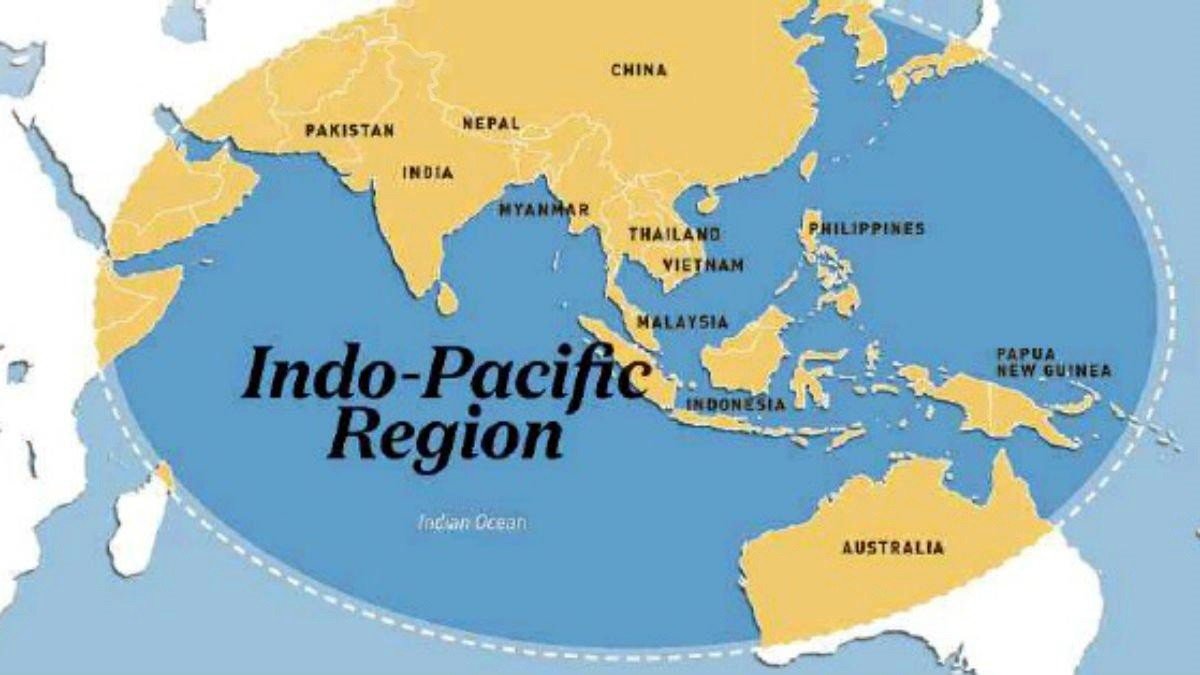
The Indo-Pacific region has emerged as a critical arena for geopolitical and strategic engagements in the 21st century. India, with its significant geographical positioning, burgeoning economy and evolving foreign policy, has become a pivotal player in this dynamic landscape. This article explores India’s strategic realignment in the Indo-Pacific, examining its policies, alliances and challenges in navigating this complex and often contentious region. The analysis delves into historical contexts, current strategic frameworks, and future implications of India’s Indo-Pacific strategy, providing a comprehensive understanding of its role and aspirations.
The concept of the Indo-Pacific has gained prominence in international relations discourse, reflecting the interconnectedness of the Indian and Pacific Oceans as a single strategic entity. This region encompasses some of the world’s most significant sea lanes, facilitating the bulk of global maritime trade. The Indo-Pacific is not merely a geographical construct but a strategic space defined by the interactions of major global and regional powers. India, situated at the crossroads of this region, has increasingly aligned its strategic outlook with the Indo-Pacific framework. This shift signifies a departure from its traditional focus on South Asia and a response to the evolving geopolitical landscape characterized by the rise of China and the strategic interests of other major powers like the United States, Japan, and Australia. Historically, India’s peninsular configuration, surrounded by three waters with a coastline stretching over 7,500 km, has made it a natural maritime power. The Indian Ocean, the Arabian Sea and the Bay of Bengal have been crucial conduits for trade, cultural exchanges, and strategic interactions. This legacy of maritime engagement dates back to ancient times when Indian merchants and sailors traversed these waters, establishing trade links with Africa, Southeast Asia, and the Arabian Peninsula.
India’s engagement with the Indo-Pacific is rooted in its historical maritime traditions and colonial past. The Indian Ocean, often regarded as India’s strategic backyard, has long been a conduit for trade, cultural exchange, and influence. Post-independence, India’s foreign policy was primarily shaped by non-alignment and a focus on regional stability. However, the end of the Cold War and the onset of globalization necessitated a reorientation of its strategic priorities. The Look East Policy, initiated in the early 1990s, marked the beginning of India’s strategic outreach to Southeast Asia and beyond. This policy laid the groundwork for India’s current Indo-Pacific strategy, emphasizing economic integration, maritime security, and diplomatic engagement. In the contemporary era, India’s strategic orientation towards the Indo-Pacific has been shaped by several historical milestones. The end of British colonial rule in 1947 marked the beginning of India’s independent foreign policy, initially characterized by non-alignment and a focus on regional solidarity which led to a more pronounced engagement with the Indo-Pacific.
STRATEGIC SIGNIFICANCE OF THE INDO-PACIFIC
The Indo-Pacific region holds immense strategic significance for India for several reasons. Firstly, the region is a hub of global maritime trade, with critical sea lanes of communication (SLOCs) passing through it. These SLOCs, including the Straits of Malacca, Lombok and Sunda, are vital for the flow of energy, goods, and resources. As a net importer of energy, goods and resources. As a net importer of energy, India’s economic security is intrinsically linked to the stability and security of these maritime routes.
Secondly, the Indo-Pacific region is characterized by a dynamic and evolving security architecture. The rise of China and its assertive policies, including the Belt and Road Initiative (BRI) and the militarization of the South China Sea, pose significant strategic challenges. India’s strategic calculus in the Indo-Pacific is influenced by the need to counterbalance China’s growing influence and ensure a stable and multipolar regional order.
Thirdly, the Indo-Pacific is home to a diverse array of political, economic and cultural entities. This diversity presents both opportunities and challenges for India. On one hand, it allows India to forge strategic partnerships with like-minded countries such as Japan, Australia, and ASEAN nations. On the other hand, it necessitates a nuanced and flexible foreign policy approach to navigate the complex regional dynamics.
INDIA’S INDO-PACIFIC STRATEGY
India’s Indo-Pacific strategy is multifaceted, encompassing diplomatic, economic, and military dimensions. At the core of this strategy is the vision of a free, open and inclusive Indo-Pacific strategy that is multifaceted, encompassing diplomatic, economic and military dimensions and articulated by Prime Minister Narendra Modi in his keynote address at the Shangri-La Dialogue in 2018. This vision emphasizes respect for sovereignty, international law and a rules-based order.
Diplomatically, India has sought to enhance its engagements with key regional actors and multilateral institutions. The Act East Policy, a cornerstone of India’s foreign policy, aims to strengthen economic and strategic ties with Southeast Asian countries. This policy has evolved from the earlier Look East Policy, reflecting a more proactive and assertive approach.
India has also deepened its strategic partnerships with major Indo-Pacific powers. The Quad, comprising India, the United States, Japan and Australia, represents a significant diplomatic initiative aimed at promoting security and stability in the region. The Quad’s agenda includes maritime security and disaster relief, reflecting a comprehensive approach to regional challenges.
In addition to the Quad, India has engaged with regional forums such as the ASEAN Regional Forum (ARF), East Asia Summit (EAS), and the India Ocean Rim Association (IORA). These multilateral engagements underscore India’s commitment to a cooperative and inclusive regional order.
Economically, India has sought to leverage its strategic location and burgeoning market potential to enhance regional connectivity and trade. The development of infrastructure projects such as the Sagarmala initiative, aimed at modernizing India’s port infrastructure, and the Bharatmala project, focused on improving road connectivity, are integral to India’s Indo-Pacific strategy. These initiatives aim to bolster India’s role as a regional hub for trade and logistics.
India has also pursued bilateral and multilateral trade agreements to enhance economic integration with the Indo-Pacific region. The Indian-ASEAN Free Trade Agreement and the Comprehensive Economic Partnership Agreements (CEPAs) with countries such as Japan and South Korea are indicative of this approach. Furthermore, India’s involvement in regional economic frameworks such as the Regional Comprehensive Economic Partnership (RCEP) negotiations reflects its commitment to fostering economic ties, although it opted out of the RCEP due to concerns over market access and trade imbalances.
On the military front, India has significantly enhanced its maritime capabilities and strategic reach. The Indian Navy’s modernization and expansion are central to India’s Indo-Pacific strategy. Initiatives such as the commissioning of new aircraft carriers, submarines and advanced warships are aimed at ensuring a credible and effective maritime presence. The establishment of the Andaman and Nicobar Command, India’s only tri-services command, underscores the strategic importance of the eastern Indian Ocean and the Andaman Sea.
India has also intensified its defense cooperation with key Indo-Pacific partners. Bilateral naval exercises such as the Malabar Exercise with key Indo-Pacific partners, AUSINDEX with Australia, and SIMBEX with Singapore, as well as multilateral exercises like the MILAN, enhance interoperability and strategic coordination. These exercises not only demonstrate India’s maritime capabilities but also signal its commitment to regional security.
The development of strategic military facilitates and agreements further bolster India’s strategic posture. Agreements such as the Logistics Exchange Memorandum of Agreement (LEMOA) with the U.S., the Acquisition and Cross-Servicing Agreement (ACSA) with Japan, and the Mutual Logistics Support Agreement (MLSA) with Australia facilitate logistical support and operational cooperation, enhancing India’s strategic reach and sustainability in the Indo-Pacific.
India’s engagement with the Indo-Pacific is not without challenges. The foremost challenge is the rise of China and its assertive policies in the region. China’s territorial claims in the South China Sea, its Belt and Road Initiative (BRI) and its growing military capabilities pose significant strategic challenges for India. Balancing cooperation and competition with China remain a delicate task for Indian policymakers.
Another challenge is the complex and diverse political landscape of the Indo-Pacific. The region encompasses a wide array of political systems, economic models and cultural contexts. Navigating these cultural contexts. Navigating these complexities requires a nuanced and adaptable foreign policy approach. India must balance its relations with various regional actors, ensuring that its engagements are seen as inclusive and non-confrontational
The economic dimension also presents both opportunities and challenges. While the Indo-Pacific region offers vast economic potential, issues such as trade imbalances, protectionist policies, and infrastructural bottlenecks need to be addressed. Enhancing regional connectivity, ensuring equitable trade relations, and fostering economic integration are key to realizing the economic potential of the Indo-Pacific.
Opportunities for India in the Indo-Pacific are manifold. The region’s strategic importance offers India a platform to enhance its global standing and influence. By positioning itself as a key player in the Indo-Pacific, India can leverage its strategic location, democratic values, and economic potential to foster regional stability and prosperity.
The Indo-Pacific also offers opportunities for India to deepen its strategic partnerships. The Quad, for instance, provides a platform for India to collaborate with like-minded democracies on issues of mutual concern. Enhanced defense cooperation, intelligence sharing, and joint strategic initiatives with Indo-Pacific partners can bolster India’s security and strategic posture.
FUTURE PROSPECTS
The future of India’s Indo-Pacific strategy hinges on its ability to navigate these challenges and leverage its strengths. The future of India’s role in the Indo-Pacific will be shaped by several factors. Firstly, the evolving geopolitical landscape, particularly the U.S.-China strategic competition, will significantly influence India’s strategic choices. India’s ability to navigate this complex dynamic and maintain strategic autonomy will be crucial.
Secondly, India’s domestic capabilities will play a critical role. Economic growth, technological advancements and military modernization are essential for India to project power and influence in the Indo-Pacific. Strengthening domestic capabilities will enhance India’s strategic leverage and enable it to play a more proactive role in regional affairs.
Thirdly, regional cooperation and multilateralism will be key to India’s Indo-Pacific strategy. Engaging with regional forums, fostering economic integration, and enhancing strategic partnerships will be central to India’s approach. Building a network of strategic partnerships will be central to India’s approach.
Moreover, strengthening strategic partnerships will remain a priority for India. The Quad is likely to play a central role in this regard, with potential expansions to include other like-minded countries. Enhancing bilateral and multilateral defense cooperation, particularly in areas such as Maritime Domain Awareness, cyber security and counterterrorism, will be crucial. India’s engagements with ASEAN, IORA, and other regional organizations will continue to provide platforms for dialogue and cooperation.
Economic integration with the Indo-Pacific region will be a key focus for India. Enhancing connectivity through initiatives like the Asia-Africa Growth Corridor (AAGC) and participating in regional trade agreements can boost India’s economic footprint. Infrastructure development, particularly in maritime and digital domains, will be essential to support these efforts. Additionally, fostering innovation and technology partnerships can drive economic growth and create new avenues for collaboration.
Maintaining maritime dominance in the Indian Ocean will be critical for India’s strategic interests. This involves not only enhancing naval capabilities but also developing comprehensive maritime policies that address issues such as blue economy, environmental sustainability, and maritime dominance in the Indian Ocean will be critical for India’s strategic interests. This involves not only enhancing naval capabilities but also developing comprehensive maritime policies that address issues such as blue economy, environmental sustainability, and maritime governance4. India’s leadership in initiatives like the Indo-Pacific Oceans Initiative (IPOI) reflects its commitment to promoting a rules-based maritime order.
Diplomatic agility will be essential for India to navigate the complexities of the Indo-Pacific. This involves maintaining a pragmatic and flexible approach to regional engagements, leveraging its soft power, and building coalitions on shared interests. India’s role as a net security provider and a proponent of inclusive regional architecture will reinforce its strategic relevance.
CONCLUSION
In conclusion, India’s role in the Indo-Pacific is pivotal to the region’s strategic landscape. As a major maritime power with a strategic location, India’s engagement with the Indo-Pacific is driven by historical legacies, economic imperatives, and security considerations. The challenges and opportunities in the region necessitate a comprehensive and proactive approach, encompassing diplomatic, economic, and military dimensions. By leveraging its strengths and fostering strategic partnerships, India can play a crucial role in ensuring a stable, prosperous, and inclusive Indo-Pacific.
India’s evolving role in the Indo-Pacific represents a strategic realignment driven by the imperatives of securing its maritime interests, counterbalancing China’s influence, and fostering regional stability. While significant challenges remain, India’s proactive engagement, strategic partnerships, and emphasis on economic integration and maritime security position it as a key player in the region. The success of India’s Indo-Pacific strategy will depend on its ability to navigate the complex geopolitical landscape, leverage its strengths, and sustain its strategic initiatives. As the Indo-Pacific continues to shape the contours of the global geopolitical landscape, leverage its strengths, and sustain its strategic initiatives. As the Indo-Pacific continues to shape the contours of global geopolitics, India’s role will be pivotal in ensuring a stable and secure regional order.
REFERENCES
- Brewster, D. (2014). India’s Ocean: The Story of India’s Bid for Regional Leadership.
- Chaudhuri, R., & Kalyanaraman, S. (2019). India and the Indo-Pacific: In Pursuit of a New World Order.
- Grare, F., & Mattoo, A. (Eds.). (2013). India and the World: International Relations and Security Perspectives. HarperCollins India.
- Kapila, S. (2018). India’s Foreign Policy in the 21st Pentagon Press.
- Malik, M. (2012). China and India: Great power Rivals. Lynne Riener Publishers.
- Pant, H. V. (2019). New Directions in India’s Foreign Policy: Theory and Praxis. Cambridge University Press.
- Scoot, D. (2012). Handbook of India’s International Relations
 AUTHOR
Akanksha Pal
RLA Research intern