Narco-Arms Trafficking from Afghanistan
Abstract
Arms and drug trafficking have long been associated with Afghanistan and have been intricately entwined with the country’s turbulent past. Arms smuggling in Afghanistan dates back to resistance against British colonial forces in the 19th century. Afghan tribes relied on clandestine networks to obtain weapons from neighbouring regions like Persia and Central Asia, crucial for their fight for independence. This tradition persisted into the 20th century, remaining significant despite Afghanistan’s independence from British Forces, due to its rugged terrain and porous borders facilitating clandestine activities. However, since the Soviet invasion of Afghanistan and the US-Pakistan involvement in the war, arms smuggling further flourished, with war groups receiving weapons through Pakistan.
Whereas, the scale of production of Opium was relatively small in Afghanistan before the Soviet invasion and there was not a well-established narco-smuggling network as is seen in later decades. However, in the 1960s and 1970s, the demand for Afghan drugs grew beyond regional markets of Middle East, Central Asia, and Southeast Asia. The narcotics phenomenon peaked during the country’s civil war and became an infamous source of income for the group during the Taliban’s rule in 1996.
Since then, Afghanistan has suffered from these two ominous phenomena. After 2001 and the US invasion of Afghanistan, several measures were taken to combat these phenomena, but the scope was so strong that despite the presence of the United States and NATO, it did not stop it at all. The United States spent 9 billion dollars in counternarcotic operations in Afghanistan since 2002. (HEARING, 2020) Now that the Taliban have once again come to power, the question has been on the minds of many experts: will drug and arms trafficking, which are important sources for the survival of terrorist groups in the region and the world, increase?
Drugs trafficking
As many experts argue that there is a deep and growing relationship between terrorism and drugs. In fact, in the cultivation of narcotics, large networks of trafficking and its refinement are the main sources of funding for the war economies of terrorist groups. For this reason, drug cultivation is common in countries where terrorism has deep roots and is prone to violence and extremism.
Historically, the British East India Company monopolized the opium trade in Asia during the 18th century to fund its expansionist goals with tightly controlled production levels to maintain high prices. Facing competition from Turkey and Persia in the Chinese market, Britain increased opium cultivation in Bengal and Bihar. To meet demand, cultivation expanded to Afghanistan during British friendly Emir Abdur Rahman Khan’s rule (1880-1901). Opium produced in Afghanistan was exported to China, India, and Russia. ( UNODC , 2008) The Mahaban Mountains along the Afghanistan-Pakistan border became a prime cultivation area. Opium trade flourished in British India’s North-West Frontier Province (now Khyber Pakhtunkhwa, Pakistan), where it remains prevalent even today. Although opium production was limited to the Mahaban Mountains, this period marked Afghanistan’s first time ever formal engagement in the opium trade under Abdur Rahman’s government. (Winston, 2022)
The “Golden Crescent” region, which includes Afghanistan, southwestern Pakistan and southeastern Iran, is one of the major geographical areas for the cultivation, packaging, refining and trafficking of narcotics especially Opium, Hashish and Heroin, which plays a major role in the rotation of this security phenomenon. (Sen, 1992) More recently, the methamphetamine industry has also intensified in Afghanistan. Before Afghanistan entered a cycle of violence, war, and terrorism, other countries like Colombia, Mexico & Myanmar were major producers of narcotics, known as the “crescent zone,” which produced and trafficked a significant portion of the world’s narcotics.
Although narcotics cultivation in Afghanistan has a long history, the beginning of the armed struggle against Soviet aggression in Afghanistan, the civil war within the Mujahidin and the emergence and rise of great warlords mark the peak of the cultivation, refining and major smuggling of opium. This was the time when warlords gained more power and controlled a particular region in the country such as the Northern Alliance in the north and Haqqani network, Hezb-e-Islami and the Taliban group in the Southeast. When the old Mujahidins were ousted in the midst of a civil war fighting against more extremist, harsh and violent version with an Islamic ideology i.e. Taliban in 1994, drug production and trafficking peaked and the Taliban’s birth coincided with the stormy birth of the narcotics phenomenon on a large scale. (Peters, 2009)
Furthermore, in the 1980s, the CIA’s support of the Afghan mujahidin resulted in a significant increase in opium production in Afghanistan. This surge in production facilitated the expansion of heroin laboratories in Pakistan, which became linked to the global market. By 1989, after a decade of substantial CIA covert operations in the region, Afghanistan emerged as the world’s largest supplier of illicit heroin, with Pakistan following closely as the second largest supplier. (Haq, 1996)
 Fig. 1: Afghanistan’s Opium Poppy cultivation from 1996 to 2006 (in hectares)
Source: Strategic Studies Institute, U.S (Glaze, 2007)
During the 1970s, Pakistan led Afghanistan in opium production, but Afghanistan rapidly caught up in the 1980s. Following the Soviet invasion, some Afghan farmers returned to poppy cultivation. The occupation further fueled an illicit economy due to Soviet policies that aimed to starve the mujahidin by destroying food crops. The disruption of agricultural production, combined with neglect from the government and a lack of support from Western and Muslim countries, led to the abandonment of legal agriculture and a turn to opium cultivation in some areas. Heroin profits were used to purchase weapons and food in Pakistan. In 1980s, reports emerged of a drug trade route through Pakistan-occupied Kashmir from the adjacent NWFP that went up the Karakoram Pass into Chinese controlled Xinjiang and Tibet, then down into Nepal; where nearly all the opium was sent to India. As there were no effective controls on the India-Nepal border, the drug supply could pass through to a port for shipment abroad. (Haq, 1996)
Opium and narcotics funded the Taliban’s war economy. Although the consumption and sale of intoxicants are forbidden in Islam, Taliban religious leaders have made a half-hearted and shaky reason for legitimizing it, encouraging peasants to cultivate it, and financing their war machine, which is funded by drug trafficking. The Taliban’s justification for growing opium was also a ploy to deceive the people.
Ahmed Rashid, a well-known Pakistani journalist and writer, met with the Taliban counter-narcotics officer in Kandahar in 1997. He quotes the Taliban regime’s director general of counter-narcotics as arguing that it has banned the cultivation of hashish and the cultivation of opium. According to this high-ranking Taliban official, the opium had a good profit for the farmers as well as for the Taliban, he also said that the opium produced is consumed by Westerners and Kafir (infidels), which is why its cultivation is allowed and cannabis is used internally, and Afghans use it, which is forbidden. (Felbab-Brown, 2021)
Another argument put forward by the Taliban was that if they banned the cultivation of opium, the peasants and farmers would revolt against them and create a big problem for the government and security of their regime. This reason of the Taliban was baseless and they used it only to justify the cultivation, production and trafficking of opium on a global scale for reasons that had no objective and convincing case. Otherwise, the peasant uprising under the Taliban would have been impossible with all the tyranny and oppression that was going on in Afghanistan under the name of religion.
Earlier opium was produced in large quantities in Pakistan, Rashid writes. In 1986, about 70% of the world’s heroin was produced in Pakistan, but according to US and Pakistani policies, the geography of opium cultivation and large heroin refineries moved to southern Afghanistan. Today, large quantities of opiates and methamphetamine are trafficked from Afghanistan to the Torkham border crossing and Ghulam Khan in Khyber Pakhtunkhwa province. From there, they are transported to Lahore and Faisalabad, where they are consolidated into huge consignments. (South Asia Press, 2022)
After Pakistan shifted the geography of opium production to the south of the Taliban, Pakistan’s production of 700 tons of opium in 1986 fell by two tons in 1999. In this way, Pakistan was relieved of world political pressure to shift the burden of opium production to Afghanistan. After the rise of the Taliban, the group boosted the opium trade and Afghanistan became the world’s largest producer of illicit opium. In 1990, it produced 79% of global illicit opium, much of which went to Pakistan and was smuggled under Pakistani intelligence. The presence of the Taliban in Afghanistan and three decades of devastating war have increased the phenomenon of cultivation and drug trafficking, turning Afghanistan into a land of opium and narcotics. (UNODC, 2001)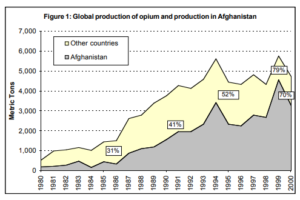 Fig. 2: Global Production of Opium and Production in Afghanistan
Source: United Nations: Office of Drugs and Crime
With this background, the production, cultivation and increase of narcotics in Afghanistan, understanding the relationship between terrorism and narcotics is one of the requirements of this blood-soaked process. Opium and narcotics form the economic core of terrorism in the region. Al-Qaeda, the main arm of the Taliban and thousands of foreign fighters living under the Taliban’s security umbrella, have used drugs in the past and kept their war machine afloat. (Landay, 2021) In fact, terrorism has a synergistic relationship with the production and trafficking of drugs.
After the first fall of the Taliban regime and the resurgence of black ideology and extremism between 2004 and 2010, the Taliban took a broader approach to drug trafficking. They thought that with the income from drugs, they could fight against the United States and the post-war regime. The Taliban have militarily housed and equipped thousands of foreign fighters, set up hundreds of large narcotics networks, and made Helmand, Badakhshan and Nangarhar the main centres of narcotics and heroin production.
The Taliban’s new chapter, after their resurgence early in the second term of former President Hamid Karzai, began when US Special Envoy for Afghanistan Zalmai Khalilzad began systematic and sustained negotiations, whose diplomacy led to the Doha Agreement and active presence of the Taliban the area. The group’s second politico-military uprising was the group’s active presence in the region after the group gained power with the help of Pakistan and all-out with al-Qaeda and international jihadists. (United States Institute of Peace, 2020)
In the Doha agreement, the Taliban pledged to the Americans that they would cut ties with global terrorism and al-Qaeda and expel the group’s fighters from Afghanistan. The Taliban’s approach and commitment to sever ties with international jihadists is a sign of the Taliban’s new approach, but objective evidence and global studies show that the Taliban not only failed to live up to their commitment, but their relationship with global terrorism and al-Qaeda became stronger and stronger.
Prior to 2014, the Taliban’s war economy relied on opium trade, Arab aid, and Pakistani cooperation; although the aid countries played a role in the Taliban’s economic organization; drug trafficking was the Taliban’s most prominent economic pillar, backed by the group’s military. But after 2014, with the Taliban gaining access to highways, mines and natural resources, the group’s economic approach changed. The Taliban extracted natural mines and took control of lucrative highways.
However, about half of the Taliban’s income is financed by drug trafficking. Drug trafficking, which is part of the Taliban’s military and provincial commissions, has in recent years established links with major drug traffickers and cartels from Iran and Pakistan to the Arab world, Turkey, Greece and Europe. Today, much of Afghanistan’s drugs and heroin that go to Europe are refined at major Taliban refineries in Helmand and Badakhshan and exported from the group’s warehouses in Quetta and Peshawar to the world.
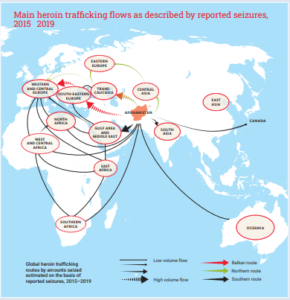
Fig. 3: Main routes of Heroin flow as described by reported seizures from 2015-2019.
Source: United Nations: Office of Drugs and Crime
The Taliban earned about $500 million a year from cultivating, producing and smuggling opium. This shows that not only drugs and opium have played a role in the formation of the Taliban, but also in the survival of the group. (Shaikh, 2021)
The Taliban have not only changed their approach to the war-based economy of smuggling, but they are also smuggling drugs and producing heroin and Crystal meth systematically and coherently with new tools, improved methods, and wider and larger geographical areas. Although there are differences between the military and Taliban political leaders over how to smuggle, it is for personal gain that the military gains in this way and a number of political leaders are excluded.
Just as the group’s policy and approach to global jihad and trans-regional terrorism have not changed; their view of the illicit trade in drugs, glass and heroin has not changed. Today, hundreds of thousands of hectares of land are cultivated in the territory of the Taliban, and there are hundreds of Anbar (a place where drugs are stored for shipment) and refineries in border and strategic provinces to refine and maintain these shipments for export to countries around the world. Exports, the bulk of which goes to the Taliban and Pakistani intelligence to keep the Taliban fighting machine active.
Now that the tide has turned and the Taliban have regained control of Afghanistan, the group claims to be serious about fighting drugs. Mullah Hebatullah Akhundzadeh, the leader of this group, has ordered that the cultivation, trafficking and use of any kind of drugs be prohibited and a crime. (ANI, Taliban announce ban on poppy cultivation, 2022) This has resulted in Myanmar becoming the largest producer of Opium. In 2000, Mullah Mohammad Omar issued a similar decree, although his decree had more of a propaganda aspect for the international community than the domestic one. In this regard, two scenarios seem very likely:
First, the Taliban needed international recognition, so they announced that the decision was more propaganda than practical. Secondly, the Taliban in a very cautious move, have doubled prices by banning the cultivation and production of narcotics. Now more than ever, the Taliban need money and financial resources to run the government. On one hand, they are seeking international support, and on the other hand, they are pressuring drug buyers to pay more.
Arms trafficking
The illegal arms trade in Afghanistan, particularly along the Afghan-Pakistan border, has flourished due to various historical factors and ongoing conflicts in the region. During the Soviet-Afghan War in the 1980s, the United States provided extensive military aid to Afghan mujahidin fighters through Pakistan’s Inter-Services Intelligence (ISI) agency. This aid included weapons, ammunition, and other supplies to support the Afghan resistance against Soviet forces. However, a significant portion of these arms ended up in the hands of various factions and warlords after the Soviet withdrawal in 1989. With the collapse of the Soviet-backed government in Kabul, Afghanistan descended into a civil war characterized by factional fighting and power struggles among different mujahidin groups. This period saw the proliferation of weapons, as various factions vied for control over territory and resources. Surplus Soviet arms, as well as weapons obtained from other sources, flooded the region and contributed to the growth of the illegal arms trade. Furthermore, the rise of the Taliban in the mid-1990s further fueled the arms trade, as the group seized control of large swaths of territory and established a de facto government. The Taliban relied heavily on weapons obtained through both legal and illegal means to maintain control and enforce their harsh interpretation of Islamic law.
The military equipment left by the US forces in Afghanistan has caused a great deal of concern. The US gave a total of $18.6 billion of equipment to the Afghan National Defense and Security Forces (ANDSF) from 2005 to August 2021. Of that total, equipment worth $7.12 billion remained in Afghanistan after the US withdrawal was completed on August 30, 2021. It included aircraft, air-to-ground munitions, military vehicles, weapons, communications equipment and other materials. These types of equipment are now in the hands of the Taliban, and there are occasional reports of it being smuggled to neighbouring countries, especially Pakistan. (Kaufman, 2022)
Today, there is an abundant supply of weapons in Pakistan’s Pashtun tribal belt near the Afghan border. While some of these weapons come from Afghanistan, a large majority are made locally in the region. (Fleischner, July 2023) The Valley is home to one of the world’s largest illicit arms bazaars, where an extensive variety of weapons are available for purchase. This robust arms trade leads to the spread of weapons in the region, exacerbating both local and regional security concerns. The continuing conflicts, insurgency, and instability in Afghanistan have maintained the need for firearms, fueling the illegal arms trade. Furthermore, the porous and rocky terrain along the border helps the smuggling of arms, allowing traffickers to elude law enforcement and security personnel. (Recknagel, 2001)
While providing interconnection of Pakistani Army and ISI with expansion of Afghanistan’s drug smuggling in Europe, Iqbal Malhotra in his book, The Bomb, the Bank, the Mullah and the Poppies, stated that Lieutenant General Fazle Haq, a close friend of General Zia and governor of NWFP, played a pivotal role in Pakistan’s political and illicit activities. Haq exploited political turmoil in Afghanistan and established a lucrative opium refining business in the region. With the Western route for Afghan opium blocked after the overthrow of the Shah of Iran, Haq capitalized on the opportunity to refine heroin and ship it to Western Europe and North America. Financing for these operations came from the Bank of Credit and Commerce International, facilitated by connections like Ghulam Ishaq Khan. (Singh, 2023)
Presently, the Taliban claims to have prevented arms smuggling, yet this assertion appears deceptive. As highlighted in the preceding section, the Taliban has been deeply entrenched in various illicit activities, including arms smuggling, to sustain its operations and fund its insurgency. Therefore, their purported efforts to curtail arms smuggling may be aimed at deceiving the public and projecting a false image of governance and stability.
While the Taliban occasionally claim to have arrested people for arms smuggling. However, concerns are growing that there are many reports of a large arms smuggling market on the Pakistan-Afghanistan border. Indian media outlets, quoting the Canada-based International Law and Security Institute, wrote that arms dealers were selling large quantities of weapons, equipment and military facilities on the Pakistan-Afghanistan border. These weapons are usually given to Pakistani fighters on the border between India and Pakistan. (ANI, the stateman, 2022)
Concerns from countries in the region, especially India, have also grown. Although it is a priority for Indian officials to prevent drug trafficking into the country; however, with India’s hostile neighbour, it should not be taken lightly. With the complete withdrawal of US and NATO troops from Afghanistan at the end of August 2021, although foreign forces withdrew some of their weapons and destroyed others, a significant amount of military equipment and weapons remained at their military bases. In addition, with the fall of the country to the Taliban, the bases and depots of weapons and military equipment of the Afghan security forces also fell to the Taliban. Smugglers collect weapons from abandoned Afghan army bases or procure them from former Afghan government soldiers and Taliban fighters and sell them in markets in tribal areas along the Afghanistan-Pakistan border, mostly on the Torkham (Khyber Pakhtunkhwa), (Balochistan), Ghulam Khan (North Waziristan) and Nova Pass (Bajaur) areas. Pakistan shares a 2,400-kilometer border with Afghanistan that has mostly crossings. The route has served as a transit corridor for drug and arms traffickers for many years.
Moreover, not only India is concerned about the issue of arms smuggling from Afghanistan after the Taliban took over, but the Central Asian countries and Iran are also struggling. There were also reports that American armoured vehicles were seen in Iran after the withdrawal of international forces and the fall of the government to the Taliban. (MEE, 2021)
Conclusion
Drug and arms trafficking has a long history in Afghanistan and is tied to Afghanistan’s 40-year war. The drug trade is a good source of income for terrorist groups, especially for the Taliban, both in the past and now. Although the Taliban seemingly prohibit drug trafficking, the reality is that the Taliban are never willing to lose such a source of income, especially now that they need more money. Therefore, if the situation continues in the same way, the cultivation and trafficking of drugs will also increase. As for arms smuggling, the Taliban now need weapons and ammunition themselves and may take action against arms smuggling in the short term, but in the long run, the trade will flourish due to the Taliban’s inability and increased smuggling activity. Because many countries and groups are eager to buy advanced American weapons that remain in Afghanistan after the withdrawal of these forces.
Bibliography
UNODC . (2008). World Drug Report 2008. Vienna: UNODC (United Nations Office on Drugs and Crime).
ANI. (2022). Taliban announce ban on poppy cultivation. ANI. Retrieved May 29, 2022, from https://www.aninews.in/news/world/asia/taliban-announce-ban-on-poppy-cultivation20220403153741/
ANI. (2022, April 14). the statesman. Retrieved May 30, 2022, from the stateman: https://www.thestatesman.com/world/taliban-smuggling-weapons-pakistan-used-cross-border-skirmishes-india-report-1503060174.html
Felbab-Brown, V. (2021, Sptember 15). Pipe dreams: The Taliban and drugs from the 1990s into its new regime. Small Wars Journal. Retrieved May 28, 2022, from https://www.brookings.edu/articles/pipe-dreams-the-taliban-and-drugs-from-the-1990s-into-its-new-regime/
Fleischner, J. (July 2023). Arms Smuggling Dynamics under Taliban Rule. Afghan Peace Watch. Retrieved from https://smallarmssurvey.org/sites/default/files/resources/Situation%20Update-Smuggling-Dynamics-under-Taliban-Rule-Final.pdf
Glaze, J. A. (2007). OPIUM AND AFGHANISTAN: REASSESSING U.S. COUNTERNARCOTICS STRATEGY. 5.
Haq, I. (1996). Pak-Afghan Drug Trade in Historical Perspective. Asian Survey 36, no. 10, 945–63. doi: https://doi.org/10.2307/2645627
HEARING. (2020). U.S. LESSONS LEARNED IN AFGHANISTAN. WASHINGTON: U.S. Government Publishing Office. Retrieved May 29, 2022, from https://www.govinfo.gov/content/pkg/CHRG-116hhrg38915/html/CHRG-116hhrg38915.htm
Kaufman, E. (2022). US left behind $7 billion of military equipment in Afghanistan after 2021 withdrawal, Pentagon report says. Washington: CNN. Retrieved May 30, 2022, from https://edition.cnn.com/2022/04/27/politics/afghan-weapons-left-behind/index.html
Landay, B. J. (2021, August 16). Reuters. Retrieved May 29, 2022, from Reuters: https://www.reuters.com/world/asia-pacific/profits-poppy-afghanistans-illegal-drug-trade-boon-taliban-2021-08-16/
MEE, s. (2021). US military equipment left behind in Afghanistan spotted in Iran: Report. Middle East Eye. Retrieved May 30, 2022, from https://www.middleeasteye.net/news/us-supplied-military-equipment-seen-iran-following-afghanistan-withdrawal-report
Peters, G. (2009). How Opium Profits the Taliban. Washington, DC: United States Institute of Peace. Retrieved May 28, 2022, from https://www.usip.org/sites/default/files/resources/taliban_opium_1.pdf
Recknagel, C. (2001, November 12). Pakistan: Illicit Market On Afghan Border Has Weapons For Any Need. Retrieved from Radio Free Europe: https://www.rferl.org/a/1097962.html
Sen, S. (1992, July-September). Heroin Trafficking in the Golden Crescent. polic Journal, 65(3), 6. Retrieved May 27, 2022, from https://www.ojp.gov/ncjrs/virtual-library/abstracts/heroin-trafficking-golden-crescent
Shaikh, M. U. (2021, September 12). In-Depth | Taliban and opium trade: Will Afghanistan be the world’s biggest ‘narco-state’? Money Control. Retrieved May 29, 2022, from https://www.moneycontrol.com/news/world/in-depth-taliban-and-opium-trade-will-afghanistan-be-the-worlds-biggest-narco-state-7452001.html
Singh, J. (2023, August 20). The ISI drug cartel: A deep dive into Pak’s deep state. Retrieved from The Sunday Guardian : https://sundayguardianlive.com/investigation/the-isi-drug-cartel-a-deep-dive-into-paks-deep-state
South Asia Press. (2022, September 27). “Taliban, Pakistan Army and the heroin networks” – NATO’s latest investigation reveals how Afghanistan and Pakistan are involved in narco trade. Retrieved from South Asia Press: https://southasiapress.org/2022/09/27/taliban-pakistan-army-and-the-heroin-networks-natos-latest-investigation-reveals-how-afghanistan-and-pakistan-are-involved-in-narco-trade/#:~:text=According%20to%20this%202022%20report,whom%20relied%20heavily%20on%20n
United States Institute of Peace. (2020). Retrieved from United States Institute of Peace: https://www.usip.org/programs/afghanistan-peace-process
UNODC. (2001). How did Afghanistan became a major supplier of illicit opium? United Nations Office on drugs and crime. Retrieved May 28, 2022, from https://www.unodc.org/pdf/report_2001-06-26_1/analysis_afghanistan.pdf
Winston, D. R. (2022). Narco-Insecurity, Inc. The Convergence of the Narcotics Underworld and Extremists in Afghanistan and Pakistan and Its Global. NATO.

Author’s Bio
Mr. Kamaluddin Sahem is an Assistant Professor of Research (International Relations). He has also served as a research coordinator in the Global Counter-Terrorism Council. Prior to this role, he served as a Resident Scholar under the Rashtriya Raksha University National Security and Police Scholarship program. Mr Sahem previously served as a Junior Assistant Professor at the Academy of Sciences of Afghanistan, Kabul. Additionally, he has been a Scientific Member of the Regional Studies Center, Afghanistan. Mr. Sahem has authored two articles and a project, which have been published in various journals in India. Additionally, he has seven publications in the Academy of Sciences of Afghanistan’s journals, covering topics such as US bilateral relationships with Central Asian countries and other regional issues.
X (Twitter): @kamal_sahem